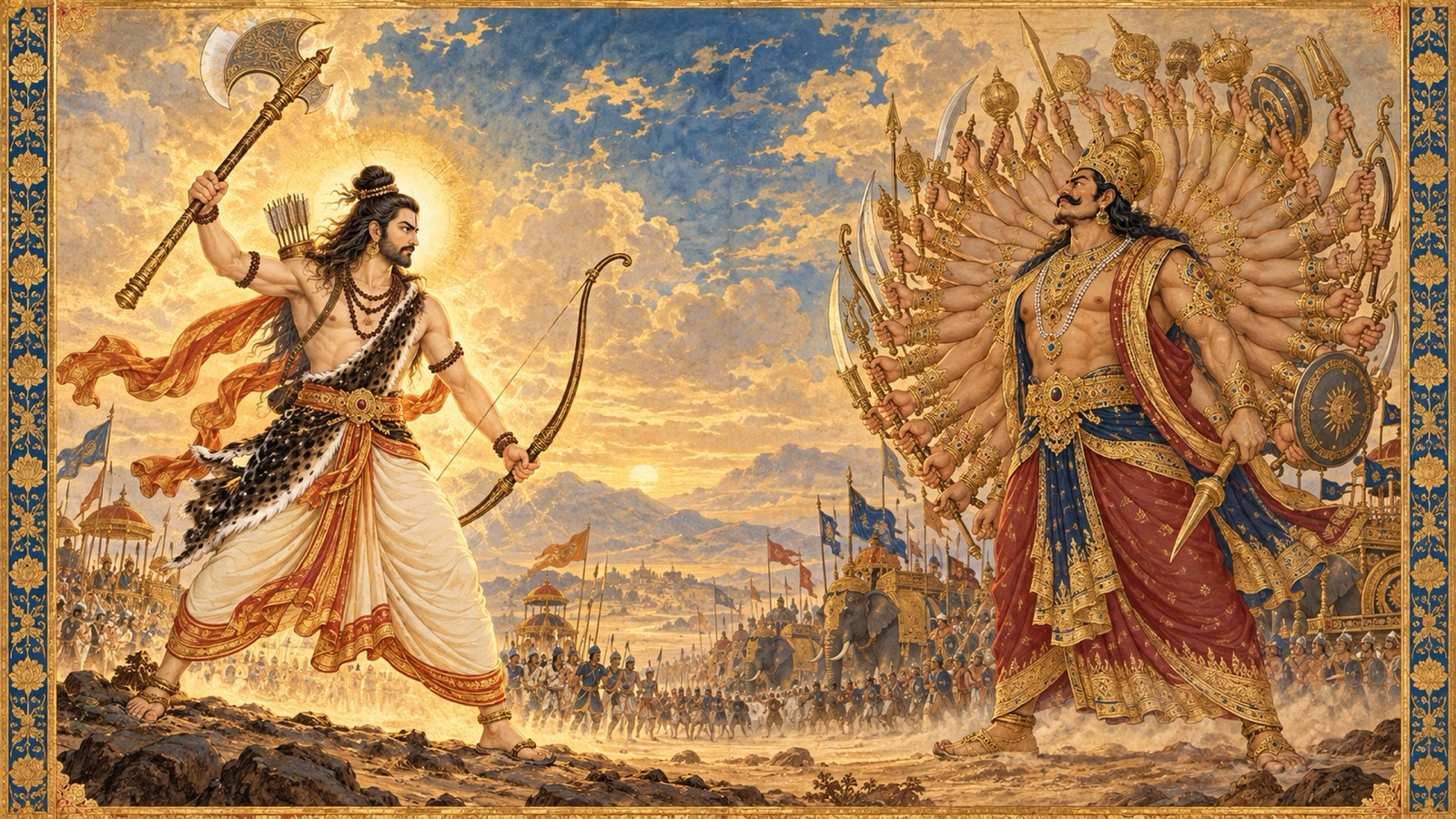
His terrible axe raised, Lord Parashurama, the Lord’s warrior incarnation, confronts the thousand-armed King Kartavirya Arjuna — righteous power rising to end the tyranny of a proud and lawless king.
Om Namo Bhagavate Vasudevaya.
Om Namo Bhagavate Vasudevaya.
Om Namo Bhagavate Vasudevaya.
Welcome to Srimad Bhagavatam Wisdom, a devotional journey through the sacred histories and teachings of the Srimad Bhagavat Mahapurana. This fifteenth chapter of Book Nine tells of the advent of Lord Parashurama, a partial incarnation of Lord Vishnu born in the line of the sage Bhrgu. Sukadeva relates for King Parikshit the story of the sage Rcika and Satyavati, the strange exchange of sacred oblations that shaped the destiny of their descendants, and the birth of Jamadagni and his son Rama — Parashurama. The chapter then turns to King Kartavirya Arjuna of the Haihayas, who, by worshipping Lord Dattatreya, gained a thousand arms and immense power, but grew so proud that he stole the sacred cow of plenty from Jamadagni’s hermitage. This offence brought upon him the wrath of Parashurama, who pursued and destroyed the tyrant and his army. It is a chapter about the perils of pride and power, the sanctity of the brahmanas, the higher glory of forgiveness, and the Lord descending as a warrior to relieve the earth of its burden.
Chapter Information
- Scripture: Śrīmad Bhāgavata Mahāpurāṇa
- Canto: 9 (Book Nine)
- Chapter: 15 (Discourse 15)
- Chapter title: Parashurama, the Lord’s Warrior Incarnation
- Principal speaker: Sukadeva Gosvami, narrating to King Parikshit — the whole related by Suta Gosvami to the sage Saunaka and the assembly of sages at Naimisaranya
- Principal listener: King Parikshit
- Main setting: The line of the sage Bhrgu; the hermitage of the sage Jamadagni; the kingdom of the Haihayas at Mahishmati
- Central subject: The birth of Parashurama, the pride and offence of King Kartavirya Arjuna, the theft of the sacred cow, and its recovery by Parashurama
- Principal verse range: Canto 9, Chapter 15, verses 1–41
- Primary edition: Gita Press Śrīmad Bhāgavata Mahāpurāṇa
From Pururava to Gadhi
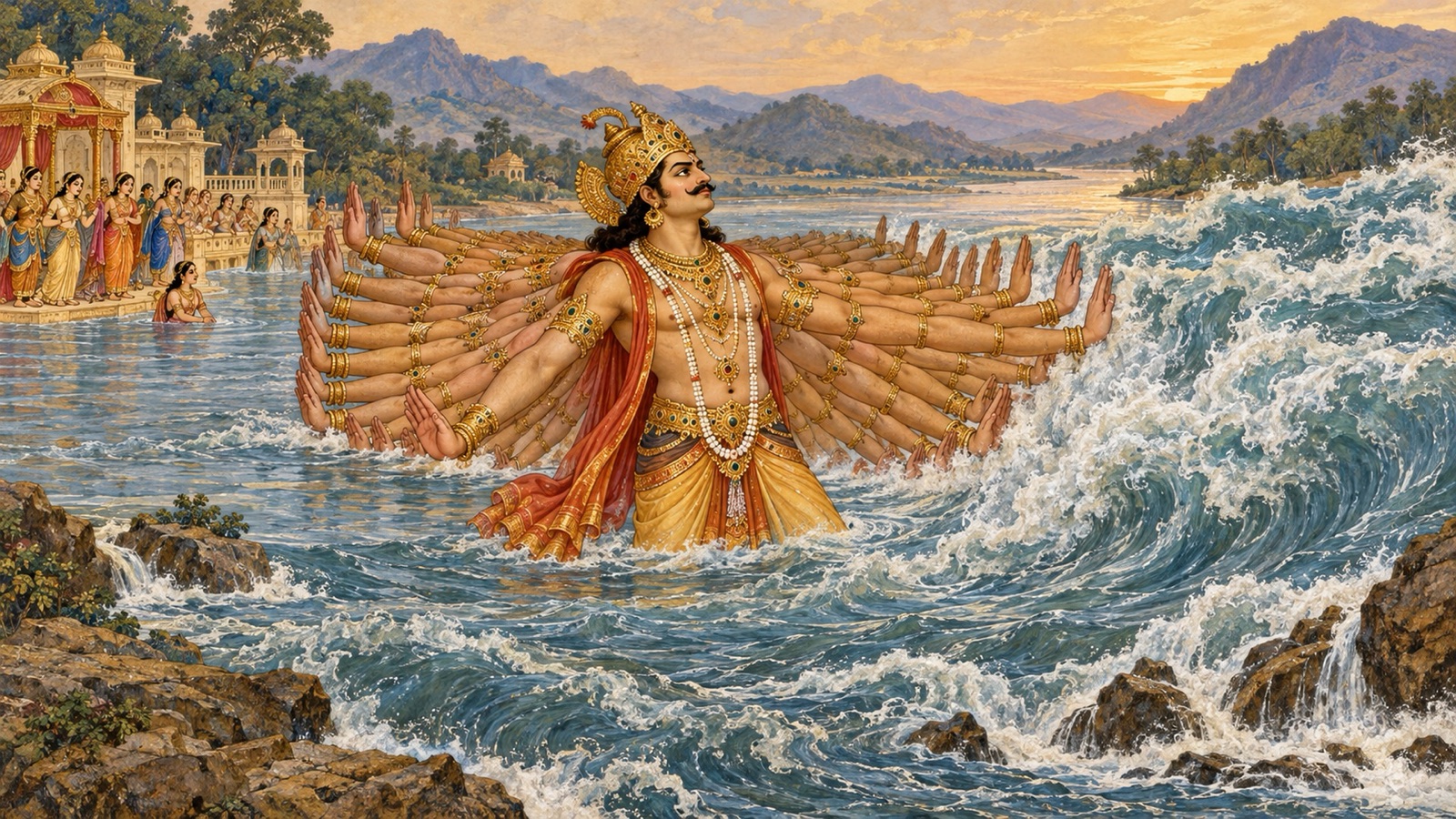
Sukadeva continued the lunar line. Pururava had six sons through Urvasi, among them Ayu, and from that line came many kings — including Jahnu, who once took the whole Ganga into the hollow of his palms and drank her. In time came Kusa, and from his son Kusamba came Gadhi, whose daughter was the virtuous Satyavati.
The Marriage of Rcika and Satyavati
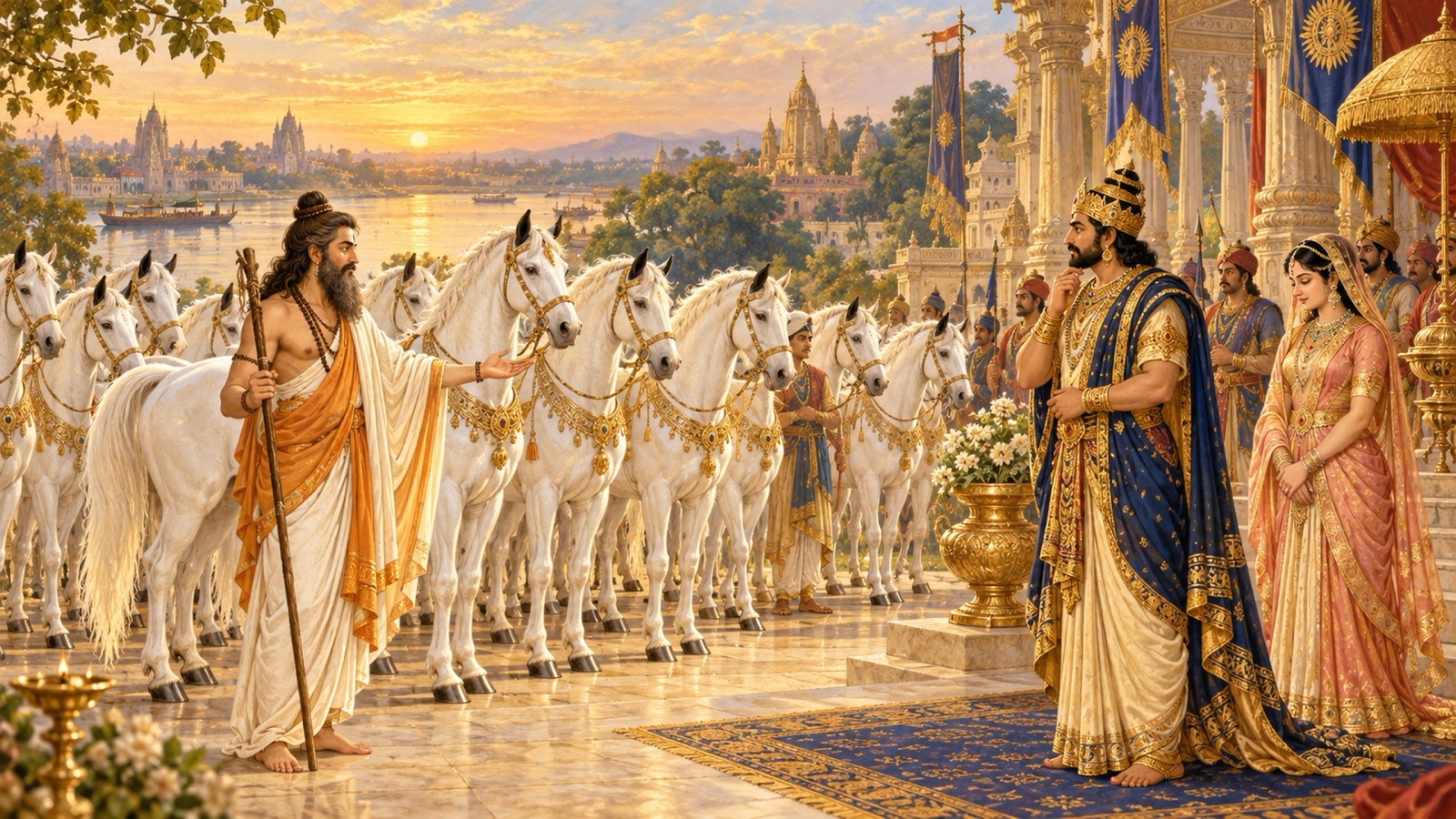
The brahmana sage Rcika, a descendant of Bhrgu, asked Gadhi for the hand of Satyavati. Considering the sage no fit match for a princess of his royal line, Gadhi set before him an extraordinary bride-price.
तस्य सत्यवतीं कन्यामृचीकोऽयाचत द्विज: । वरं विसदृशं मत्वा गाधिर्भार्गवमब्रवीत् ॥ ५ ॥ एकत: श्यामकर्णानां हयानां चन्द्रवर्चसाम् । सहस्रं दीयतां शुल्कं कन्याया: कुशिका वयम् ॥ ६ ॥
tasya satyavatīṁ kanyām ṛcīko ’yācata dvijaḥ varaṁ visadṛśaṁ matvā gādhir bhārgavam abravīt ekataḥ śyāma-karṇānāṁ hayānāṁ candra-varcasām sahasraṁ dīyatāṁ śulkaṁ kanyāyāḥ kuśikā vayam
Meaning: The brahmana Rcika asked for the hand of Satyavati; thinking him an unequal match, Gadhi said: “Give as the bride-price a thousand horses, white as the moon, each with one black ear, for we are of the noble race of Kusika.” (Canto 9, Chapter 15, verses 5-6)
Understanding his intent, Rcika obtained the horses from Varuna, delivered them, and married the lovely princess.
The Two Oblations and the Birth of Parashurama
Entreated by both his wife and his mother-in-law, each longing for a son, Rcika prepared two sacred oblations (charus), one charged with the power to bring forth a great brahmana and the other a great warrior, and went to bathe. But the two women, each thinking the other’s portion superior, exchanged them. Perceiving this, the sage told his wife that she had made a grave error: her son would now be a fierce warrior, and her brother a great knower of Brahman.
तद् विदित्वा मुनि: प्राह पत्नीं कष्टमकारषी: । घोरो दण्डधर: पुत्रो भ्राता ते ब्रह्मवित्तम: ॥ १० ॥
tad viditvā muniḥ prāha patnīṁ kaṣṭam akāraṣīḥ ghoro daṇḍa-dharaḥ putro bhrātā te brahma-vittamaḥ
Meaning: Understanding what had happened, the sage told his wife: “You have done a grievous thing. Your son will now be a fierce wielder of punishment, and your brother a supreme knower of Brahman.” (Canto 9, Chapter 15, verse 10)
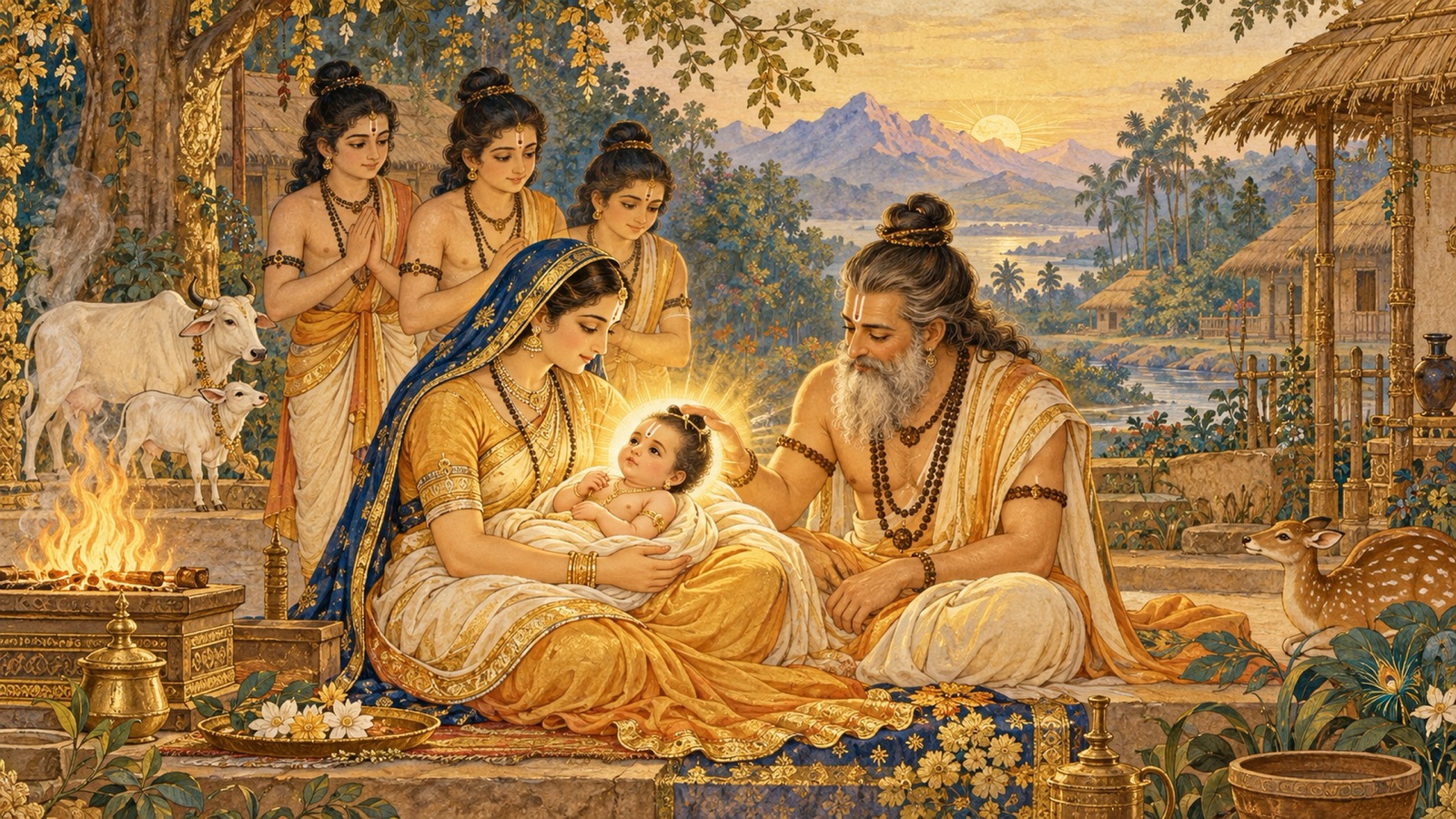
At Satyavati’s plea, the sage relented so that the warrior nature would pass instead to her grandson; and so Jamadagni was born to her. Satyavati herself became the sacred, world-purifying river Kausiki (the Kosi). Of Jamadagni, through his wife Renuka, were born several sons, the youngest of whom became renowned as Rama — Parashurama — a partial incarnation of Lord Vasudeva, destined to rid the earth of the tyrannous warrior-kings who had become its burden.
सा चाभूत् सुमहत्पुण्या कौशिकी लोकपावनी । रेणो: सुतां रेणुकां वै जमदग्निरुवाह याम् ॥ १२ ॥ तस्यां वै भार्गवऋषे: सुता वसुमदादय: । यवीयाञ्जज्ञ एतेषां राम इत्यभिविश्रुत: ॥ १३ ॥
sā cābhūt sumahat-puṇyā kauśikī loka-pāvanī reṇoḥ sutāṁ reṇukāṁ vai jamadagnir uvāha yām tasyāṁ vai bhārgava-ṛṣeḥ sutā vasumad-ādayaḥ yavīyāñ jajña eteṣāṁ rāma ity abhiviśrutaḥ
Meaning: Satyavati became the greatly holy, world-purifying river Kausiki. Jamadagni married Renuka, the daughter of Renu, and through her the sage of the Bhrgu line had sons, Vasuman and others, the youngest of whom became widely renowned as Rama (Parashurama). (Canto 9, Chapter 15, verses 12-13)
The Pride of Kartavirya Arjuna
King Parikshit asked what offence had provoked Parashurama to clear the earth of unrighteous warrior-kings again and again. Sukadeva explained. King Kartavirya Arjuna of the Haihayas, having worshipped Lord Dattatreya — a partial manifestation of Lord Narayana — had gained a thousand arms, invincibility, and every kind of power, roaming the worlds unhindered like the wind.
श्रीबादरायणिरुवाच हैहयानामधिपतिरर्जुन: क्षत्रियर्षभ: । दत्तं नारायणांशांशमाराध्य परिकर्मभि: ॥ १७ ॥ बाहून् दशशतं लेभे दुर्धर्षत्वमरातिषु । अव्याहतेन्द्रियौज:श्रीतेजोवीर्ययशोबलम् ॥ १८ ॥
śrī-bādarāyaṇir uvāca haihayānām adhipatir arjunaḥ kṣatriyarṣabhaḥ dattaṁ nārāyaṇāṁśāṁśam ārādhya parikarmabhiḥ bāhūn daśa-śataṁ lebhe durdharṣatvam arātiṣu avyāhatendriyaujaḥ śrī- tejo-vīrya-yaśo-balam
Meaning: Sukadeva said: Kartavirya Arjuna, lord of the Haihayas and best of warriors, having worshipped Lord Dattatreya, a partial manifestation of Narayana, obtained a thousand arms, invincibility against foes, and unfailing power of the senses, splendour, might, fame and strength. (Canto 9, Chapter 15, verses 17-19)
Intoxicated with pride, he once obstructed the very stream of the Narmada with his thousand arms while sporting in her waters, and when the ten-headed Ravana took offence, Arjuna seized him and imprisoned him at Mahishmati like a caged monkey before letting him go.
The Theft of the Sacred Cow
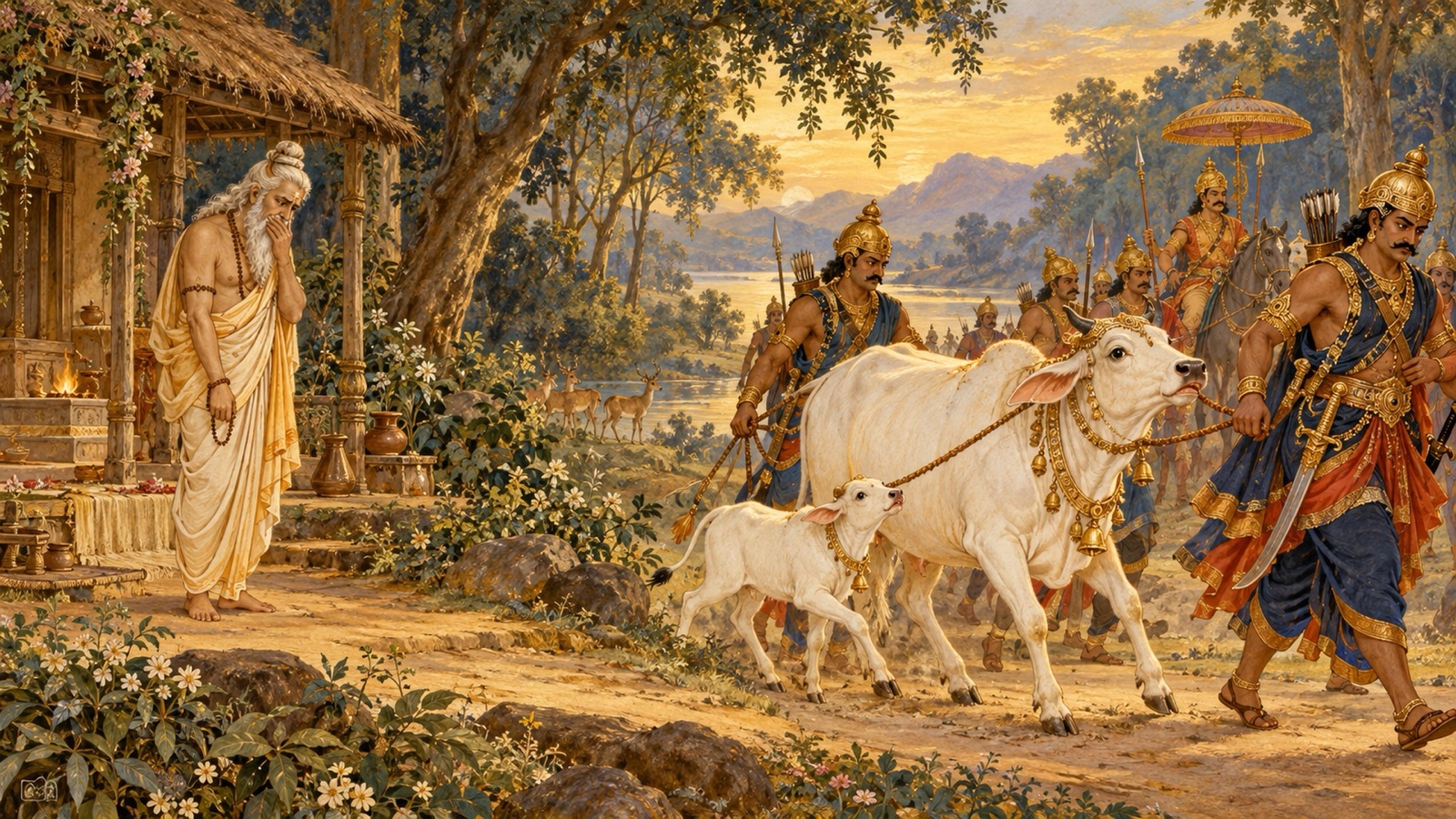
Hunting one day, Arjuna came upon the hermitage of the sage Jamadagni, who, by the power of his cow of plenty, Kamadhenu, hospitably feasted the king together with his whole army. Seeing wealth surpassing his own and coveting the wondrous cow, Arjuna in his arrogance commanded his men to seize her, and they carried the screaming cow and her calf away by force to Mahishmati.
हविर्धानीमृषेर्दर्पान्नरान् हर्तुमचोदयत् । ते च माहिष्मतीं निन्यु: सवत्सां क्रन्दतीं बलात् ॥ २६ ॥
havirdhānīm ṛṣer darpān narān hartum acodayat te ca māhiṣmatīṁ ninyuḥ sa-vatsāṁ krandatīṁ balāt
Meaning: Out of pride, Arjuna commanded his men to seize the sage’s cow, the vessel of sacred oblations; and they carried her, screaming, together with her calf, by force to Mahishmati. (Canto 9, Chapter 15, verse 26)
The Fall of Kartavirya Arjuna
Returning to the hermitage and learning of the outrage, Parashurama flew into a rage like a struck serpent. Taking up his terrible axe, shield and bow, he pursued the king like a lion after the leader of a herd of elephants. Arjuna sent seventeen mighty divisions of his army against him, but Parashurama destroyed them all single-handed. When Arjuna rushed forward hurling uprooted rocks and trees with his thousand arms, Parashurama lopped them all off with his axe, as one lops the hoods of a serpent.
पुन: स्वहस्तैरचलान् मृधेऽङ्घ्रिपा- नुत्क्षिप्य वेगादभिधावतो युधि । भुजान् कुठारेण कठोरनेमिना चिच्छेद राम: प्रसभं त्वहेरिव ॥ ३४ ॥
punaḥ sva-hastair acalān mṛdhe ’ṅghripān utkṣipya vegād abhidhāvato yudhi bhujān kuṭhāreṇa kaṭhora-neminā ciccheda rāmaḥ prasabhaṁ tv aher iva
Meaning: As Arjuna rushed at him in battle, hurling boulders and trees uprooted by his own hands, Parashurama, with his hard-edged axe, violently cut off all his arms, as one severs the hoods of a serpent. (Canto 9, Chapter 15, verse 34)
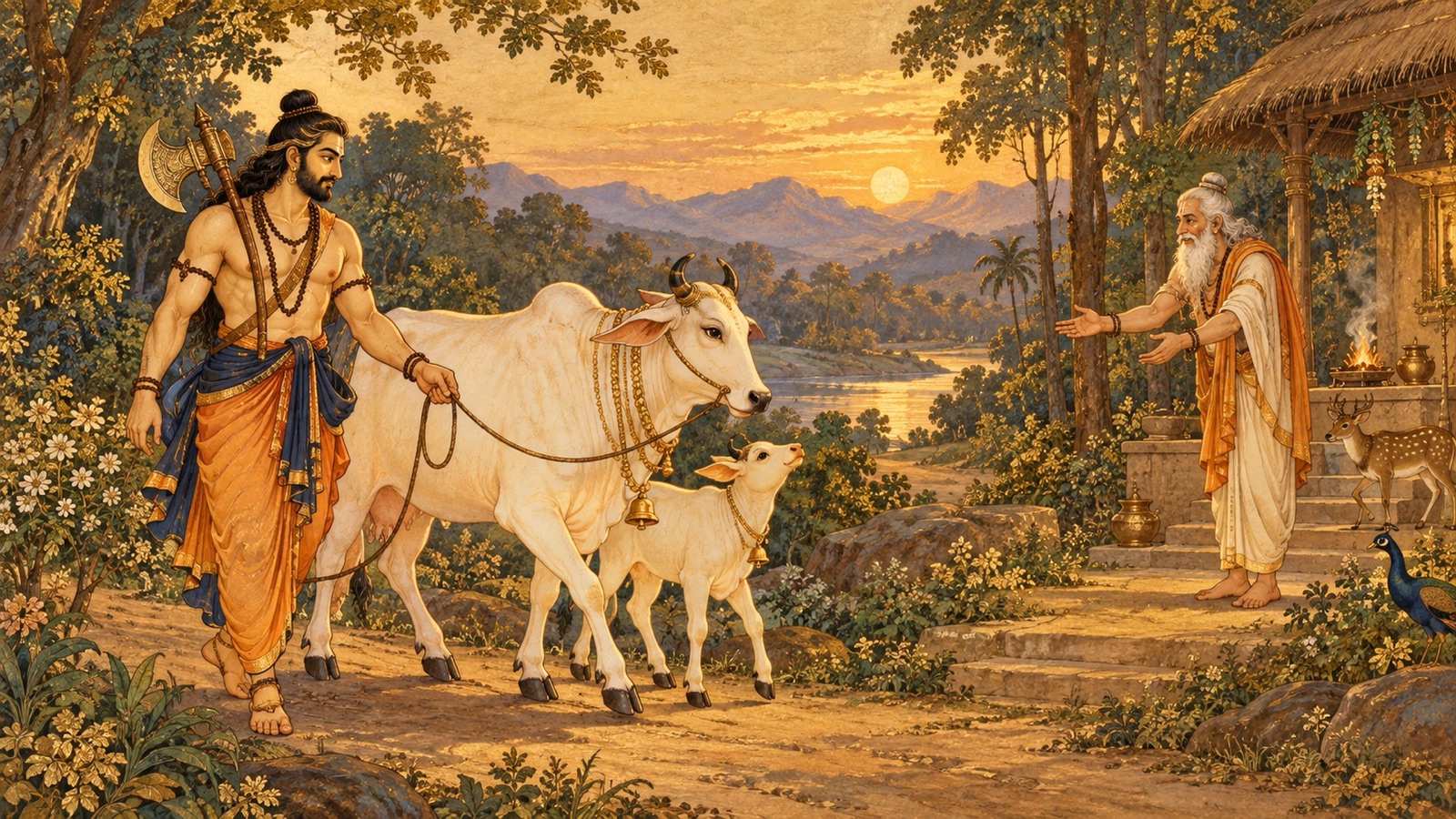
Then Parashurama severed the king’s head like the peak of a mountain; and on his death his ten thousand sons fled in fear. Recovering the distressed cow of plenty and her calf, Parashurama brought them back and restored them to his father at the hermitage.
कृत्तबाहो: शिरस्तस्य गिरे: शृङ्गमिवाहरत् । हते पितरि तत्पुत्रा अयुतं दुद्रुवुर्भयात् ॥ ३५ ॥ अग्निहोत्रीमुपावर्त्य सवत्सां परवीरहा । समुपेत्याश्रमं पित्रे परिक्लिष्टां समर्पयत् ॥ ३६ ॥
kṛtta-bāhoḥ śiras tasya gireḥ śṛṅgam ivāharat hate pitari tat-putrā ayutaṁ dudruvur bhayāt agnihotrīm upāvartya sa-vatsāṁ para-vīra-hā samupetyāśramaṁ pitre parikliṣṭāṁ samarpayat
Meaning: Parashurama severed the head of the armless king like a mountain peak; and on the father’s death his ten thousand sons fled in fear. The slayer of enemy heroes brought back the distressed cow with her calf and restored her to his father at the hermitage. (Canto 9, Chapter 15, verses 35-36)
Jamadagni’s Rebuke and the Glory of Forgiveness
Returning to the hermitage, Parashurama recounted the whole encounter to his father and brothers. But Jamadagni did not rejoice at his son’s victory; instead he rebuked him, saying that to have slain the king — who, as a duly anointed ruler, bore within him a portion of all the demigods — was itself a sin, however grievous Kartavirya Arjuna’s own offence had been (verses 37-38).
वयं हि ब्राह्मणास्तात क्षमयार्हणतां गता: । यया लोकगुरुर्देव: पारमेष्ठ्यमगात् पदम् ॥ ३९ ॥ क्षमया रोचते लक्ष्मीर्ब्राह्मी सौरी यथा प्रभा । क्षमिणामाशु भगवांस्तुष्यते हरिरीश्वर: ॥ ४० ॥
vayaṁ hi brāhmaṇās tāta kṣamayārhaṇatāṁ gatāḥ yayā loka-gurur devaḥ pārameṣṭhyam agāt padam kṣamayā rocate lakṣmīr brāhmī saurī yathā prabhā kṣamiṇām āśu bhagavāṁs tuṣyate harir īśvaraḥ
Meaning: “My son,” Jamadagni said, “we brahmanas are honoured in this world by forgiveness alone — it was this very quality that raised Lord Brahma, the guide of all the worlds, to his supreme post. As sunlight is the sun’s own brilliance, so forgiveness is the true splendour of a brahmana; and the Supreme Lord Hari is swiftly pleased with one who forgives.” (Canto 9, Chapter 15, verses 39-40)
To kill a duly consecrated king, Jamadagni continued, is a graver wrong even than killing a brahmana; yet even this sin could be dissolved through devotion to the infallible Lord and through service at the sacred pilgrimage places (verse 41). Even Parashurama, the Lord’s own warrior incarnation, was thus called back by his father from the glory of the battlefield to the higher glory of forgiveness.
Principal Teachings of This Chapter
1. Small choices can shape great destinies. The mere exchange of two sacred oblations by Satyavati and her mother reshaped the character of a whole lineage. The chapter shows how carefully the sacred must be handled, and how far small acts can reach (verses 8-11).
2. The Lord descends to protect the good. Parashurama is a partial incarnation of Lord Vishnu, born to relieve the earth of the burden of tyrannous, lawless kings. When unrighteousness grows unbearable, the Lord Himself intervenes (verses 12-15).
3. Power without humility becomes tyranny. Kartavirya Arjuna’s thousand arms and boundless might, unchecked by humility, lead him to dam a sacred river and rob a sage. Great power is a great danger when joined to pride (verses 17-26).
4. Offences against the holy invite ruin. Arjuna’s theft of the sage’s cow — his contempt for the brahmanas and the sacred — is the offence that seals his doom. The chapter underscores the gravity of harming the servants of God (verses 26-35).
5. Righteous strength serves, and then restores. Parashurama’s fearsome power is not for conquest but for protection: having slain the tyrant, his first act is to lead the frightened cow gently home. True strength ends not in destruction but in restoration (verses 35-36).
6. Even righteous strength must bow to forgiveness. After destroying the tyrant, Parashurama is rebuked by his own father: to kill a king is a sin even when the king has offended gravely, and the brahmana’s true glory — the very quality that raised Lord Brahma to his post — is forgiveness, not force (verses 37-41).
A Devotional Reflection
This chapter places two very different kinds of power side by side. Kartavirya Arjuna has a thousand arms and can dam a river or cage a demon king; yet all that strength, ungoverned by humility, curdles into arrogance and theft, and finally destroys him. Parashurama, born of a sage’s hermitage, wields a single axe — but he wields it as an instrument of the Lord, roused not by ambition but by the violation of the sacred, and once his terrible work is done, he turns at once to the tender task of leading a frightened cow home to his father. The Bhagavatam is not glorifying violence; it is showing us that power is neither good nor evil in itself, but takes the shape of the heart that holds it. In the proud, even a thousand arms become a curse; in the servant of God, even a single axe becomes a protection for the innocent. And beneath the drama lies a quieter warning — that the way we treat the holy, the humble and the helpless, symbolized by the sage’s gentle cow, is the true measure of our lives. The chapter invites us to examine not how much strength we have, but whom it serves.
A Daily Devotional Practice
Today, reflect on the power you hold — however small — and dedicate it to the service of God and the protection of the vulnerable. In whatever sphere you have influence — a word, a decision, a kindness within your reach — resolve to use it as Parashurama used his axe: not for self-assertion but for the good of others and the honour of the sacred. Guard against the pride of Kartavirya Arjuna by offering one act of humble service today to someone who can give you nothing in return. As you do, repeat gently, “Om Namo Bhagavate Vasudevaya,” and remember that the same divine strength that relieved the earth of its burden lives, in gentler form, in every hand that shields the innocent for the Lord’s sake.
Conclusion
This chapter carries the line of Bhrgu from the marriage of Rcika and Satyavati to the birth and triumph of Lord Parashurama. From the exchanged oblations that shaped two destinies to the boundless pride and downfall of Kartavirya Arjuna, it traces the peril of power ungoverned by humility and the sanctity owed to the brahmanas. Kartavirya Arjuna’s thousand arms and his theft of the sacred cow bring upon him the wrath of Parashurama, who destroys the tyrant and restores the cow to his father — yet even this victory is not the final word, for Jamadagni calls his son back from the glory of battle to the higher glory of forgiveness and bids him atone. Through it all shines a clear teaching: that strength takes the character of the heart that wields it, that offences against the holy invite ruin, and that the Lord descends, even as a warrior, only to point the way back to forgiveness.
May the divine wisdom of Srimad Bhagavatam awaken pure devotion within our hearts.
Om Namo Bhagavate Vasudevaya.
Jay Shree Madhav.
References and Attribution
- Primary edition: Gita Press, Śrīmad Bhāgavata Mahāpurāṇa (English, complete), Book Nine, Discourse 15, pages 63–68.
- Series: Srimad Bhagavatam Wisdom · Biswa Sanatan Dharma Seva Trust.
- Presented following the spiritual guidance and recommendation of Pandit Dr. Shri Kashinath Mishra.
This is an original, faithful retelling in the writer’s own words, with brief quoted verses shown in Devanāgarī and transliteration and their meanings given as summaries. It is not a reproduction of any single publisher’s continuous translation or commentary. No affiliation with or endorsement by any publisher is implied.
Jay Shree Madhav