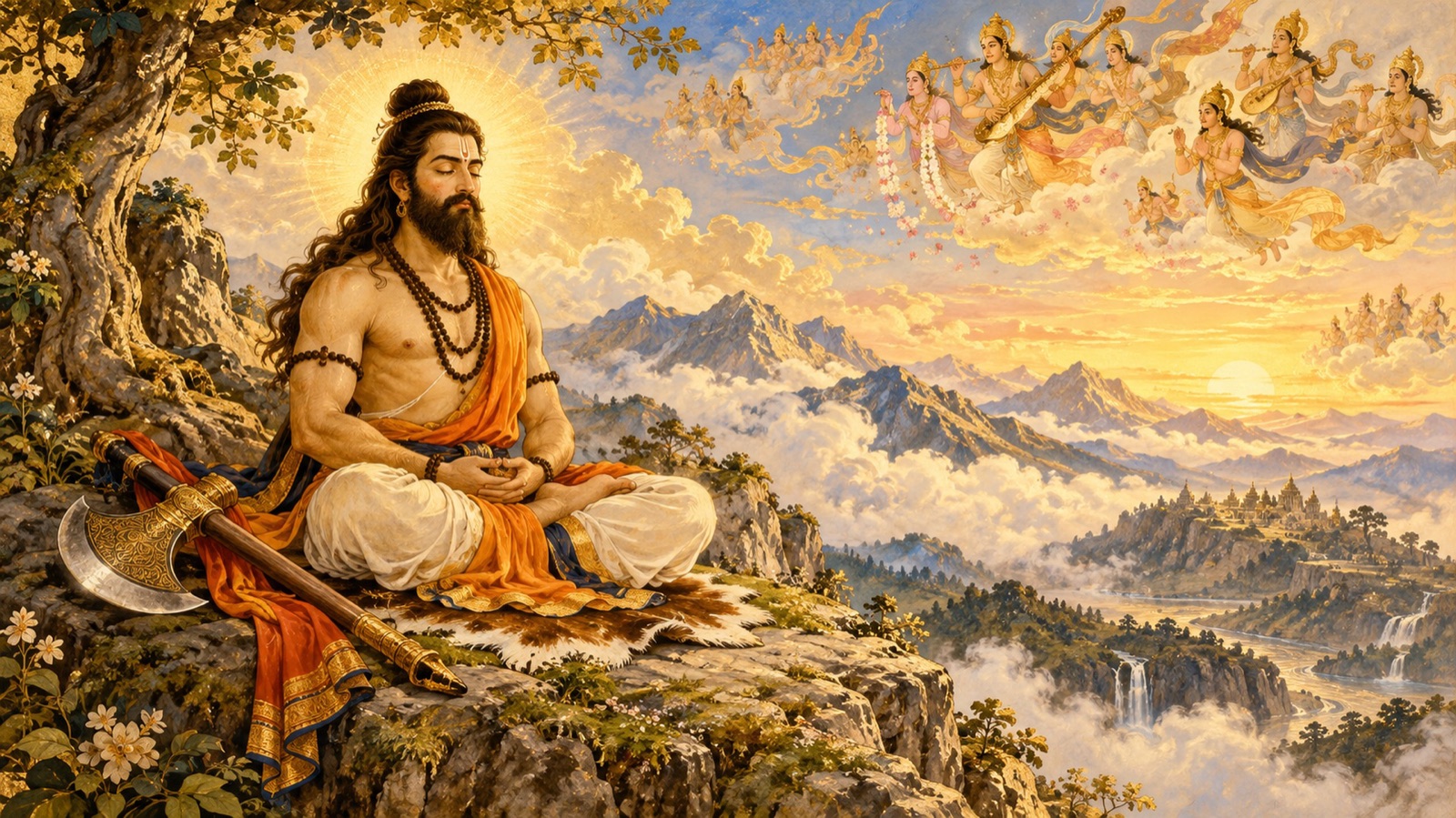
His fierce work at an end, Lord Parashurama abides to this day upon Mount Mahendra — his weapon laid aside, his mind wholly serene, his glories sung by the Siddhas, Gandharvas and Charanas.
Om Namo Bhagavate Vasudevaya.
Om Namo Bhagavate Vasudevaya.
Om Namo Bhagavate Vasudevaya.
Welcome to Srimad Bhagavatam Wisdom, a devotional journey through the sacred histories and teachings of the Srimad Bhagavat Mahapurana. This sixteenth chapter of Book Nine completes the story of Lord Parashurama — from a father’s hardest command, through a warrior’s fiercest wrath, to the stillness of a mission fulfilled.
Chapter Information
- Scripture: Śrīmad Bhāgavata Mahāpurāṇa
- Canto: 9 (Book Nine)
- Chapter: 16 (Discourse 16)
- Chapter title: Lord Parashurama Destroys the World’s Ruling Class
- Principal speaker: Sukadeva Gosvami, narrating to King Parikshit — the whole related by Suta Gosvami to the sage Saunaka and the assembly of sages at Naimisaranya
- Principal listener: King Parikshit
- Main setting: The hermitage of the sage Jamadagni; Mahishmati and Samantapanchaka (Kurukshetra); Mount Mahendra; the line of Vishwamitra
- Central subject: Parashurama’s obedience and boon, the murder of Jamadagni, the clearing of the earth of tyrannous warrior-kings, the restoration of Jamadagni, and the line of Vishwamitra
- Principal verse range: Canto 9, Chapter 16, verses 1–37
- Primary edition: Gita Press Śrīmad Bhāgavata Mahāpurāṇa
Obedience and the Boon of Restoration
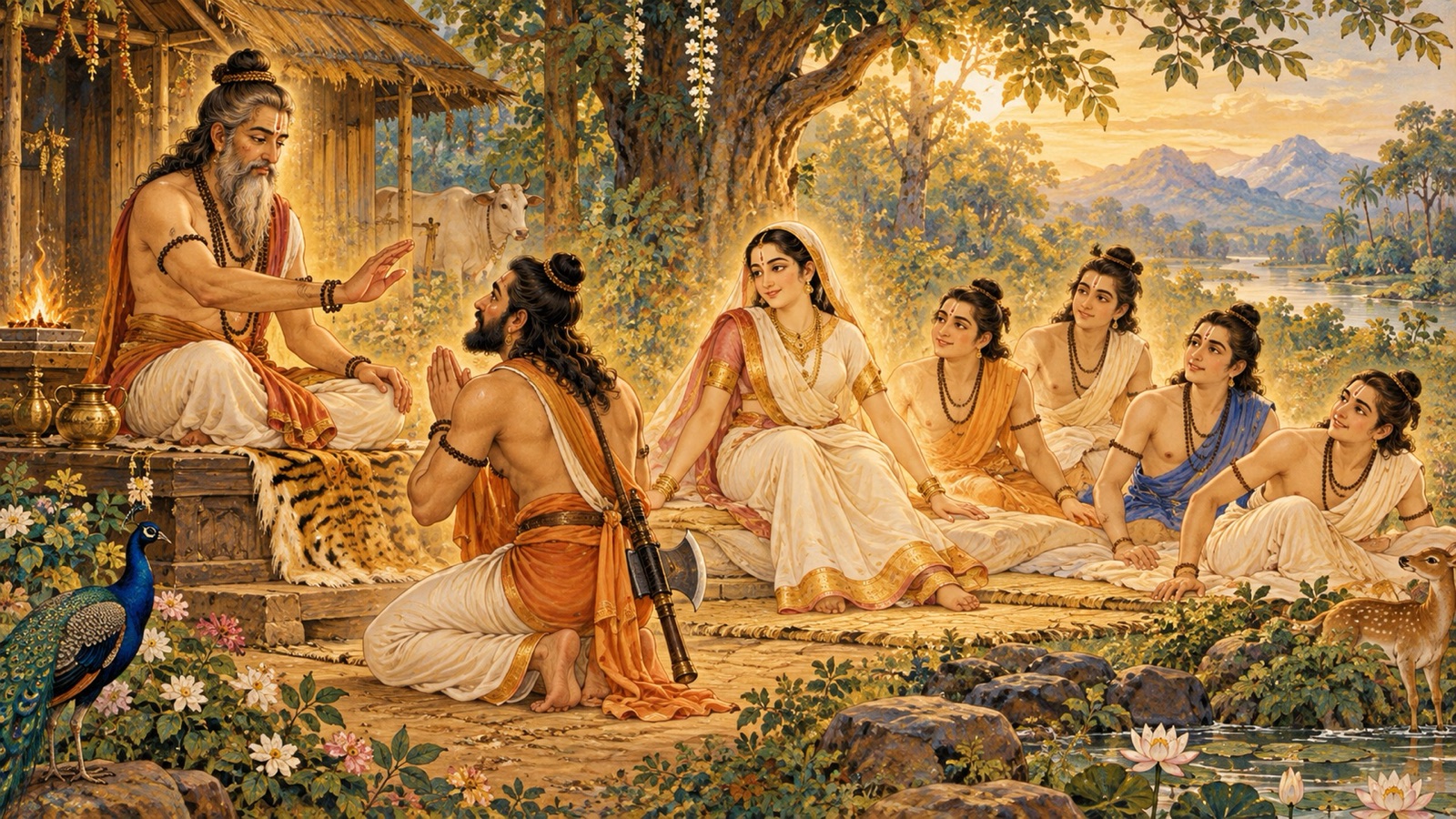
Admonished by his father to atone for slaying King Kartavirya Arjuna, Parashurama went on pilgrimage for a year and then returned. One day Renuka, his mother, going to the river for water, was momentarily captivated by the sight of the Gandharva king Chitraratha sporting with celestial nymphs, and so returned late for the offering of oblations. Perceiving her lapse of mind, the sage Jamadagni in anger commanded his sons to put her to death; but only Parashurama, who knew well the power of his father’s austerity, obeyed, and at his father’s insistence he took the lives of his mother and brothers. Pleased with his obedience, Jamadagni offered him a boon — and Parashurama asked that those he had slain be restored to life, with no memory of having been killed.
वरेणच्छन्दयामास प्रीत: सत्यवतीसुत: । वव्रे हतानां रामोऽपि जीवितं चास्मृतिं वधे ॥ ७ ॥
vareṇa cchandayām āsa prītaḥ satyavatī-sutaḥ vavre hatānāṁ rāmo ’pi jīvitaṁ cāsmṛtiṁ vadhe
Meaning: Pleased, the son of Satyavati (Jamadagni) offered him a boon; and Rama asked for the restoration to life of those he had slain, and that they should have no memory of having been killed. (Canto 9, Chapter 16, verse 7)
At once they rose whole again, as if waking from sleep. Parashurama had acted only because he knew, and honoured, the spiritual power of his father.
The Murder of Jamadagni
The sons of Kartavirya Arjuna, unable to find peace as they brooded over their father’s death, watched for their chance.
येऽर्जुनस्य सुता राजन् स्मरन्त: स्वपितुर्वधम् । रामवीर्यपराभूता लेभिरे शर्म न क्वचित् ॥ ९ ॥
ye ’rjunasya sutā rājan smarantaḥ sva-pitur vadham rāma-vīrya-parābhūtā lebhire śarma na kvacit
Meaning: The sons of Kartavirya Arjuna, defeated by Parashurama’s might, never knew a moment’s peace, for the memory of their father’s death was never far from them. (Canto 9, Chapter 16, verse 9)
Yet the Bhagavatam does not let this tragedy pass as senseless violence alone. Even a sage of Jamadagni’s great austerity was not beyond account: it was he who, in anger, had first ordered the death of his own innocent wife for no more than a lapse of the mind, and that harsh command was itself an offense that could not simply pass unanswered. The teaching here is exacting and impartial — whether sage, warrior or king, whoever acts in haste and without restraint must in time meet the fruit of that action. Holiness and austerity are real powers, but they do not exempt anyone from the law that governs every deed; only humility and self-command make a life of power safe to hold.
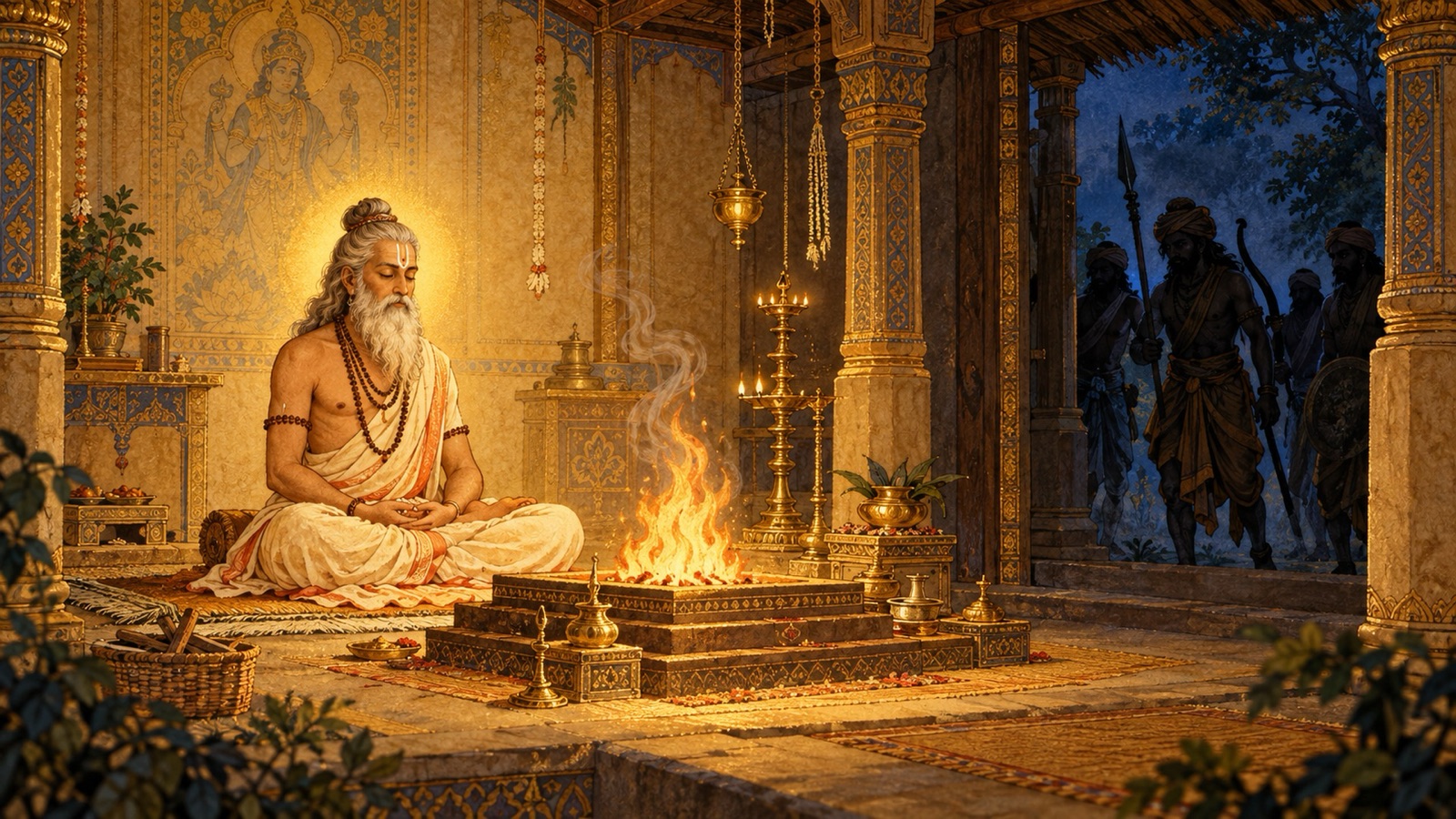
One day, when Parashurama and his brothers had gone into the woods, they came to the hermitage and found the sage Jamadagni seated in the fire-sanctuary, his mind fixed upon the Lord of sacred renown; and those of sinful resolve struck him down.
दृष्ट्वाग्न्यागार आसीनमावेशितधियं मुनिम् । भगवत्युत्तमश्लोके जघ्नुस्ते पापनिश्चया: ॥ ११ ॥
dṛṣṭvāgny-āgāra āsīnam āveśita-dhiyaṁ munim bhagavaty uttamaśloke jaghnus te pāpa-niścayāḥ
Meaning: Seeing the sage seated in the fire-sanctuary with his mind absorbed in the all-glorious Lord, those of sinful resolve struck him down. (Canto 9, Chapter 16, verse 11)
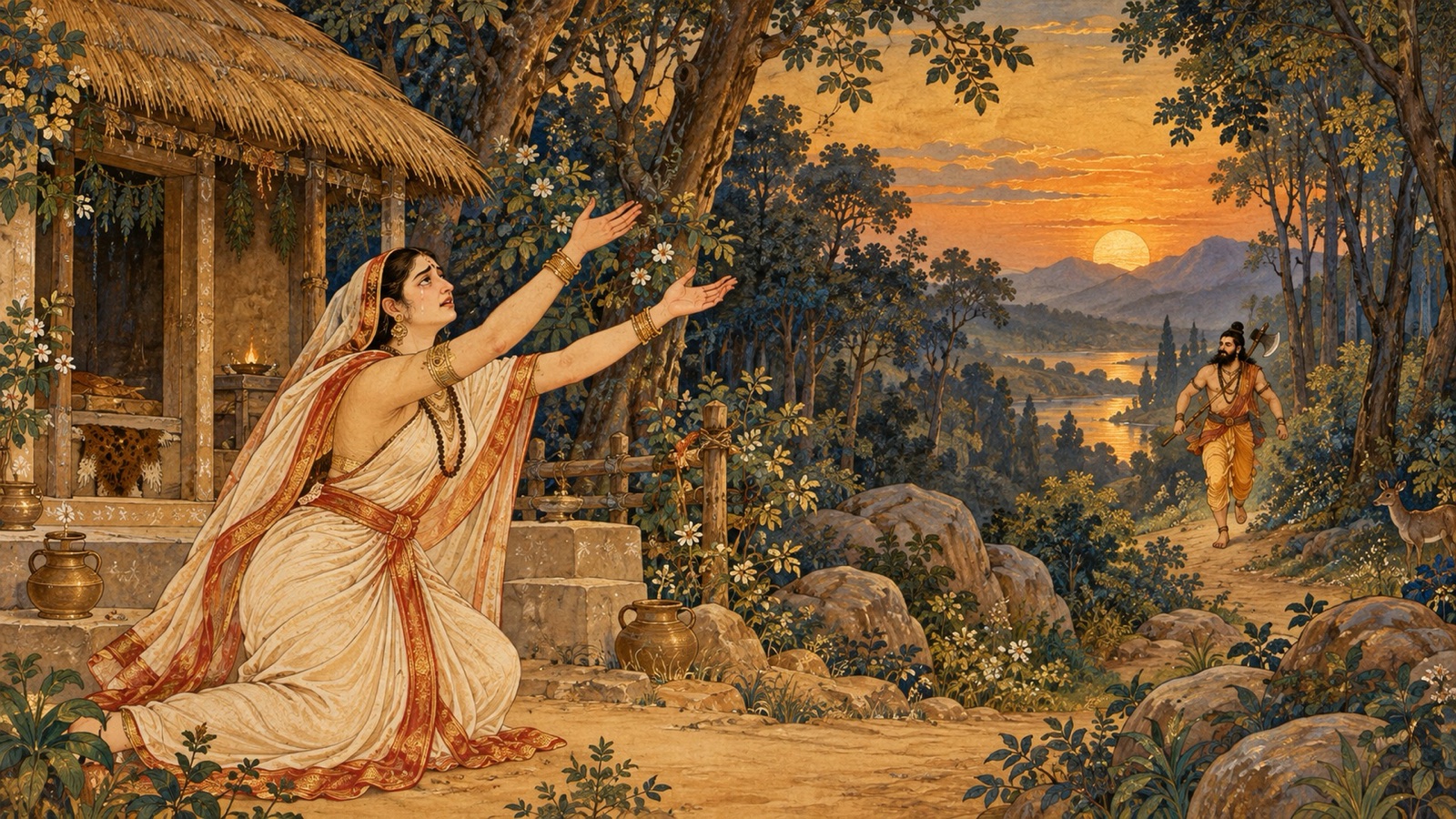
Renuka begged for her husband’s life with piteous prayers, but the sons of Kartavirya Arjuna, devoid of a true kshatriya’s honor, showed no mercy: they severed the sage’s head from his body and bore it away (verse 12).
Beating herself in agony, the virtuous Renuka cried out again and again, “Rama! O Rama! Come, dear child!”
रेणुका दु:खशोकार्ता निघ्नन्त्यात्मानमात्मना । राम रामेति तातेति विचुक्रोशोच्चकै: सती ॥ १३ ॥
reṇukā duḥkha-śokārtā nighnanty ātmānam ātmanā rāma rāmeti tāteti vicukrośoccakaiḥ satī
Meaning: Stricken with grief and sorrow and beating herself with her own hands, the virtuous Renuka cried aloud, “Rama! O Rama! O dear child!” (Canto 9, Chapter 16, verse 13)
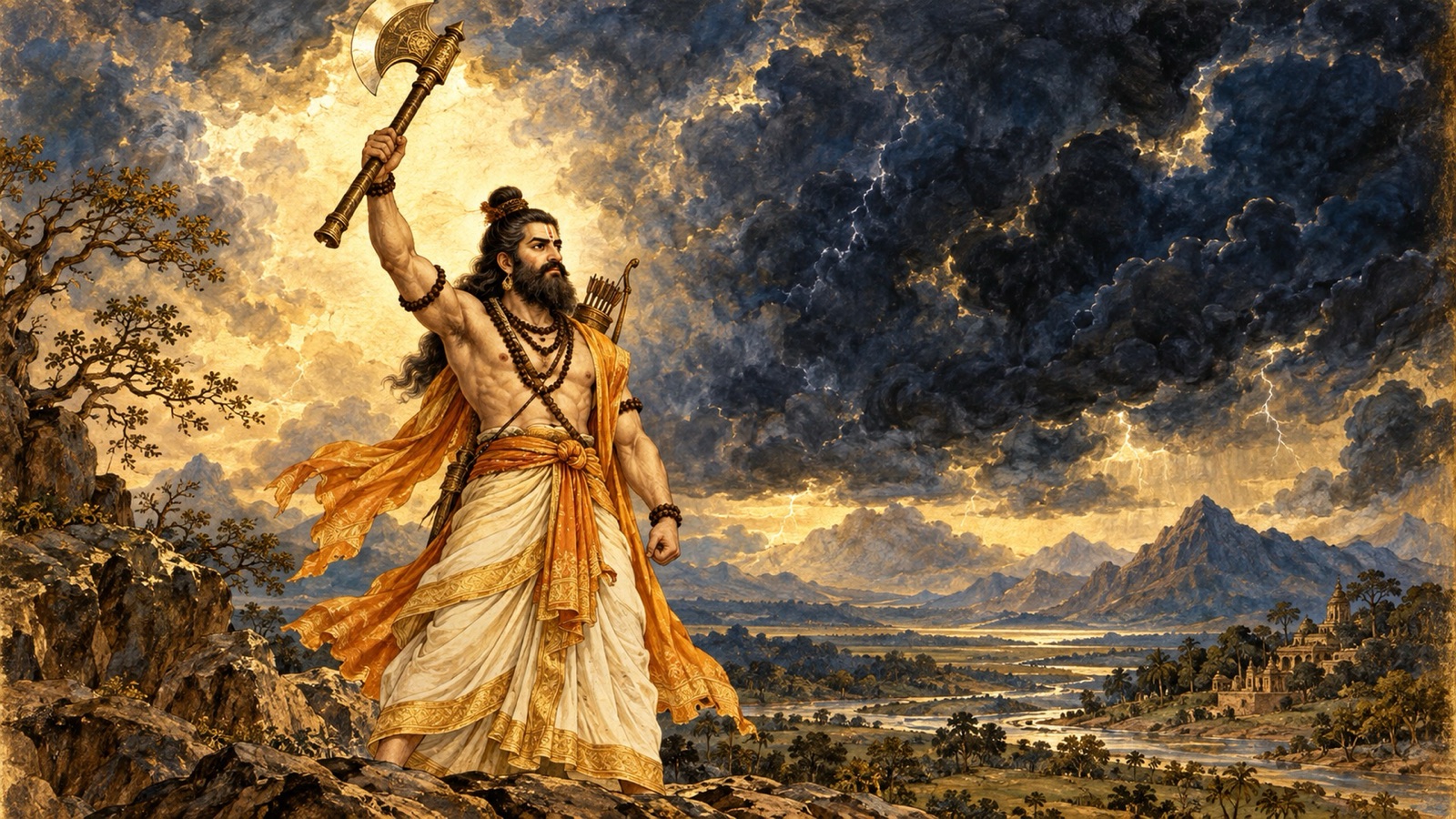
Hearing that cry from afar, Parashurama hurried back and beheld his father slain. Overcome with grief and righteous indignation, he entrusted the body to his brothers and resolved to rid the earth of the lawless warrior-kings.
The Clearing of the Earth
Going to Mahishmati, whose splendour had been destroyed by the sin of murdering a brahmana sage, Parashurama made the death of his father the occasion — for the warrior-kings had taken to unrighteous ways — and cleared the earth of the tyrannous Kshatriyas twenty-one times, creating at Samantapanchaka (Kurukshetra) lakes filled with their blood.
तद्रक्तेन नदीं घोरामब्रह्मण्यभयावहाम् । हेतुं कृत्वा पितृवधं क्षत्रेऽमङ्गलकारिणि ॥ १८ ॥ त्रि:सप्तकृत्व: पृथिवीं कृत्वा नि:क्षत्रियां प्रभु: । समन्तपञ्चके चक्रे शोणितोदान् ह्रदान् नव ॥ १९ ॥
tad-raktena nadīṁ ghorām abrahmaṇya-bhayāvahām hetuṁ kṛtvā pitṛ-vadhaṁ kṣatre ’maṅgala-kāriṇi triḥ-sapta-kṛtvaḥ pṛthivīṁ kṛtvā niḥkṣatriyāṁ prabhuḥ samanta-pañcake cakre śoṇitodān hradān nava
Meaning: Making the murder of his father the occasion — the warrior-class having taken to wickedness — the mighty Lord cleared the earth of the tyrannous Kshatriyas thrice seven (twenty-one) times, and at Samantapanchaka formed lakes filled with their blood. (Canto 9, Chapter 16, verses 18-19)
The Restoration of Jamadagni and the Peace of Mahendra
Bringing back his father’s head and joining it to his body, Parashurama worshipped the Lord — his own true Self — through many sacrifices, giving away the eastern quarter to the Hota priest, the southern to the Brahma, the western to the Adhwaryu, the northern to the Udgata, the corners to other priests, and the central region to the sage Kashyapa. Bathing at last in the Saraswati, he shone like the cloudless sun, all his sin washed away. Jamadagni, regaining a wholly spiritualized body, became the seventh of the seven sages.
स्वदेहं जमदग्निस्तु लब्ध्वा संज्ञानलक्षणम् । ऋषीणां मण्डले सोऽभूत् सप्तमो रामपूजित: ॥ २४ ॥
sva-dehaṁ jamadagnis tu labdhvā saṁjñāna-lakṣaṇam ṛṣīṇāṁ maṇḍale so ’bhūt saptamo rāma-pūjitaḥ
Meaning: Jamadagni, regaining a body marked by pure consciousness, became the seventh in the circle of the seven sages, worshipped by Parashurama. (Canto 9, Chapter 16, verse 24)
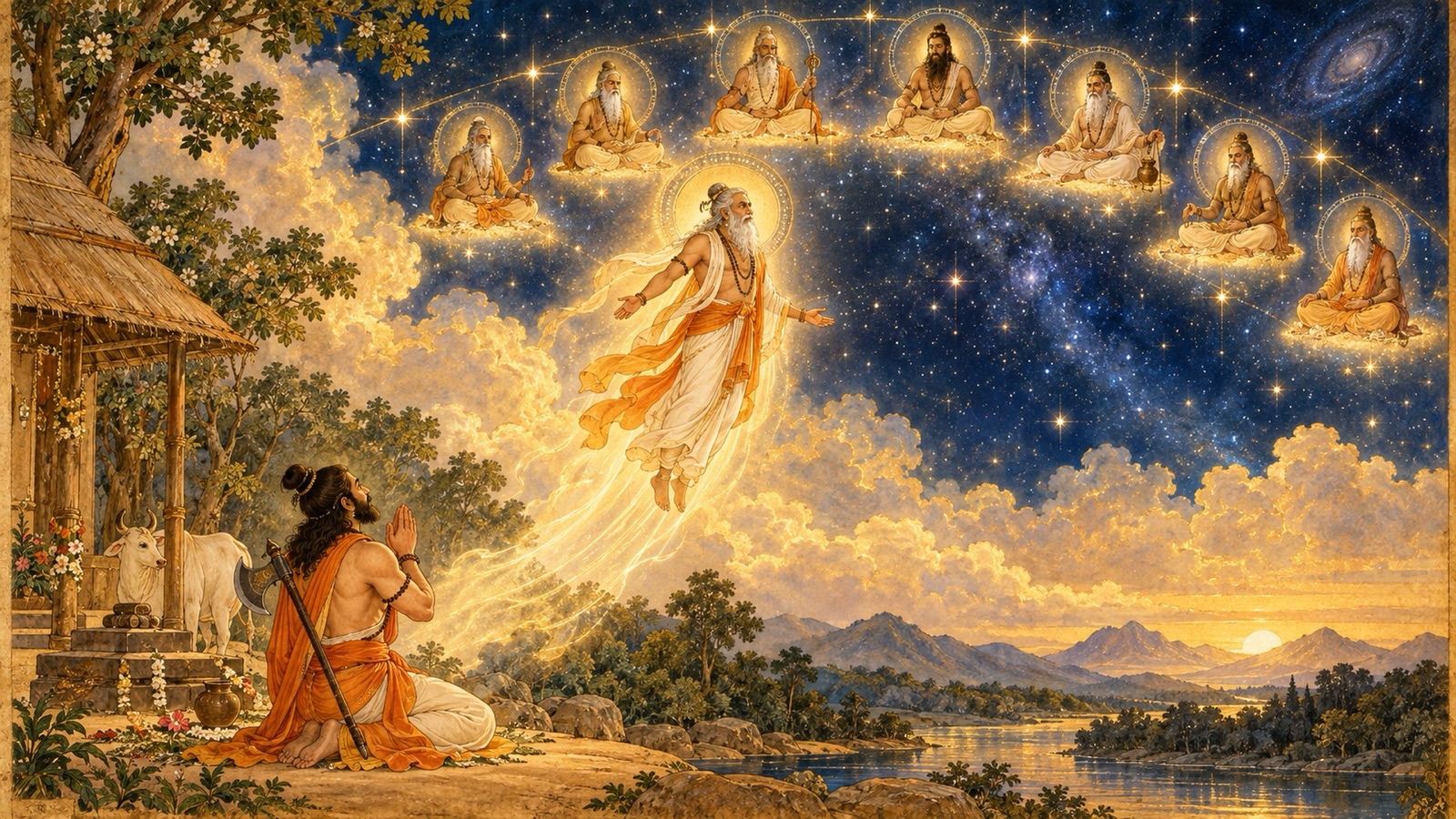
Parashurama himself, Sukadeva said, will propagate the Vedas as one of the seven sages in the coming Manvantara — and his mission now fulfilled, he dwells in unbroken tranquillity upon that same mountain, celebrated in the songs of the Siddhas, Gandharvas and Charanas.
आस्तेऽद्यापि महेन्द्राद्रौ न्यस्तदण्ड: प्रशान्तधी: । उपगीयमानचरित: सिद्धगन्धर्वचारणै: ॥ २६ ॥
āste ’dyāpi mahendrādrau nyasta-daṇḍaḥ praśānta-dhīḥ upagīyamāna-caritaḥ siddha-gandharva-cāraṇaiḥ
Meaning: Even to this day he abides on Mount Mahendra, his weapon laid aside and his mind perfectly serene, his deeds sung by the Siddhas, Gandharvas and Charanas. (Canto 9, Chapter 16, verse 26)
The Line of Vishwamitra
Sukadeva then told of Gadhi’s son, the mighty Vishwamitra, brilliant as a blazing fire, who cast off his warrior nature and attained brahmanical glory through penance.
गाधेरभून्महातेजा: समिद्ध इव पावक: । तपसा क्षात्रमुत्सृज्य यो लेभे ब्रह्मवर्चसम् ॥ २८ ॥
gādher abhūn mahā-tejāḥ samiddha iva pāvakaḥ tapasā kṣātram utsṛjya yo lebhe brahma-varcasam
Meaning: From Gadhi was born the greatly effulgent Vishwamitra, brilliant as a blazing fire, who, casting off his warrior nature through penance, attained the glory of a brahmana. (Canto 9, Chapter 16, verse 28)
Vishwamitra had a hundred and one sons; the middle one was Madhucchanda. He adopted Sunahsepa — the boy once destined to be a sacrificial victim in King Harishchandra’s rite, and saved by glorifying the gods — renaming him Devarata, and asked his sons to accept him as the eldest. The fifty elder sons who refused were cursed to become Mlecchas, while the younger, led by Madhucchanda, gladly accepted Devarata and were blessed. Thus the line of Kusika branched into many offshoots.
Principal Teachings of This Chapter
1. Obedience to a true guide is a spiritual power. Parashurama obeys even his father’s hardest command, trusting the sage’s wisdom — and his obedience is crowned by the boon that restores his family. Faith in a genuine authority is not weakness but strength (verses 5-8).
2. Offences against the holy bring terrible ruin. The murder of the sage Jamadagni by the sons of Kartavirya Arjuna unleashes a cataclysm. To harm the servants of God is to invite destruction upon oneself (verses 9-19).
3. Even righteous anger must finally be laid down. Parashurama’s fierce mission ends not in endless wrath but in atonement, sacrifice, and the laying aside of his weapon. The chapter shows that violence, even when just, is not the goal but a burden to be set down (verses 20-26).
4. Grace restores what seems irretrievably lost. The slain family rises again; the murdered sage is restored among the seven seers. However final a loss may appear, the Lord’s grace can bring life out of death (verses 7-8, 24).
5. What we are is decided by effort, not birth alone. Vishwamitra, born a warrior, becomes a brahmana through penance; Sunahsepa, sold as a victim, becomes a revered seer. The chapter affirms that sincere spiritual effort can transform one’s very nature (verses 28-32).
A Devotional Reflection
This is a hard chapter, full of grief and blood, and the Bhagavatam does not soften its telling — a mother’s lapse, a father’s harsh command, a sage murdered at his prayers, and an avenging son who clears the earth of tyrants twenty-one times. Yet if we listen closely, the chapter is not finally about vengeance at all; it is about the laying down of the axe. Parashurama’s terrible power is real, but it is never the point of his life; again and again the story turns toward restoration — the family raised from death, the father rejoined and lifted among the seven sages, and at last the warrior himself seated in perfect peace upon Mount Mahendra, his weapon set aside, his mind serene. The Lord who descended to relieve the earth of its burden does not remain a figure of wrath; he becomes a figure of stillness, his violence spent, his heart at rest in God. And around this arc the chapter scatters its quieter hopes: that grace can restore what is lost, that even a warrior can become a sage, that even a boy sold for sacrifice can become a seer. The deepest teaching may be the gentlest — that the goal of even the fiercest strength is peace, and that the truest victory is the one in which the sword is finally laid down at the feet of the Lord.
A Daily Devotional Practice
Today, in the spirit of Parashurama laying aside his axe upon Mount Mahendra, practise setting down some “weapon” of your own — a resentment you have carried, an anger you feel justified in, a grudge you keep sharpened. Even if the anger seems righteous, offer it up: sit quietly, breathe, and consciously lay it at the feet of the Lord, repeating gently, “Om Namo Bhagavate Vasudevaya.” Remember Jamadagni’s own teaching that the glory of the holy shines through forgiveness, and that Lord Hari is quickly pleased with the forgiving. Let one act of letting go — a pardon offered, a harsh word withheld, a peace chosen over being right — be your worship today, trusting that the deepest strength is the strength to set the weapon down.
Conclusion
The sixteenth chapter of Book Nine leaves Lord Parashurama at peace: his fiercest work complete, his weapon set down, his heart at rest in the Lord he was born to serve. Its deepest teaching is this — that even the most terrible power finds its fulfilment only when it is finally laid at God’s feet, and that no austerity, however great, exempts a soul from the law of action; only humility keeps power safe to hold. May we, too, learn to set down whatever weapon we carry, and find in surrender the same peace that Parashurama found upon Mount Mahendra.
May the divine wisdom of Srimad Bhagavatam awaken pure devotion within our hearts.
Om Namo Bhagavate Vasudevaya.
Jay Shree Madhav.
References and Attribution
- Primary edition: Gita Press, Śrīmad Bhāgavata Mahāpurāṇa (English, complete), Book Nine, Discourse 16, pages 68–72.
- Series: Srimad Bhagavatam Wisdom · Biswa Sanatan Dharma Seva Trust.
- Presented following the spiritual guidance and recommendation of Pandit Dr. Shri Kashinath Mishra.
This is an original, faithful retelling in the writer’s own words, with brief quoted verses shown in Devanāgarī and transliteration and their meanings given as summaries. It is not a reproduction of any single publisher’s continuous translation or commentary. No affiliation with or endorsement by any publisher is implied.
Jay Shree Madhav