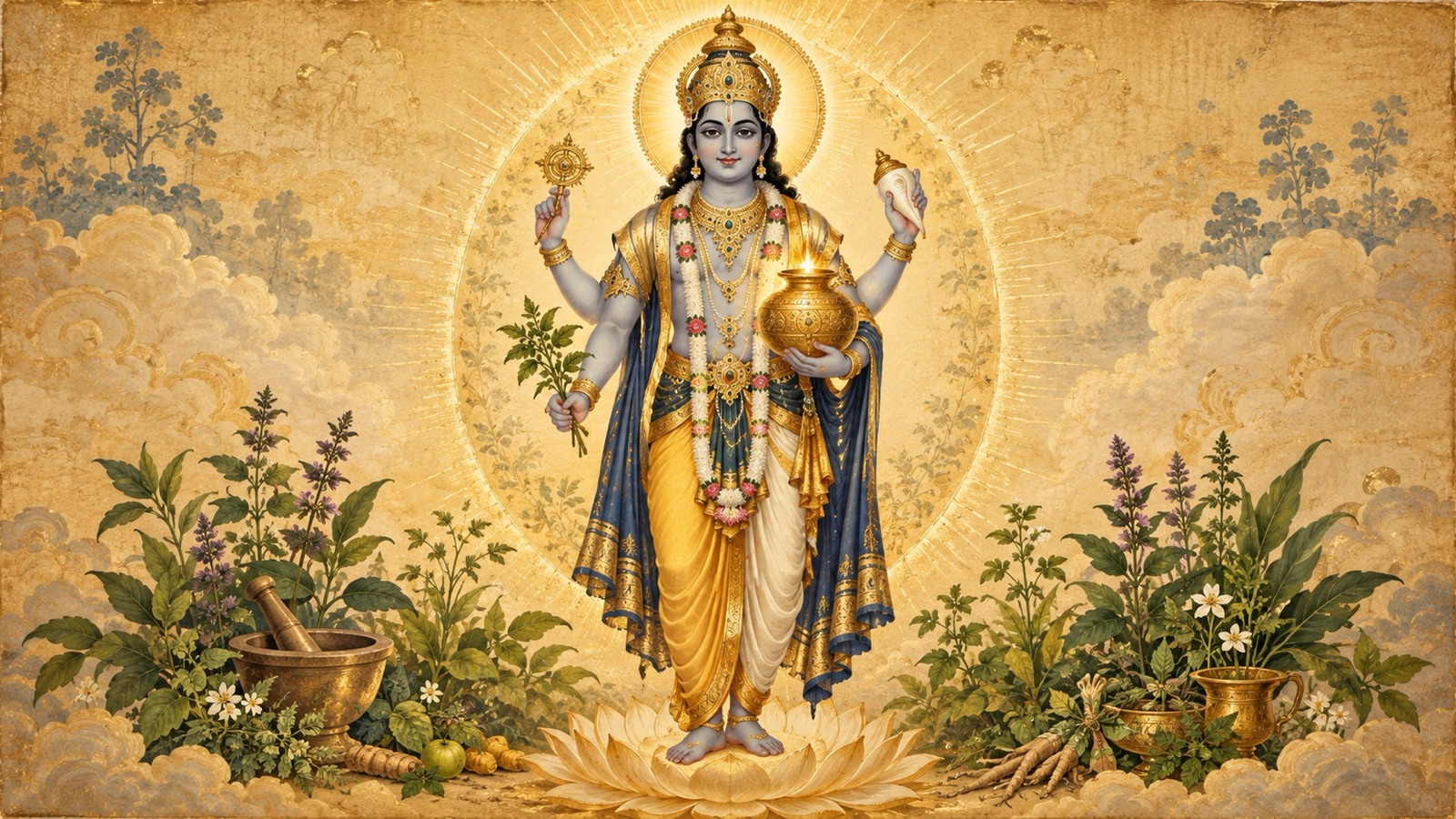
Born in the line of Kasi, Lord Dhanvantari — a partial incarnation of Lord Vasudeva and the founder of Ayurveda — appears bearing the vessel of nectar, the divine physician whose very remembrance dispels disease.
Om Namo Bhagavate Vasudevaya.
Om Namo Bhagavate Vasudevaya.
Om Namo Bhagavate Vasudevaya.
Welcome to Srimad Bhagavatam Wisdom, a devotional journey through the sacred histories and teachings of the Srimad Bhagavat Mahapurana. This seventeenth chapter of Book Nine follows the many streams of the lunar dynasty descended from Ayu, son of Pururava — among them the advent of Lord Dhanvantari as the divine healer, and the contrasting fates of King Raji and his sons.
Chapter Information
- Scripture: Śrīmad Bhāgavata Mahāpurāṇa
- Canto: 9 (Book Nine)
- Chapter: 17 (Discourse 17)
- Chapter title: The Dynasties of the Sons of Pururava
- Principal speaker: Sukadeva Gosvami, narrating to King Parikshit — the whole related by Suta Gosvami to the sage Saunaka and the assembly of sages at Naimisaranya
- Principal listener: King Parikshit
- Main setting: The lunar dynasty in the lines descended from Ayu, son of Pururava — the Kshatravrddha and Kasi lines, and the lines of Rabha (Raji) and Anena
- Central subject: The branches of the sons of Ayu, the advent of Lord Dhanvantari, the long reign of Alarka, and the story of King Raji and his sons
- Principal verse range: Canto 9, Chapter 17, verses 1–17
- Primary edition: Gita Press Śrīmad Bhāgavata Mahāpurāṇa
The Sons of Ayu
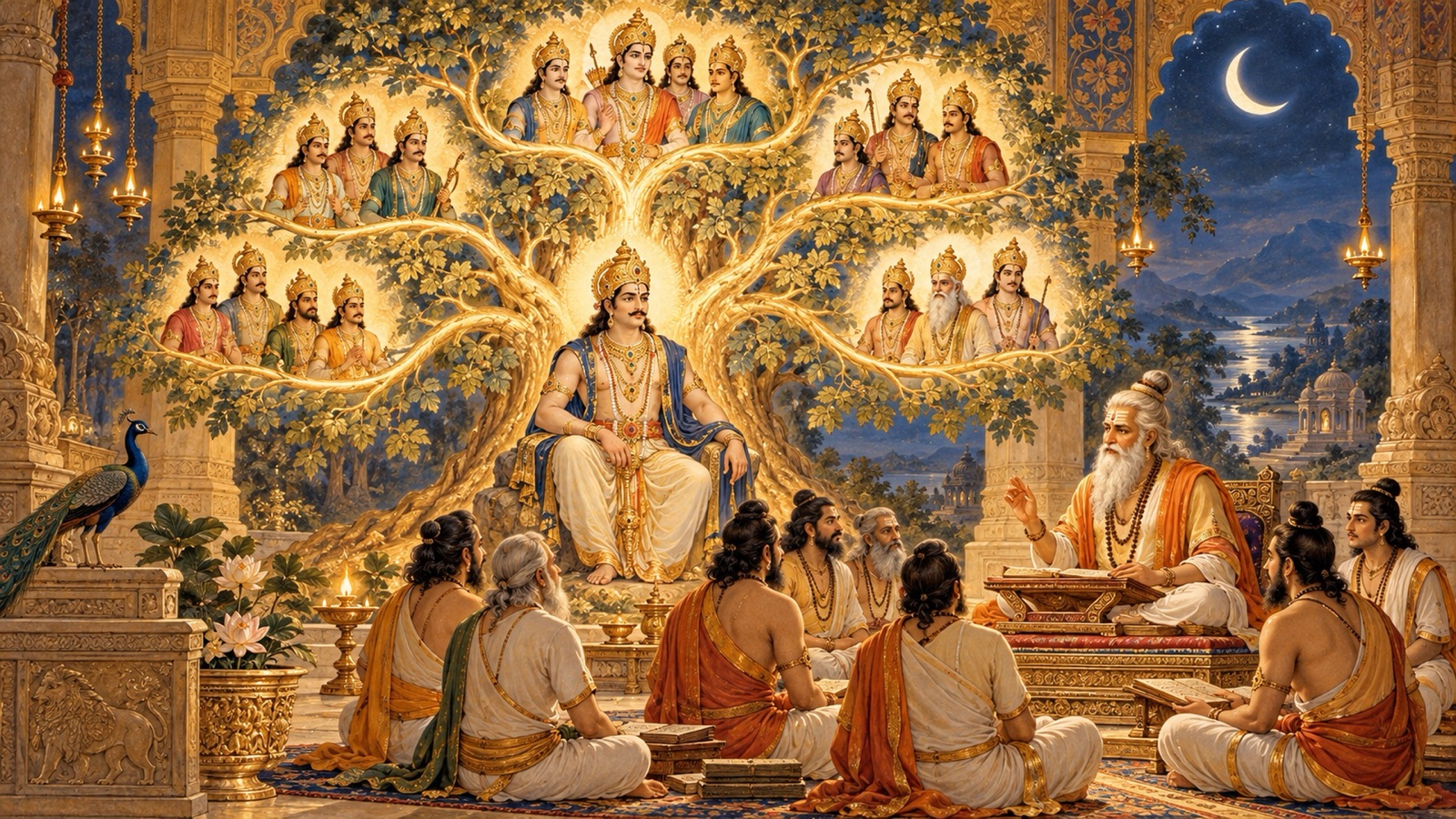
Sukadeva continued the lunar line. Ayu, the son of Pururava, had five sons: Nahusha, Kshatravrddha, Raji, Rabha, and Anena. Of the line of Kshatravrddha, his son Suhotra had three sons — Kasya, Kusa, and Gritsamada; and from Gritsamada came Sunaka, whose son was the sage Saunaka, foremost among the reciters of the Rig Veda.
श्रीबादरायणिरुवाच य: पुरूरवस: पुत्र आयुस्तस्याभवन् सुता: । नहुष: क्षत्रवृद्धश्च रजी राभश्च वीर्यवान् ॥ १ ॥ अनेना इति राजेन्द्र शृणु क्षत्रवृधोऽन्वयम् । क्षत्रवृद्धसुतस्यासन् सुहोत्रस्यात्मजास्त्रय: ॥ २ ॥ काश्य: कुशो गृत्समद इति गृत्समदादभूत् । शुनक: शौनको यस्य बह्वृचप्रवरो मुनि: ॥ ३ ॥
śrī-bādarāyaṇir uvāca yaḥ purūravasaḥ putra āyus tasyābhavan sutāḥ nahuṣaḥ kṣatravṛddhaś ca rajī rābhaś ca vīryavān anenā iti rājendra śṛṇu kṣatravṛdho ’nvayam kṣatravṛddha-sutasyāsan suhotrasyātmajās trayaḥ kāśyaḥ kuśo gṛtsamada iti gṛtsamadād abhūt śunakaḥ śaunako yasya bahvṛca-pravaro muniḥ
Meaning: Sukadeva Gosvami said: the sons born to Ayu, son of Pururava, were Nahusha, Kshatravrddha, the mighty Raji, Rabha and Anena. Within the Kshatravrddha branch, Suhotra fathered three sons — Kasya, Kusa and Gritsamada — and it was Gritsamada’s line that gave rise to Sunaka and, from him, the great sage Saunaka, most eminent among knowers of the Rig Veda. (Canto 9, Chapter 17, verses 1-3)
Dhanvantari, the Divine Physician
From Kasya came Kasi, then Rashtra, the father of Dirghatama; and from Dirghatama was born Dhanvantari, the founder of Ayurveda — a partial incarnation of Lord Vasudeva, the enjoyer of the sacrificial offerings, whose very remembrance destroys all suffering.
काश्यस्य काशिस्तत्पुत्रो राष्ट्रो दीर्घतम:पिता । धन्वन्तरिर्दीर्घतमस आयुर्वेदप्रवर्तक: । यज्ञभुग् वासुदेवांश: स्मृतमात्रार्तिनाशन: ॥ ४ ॥
kāśyasya kāśis tat-putro rāṣṭro dīrghatamaḥ-pitā dhanvantarir dīrghatamasa āyur-veda-pravartakaḥ yajña-bhug vāsudevāṁśaḥ smṛta-mātrārti-nāśanaḥ
Meaning: Kasya’s son was Kasi, and Kasi’s son Rashtra fathered Dirghatama; from Dirghatama came Dhanvantari — founder of the science of Ayurveda, a partial incarnation of Lord Vasudeva who accepts the offerings of sacrifice, and whose very remembrance drives away all suffering. (Canto 9, Chapter 17, verse 4)
The Long Reign of King Alarka
From Dhanvantari came Ketuman, then Bhimaratha, Divodasa, and Dyuman, who was also called Pratardana, Satrujit, Vatsa, Ritadhvaja, and Kuvalayasva; and from him came Alarka and others. Sukadeva noted a wonder: no king but Alarka has ever enjoyed the earth for sixty-six thousand years in the full vigour of youth.
षष्टिंवर्षसहस्राणि षष्टिंवर्षशतानि च । नालर्कादपरो राजन् बुभुजे मेदिनीं युवा ॥ ७ ॥
ṣaṣṭiṁ varṣa-sahasrāṇi ṣaṣṭiṁ varṣa-śatāni ca nālarkād aparo rājan bubhuje medinīṁ yuvā
Meaning: For sixty-six thousand years, O King, no king other than Alarka ever enjoyed the earth in the full vigour of youth. (Canto 9, Chapter 17, verse 7)
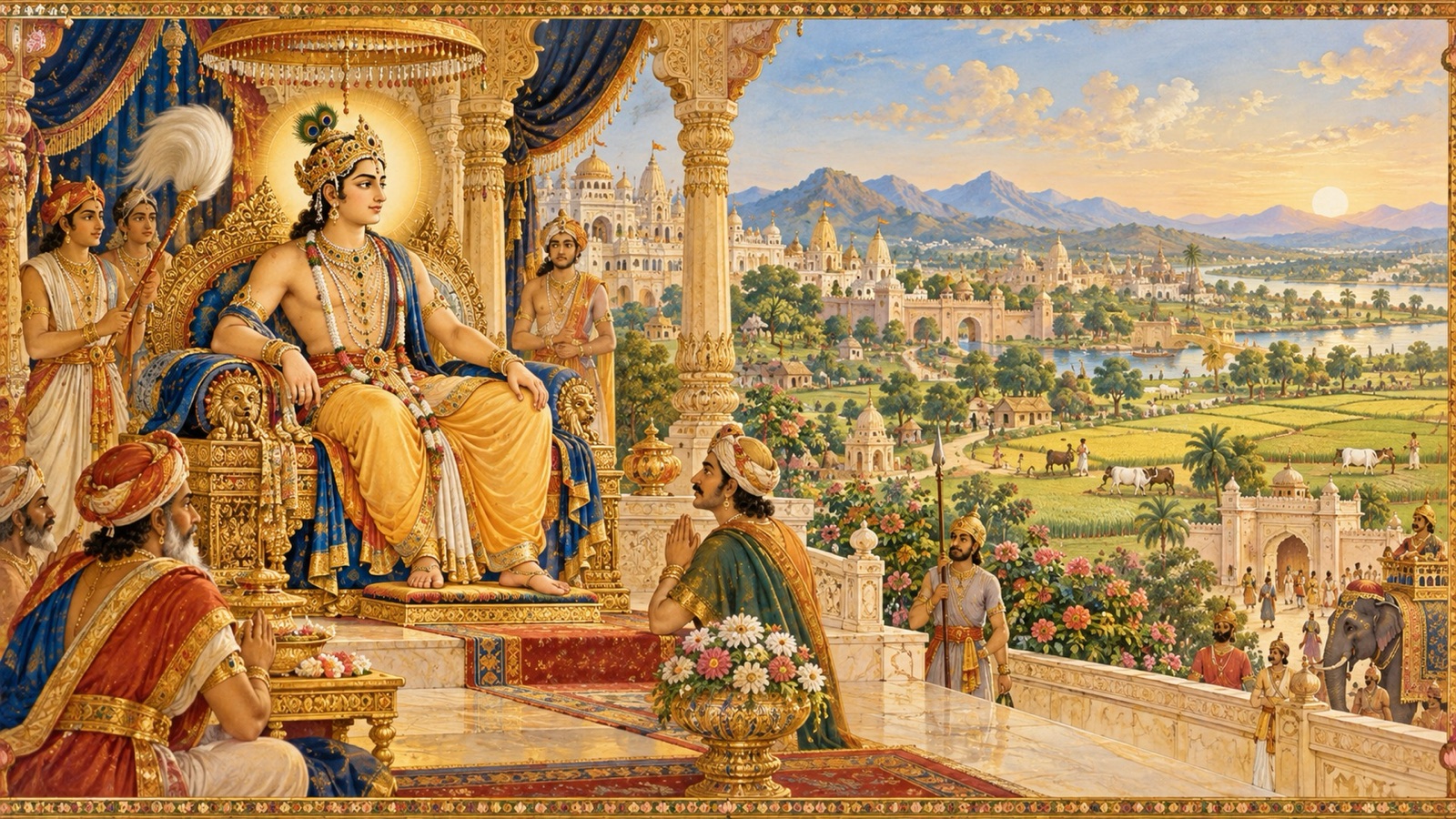
From Alarka came Santati, Sunitha, Niketana, Dharmaketu, Satyaketu, Dhrishtaketu, Sukumara, Vitihotra, Bharga, and Bhargabhumi — all kings of Kasi in the line of Kshatravrddha.
King Raji and the Kingdom of Heaven
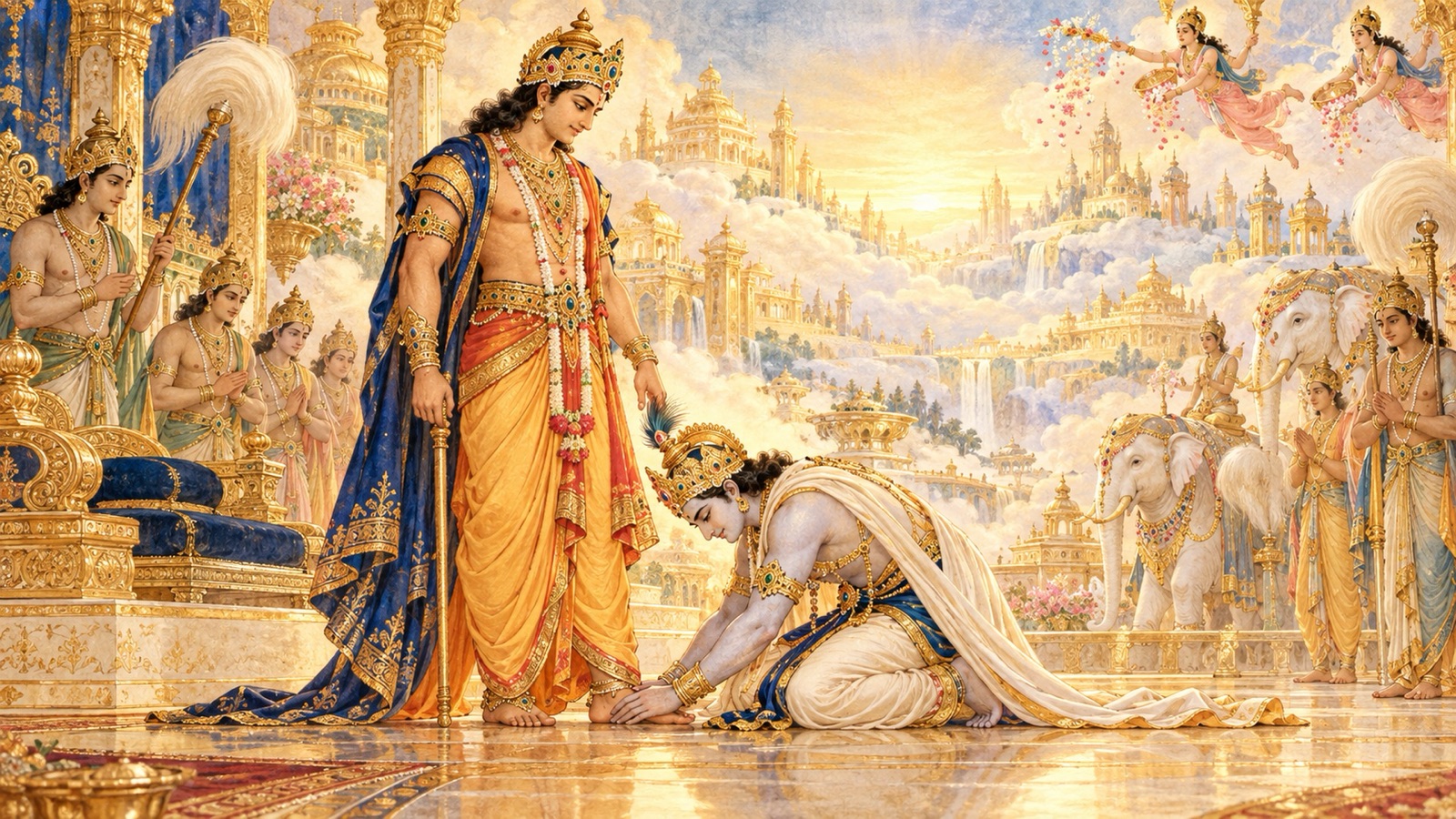
Sukadeva then told of Raji, another son of Ayu, who had five hundred sons of immense strength. Entreated by the gods, Raji slew the demons and restored the kingdom of heaven to Indra. Indra, in gratitude — and in fear of Prahlada and other foes — returned the kingdom to Raji, clasped his feet, and surrendered himself into his protection.
देवैरभ्यर्थितो दैत्यान् हत्वेन्द्रायाददाद् दिवम् । इन्द्रस्तस्मै पुनर्दत्त्वा गृहीत्वा चरणौ रजे: । आत्मानमर्पयामास प्रह्रादाद्यरिशङ्कित: ॥ १३ ॥
devair abhyarthito daityān hatvendrāyādadād divam indras tasmai punar dattvā gṛhītvā caraṇau rajeḥ ātmānam arpayām āsa prahrādādy-ari-śaṅkitaḥ
Meaning: At the gods’ entreaty, Raji struck down the demons and gave heaven back to Indra; and Indra, fearing Prahlada and the other foes of the gods, returned the kingdom to him once more, took hold of Raji’s feet, and placed himself under Raji’s protection. (Canto 9, Chapter 17, verse 13)
The Downfall of Raji’s Sons
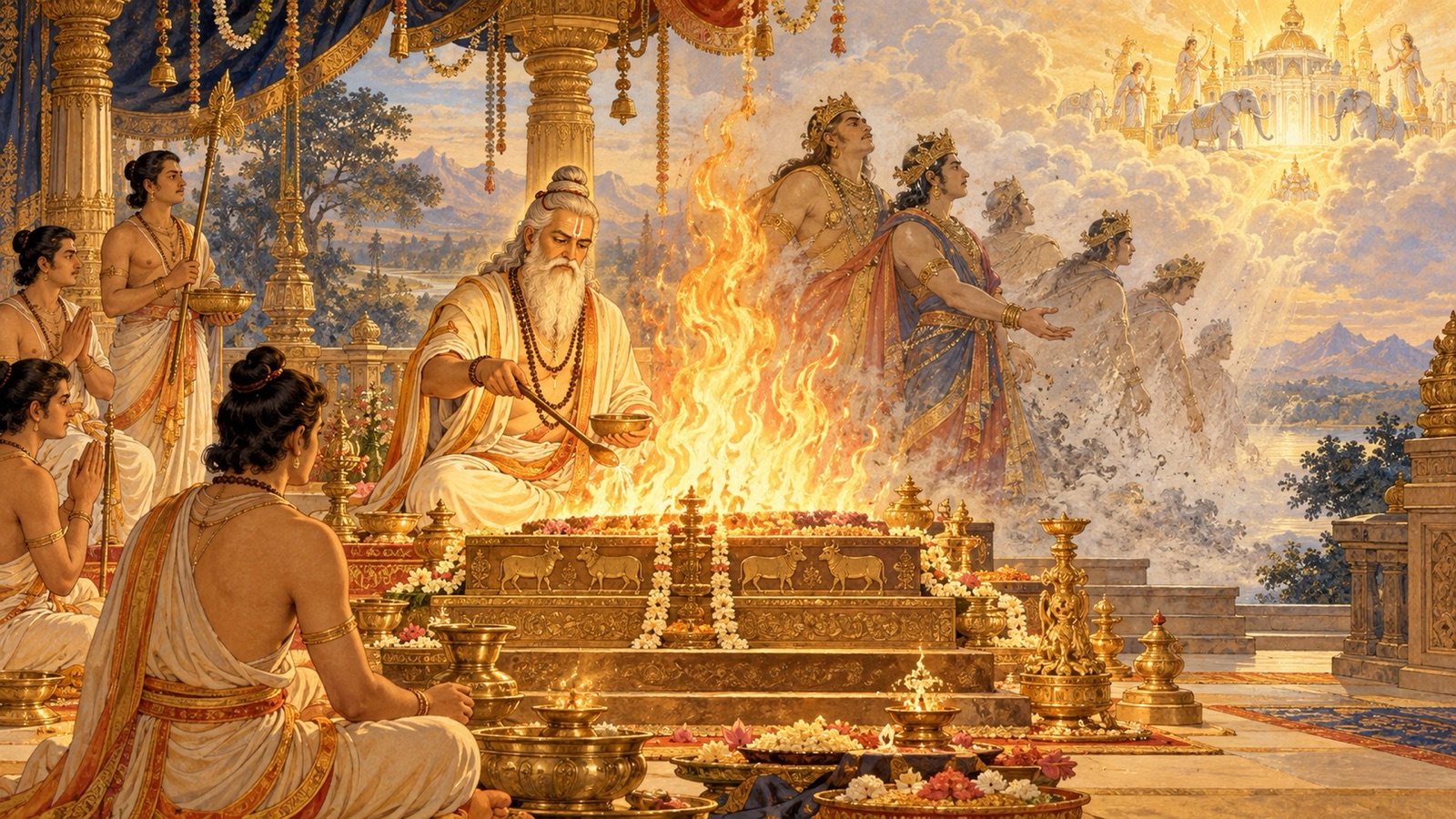
After Raji’s death, Indra begged Raji’s sons to return the kingdom of heaven; they refused, counting it their father’s rightful legacy rather than something taken from the gods — though they agreed to restore Indra’s own shares in the sacrificial rites. But when Brihaspati, the preceptor of the gods, poured oblations into the sacred fire, the sons of Raji lost their footing in virtue, and Indra slew them all with ease; not one remained alive.
गुरुणा हूयमानेऽग्नौ बलभित् तनयान् रजे: । अवधीद् भ्रंशितान् मार्गान्न कश्चिदवशेषित: ॥ १५ ॥
guruṇā hūyamāne ’gnau balabhit tanayān rajeḥ avadhīd bhraṁśitān mārgān na kaścid avaśeṣitaḥ
Meaning: When the preceptor poured the oblations into the sacred fire, Indra slew the sons of Raji, who had strayed from the path of virtue, and not one of them was left alive. (Canto 9, Chapter 17, verse 15)
From Kusa, grandson of Kshatravrddha, came Prati, then Sanjaya, Jaya, Krta, Haryabala, Sahadeva, Hina, Jayasena, Sankriti, and Jaya, a great warrior devoted to the duties of a Kshatriya — all kings of the line of Kshatravrddha, before Sukadeva turned to the line of Yayati, the son of Nahusha.
Principal Teachings of This Chapter
1. From one root spring many streams. The sons of Ayu branch into the lines of Kshatravrddha, Kasi, Raji and Anena — a reminder that the Lord’s plan unfolds through countless families and generations, each with its own dharma (verses 1-3).
2. The Lord descends even as a healer. Dhanvantari, the founder of Ayurveda, is a partial incarnation of Lord Vasudeva whose very remembrance destroys suffering. The Lord’s compassion reaches even our bodily ills, and his name itself is medicine (verse 4).
3. Even the longest reign is a passing thing. Alarka enjoyed the earth for sixty-six thousand years in unbroken youth — yet even he passed, and his line flowed on. No earthly glory, however vast, is permanent (verse 7).
4. Service is greater than sovereignty. Raji wins the gratitude of Indra himself by restoring heaven and asking nothing; his greatness lies in service, not in grasping (verses 12-13).
5. An inheritance is not enough to keep. Raji’s sons refused to return heaven, considering it their father’s rightful legacy — yet once virtue slipped from them under Brihaspati’s rites, Indra struck them down with ease. What was fairly inherited could not protect those who abandoned the conduct that had earned it (verses 14-15).
6. Dharma alone is the true fortress. Indra could not simply overpower Raji’s five hundred mighty sons by force; only their own moral fall, brought about through Brihaspati’s sacrifice, exposed them to his power. The Bhagavatam’s quiet teaching here is that what is won and guarded by righteous conduct stands secure against any strength, but the instant that conduct is abandoned, no power, however vast, remains a shelter (verses 14-15).
A Devotional Reflection
Amid the many names of this chapter, one shines with a special tenderness: Dhanvantari, the divine physician, born in the line of Kasi as a partial incarnation of Lord Vasudeva. That the Lord should descend not only to slay demons and crown kings, but to teach humanity the healing art and to be the one whose mere remembrance dispels suffering, tells us something profound about his heart. He is not a distant sovereign indifferent to our pains; he is the healer who enters even the sickroom of the world. And the chapter sets beside him two contrasting figures whose lesson is timeless: Raji, who served the gods and won even Indra’s surrender, and Raji’s sons, who grasped at what their father had freely given and were ruined. The Bhagavatam quietly asks us which we will be — the one who serves and lets go, or the one who clutches and loses. Between the healer who gives himself for the suffering and the heirs who seize what is not theirs, the whole spiritual choice of a life is drawn. And the gentlest promise of the chapter is the simplest: that the Lord, as Dhanvantari, is as near as his name, and that to remember him is already to begin to be healed.
A Daily Devotional Practice
Today, take refuge in the Lord as Dhanvantari, the divine healer whose remembrance dispels suffering. If you or someone you love is unwell in body or mind, offer a prayer for healing, placing the illness gently in the Lord’s hands, and repeat with faith, “Om Namo Bhagavate Vasudevaya.” Then, in the spirit of King Raji, choose service over grasping: do one thing today for another’s good and expect nothing in return, releasing any claim to reward or recognition. Let these two movements — trusting the Lord with your suffering, and serving without grasping — be your practice, remembering that the Lord who descended as the healer of the world draws near to every heart that turns to him in trust.
Conclusion
The seventeenth chapter of Book Nine carries many names through many generations, but it leaves one teaching standing above the rest: what is won and kept through service and virtue rests secure, while what is merely claimed cannot be held once virtue slips away. Lord Dhanvantari, whose very name heals, shows that the Lord’s compassion reaches even the sickroom of the world; King Raji, who chose service over seizing, shows that virtue itself is the truest shelter. May we meet every inheritance life gives us with the humility of service rather than the pride of ownership.
May the divine wisdom of Srimad Bhagavatam awaken pure devotion within our hearts.
Om Namo Bhagavate Vasudevaya.
Jay Shree Madhav.
References and Attribution
- Primary edition: Gita Press, Śrīmad Bhāgavata Mahāpurāṇa (English, complete), Book Nine, Discourse 17.
- Series: Srimad Bhagavatam Wisdom · Biswa Sanatan Dharma Seva Trust.
- Presented following the spiritual guidance and recommendation of Pandit Dr. Shri Kashinath Mishra.
This is an original, faithful retelling in the writer’s own words, with brief quoted verses shown in Devanāgarī and transliteration and their meanings given as summaries. It is not a reproduction of any single publisher’s continuous translation or commentary. No affiliation with or endorsement by any publisher is implied.
Jay Shree Madhav