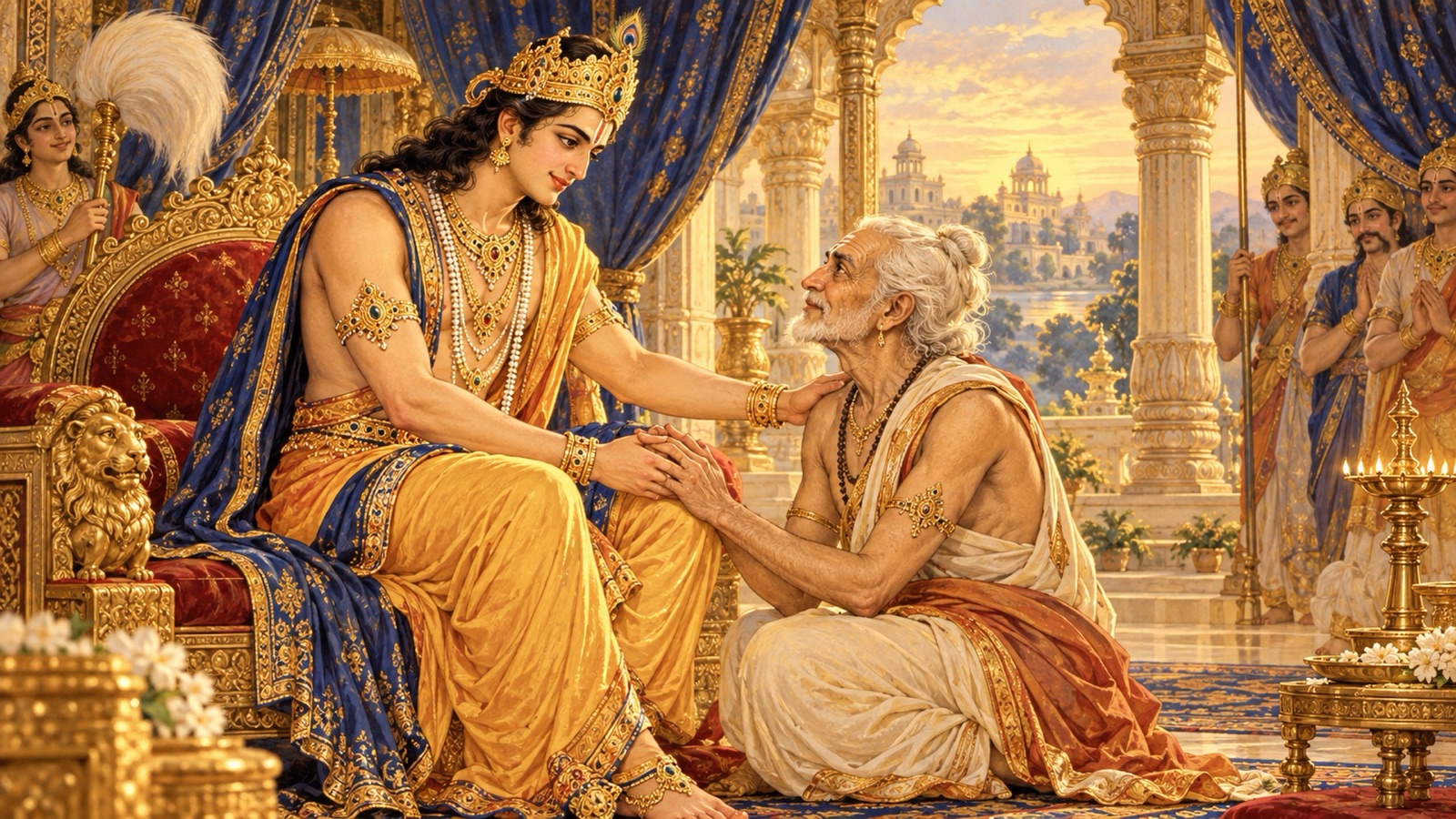
Cursed with premature old age, King Yayati receives from his youngest and most devoted son, Puru, the gift of youth — while Puru, out of pure love, willingly takes upon himself his father’s age.
Om Namo Bhagavate Vasudevaya.
Om Namo Bhagavate Vasudevaya.
Om Namo Bhagavate Vasudevaya.
Welcome to Srimad Bhagavatam Wisdom, a devotional journey through the sacred histories and teachings of the Srimad Bhagavat Mahapurana. This eighteenth chapter of Book Nine tells the celebrated story of King Yayati, son of Nahusha, of the lunar dynasty. Sukadeva relates for King Parikshit how Yayati came to marry Devayani, the daughter of the sage Sukracharya, and Sarmishtha, the daughter of the demon king Vrishaparva; how, cursed with premature old age by Sukracharya, Yayati sought to exchange his age for the youth of one of his sons; how his four elder sons refused, while Puru, the youngest, took on his father’s age in an instant, asking nothing for it. It is a chapter about pride and its consequences, the pull of unquenchable desire, and above all the beauty of a son’s selfless love — a love that anticipates a father’s wish before it is even spoken.
Chapter Information
- Scripture: Śrīmad Bhāgavata Mahāpurāṇa
- Canto: 9 (Book Nine)
- Chapter: 18 (Discourse 18)
- Chapter title: King Yayati Regains His Youth
- Principal speaker: Sukadeva Gosvami, narrating to King Parikshit — the whole related by Suta Gosvami to the sage Saunaka and the assembly of sages at Naimisaranya
- Principal listener: King Parikshit
- Main setting: The kingdom of Yayati in the lunar dynasty; the garden and city of the demon king Vrishaparva
- Central subject: The marriages of King Yayati to Devayani and Sarmishtha, the curse of premature old age, and the devotion of his son Puru who accepted that age
- Principal verse range: Canto 9, Chapter 18, verses 1–51
- Primary edition: Gita Press Śrīmad Bhāgavata Mahāpurāṇa
The Sons of Nahusha
Sukadeva began the account of Yayati. Nahusha had six sons — Yati, Yayati, Samyati, Ayati, Viyati and Krti. Yati, the eldest, declined the sovereignty his father offered, for he knew the end to which it leads: a state in which one can no longer realize the Self.
राज्यं नैच्छद् यति: पित्रा दत्तं तत्परिणामवित् । यत्र प्रविष्ट: पुरुष आत्मानं नावबुध्यते ॥ २ ॥
rājyaṁ naicchad yatiḥ pitrā dattaṁ tat-pariṇāmavit yatra praviṣṭaḥ puruṣa ātmānaṁ nāvabudhyate
Meaning: Yati did not desire the kingdom offered by his father, knowing its end — that a person absorbed in it can no longer realize the Self. (Canto 9, Chapter 18, verse 2)
When Nahusha was hurled from heaven and turned into a python through the curse of the brahmanas for his impudence, Yayati became king, appointing his younger brothers as governors of the four quarters. King Parikshit then asked how a Kshatriya king had come to marry a brahmana’s daughter.
The Quarrel at the Pond
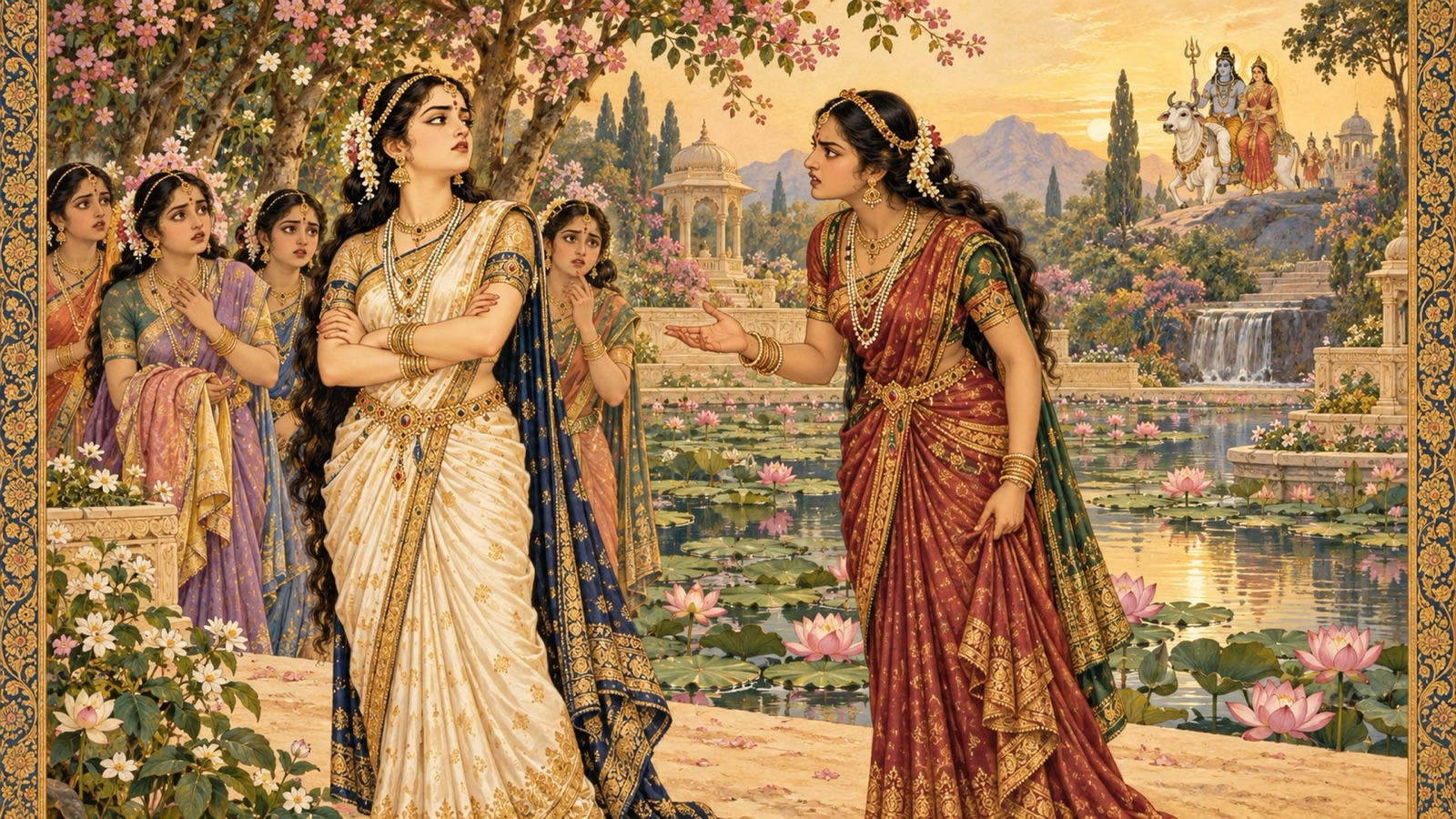
Sukadeva explained. Sarmishtha, the proud daughter of the demon king Vrishaparva, was strolling with Devayani, the daughter of Sukracharya, and a thousand companions in the city garden. Bathing in a lotus pond, the maidens left their clothes on the bank; and seeing Lord Siva pass by with Parvati, they hurriedly came out and dressed. Sarmishtha unwittingly put on Devayani’s garment, and Devayani, enraged, rebuked her sharply.
अहो निरीक्ष्यतामस्या दास्या: कर्म ह्यसाम्प्रतम् । अस्मद्धार्यं धृतवती शुनीव हविरध्वरे ॥ ११ ॥
aho nirīkṣyatām asyā dāsyāḥ karma hy asāmpratam asmad-dhāryaṁ dhṛtavatī śunīva havir adhvare
Meaning: “Just look at the unbecoming act of this servant-maid! Like a bitch snatching the oblation at a sacrifice, she has put on the garment meant for us.” (Canto 9, Chapter 18, verse 11)
Stung by these words, Sarmishtha answered harshly in turn, and in her anger snatched Devayani’s clothes and threw her into a well before leaving for home.
Yayati Lifts Devayani from the Well
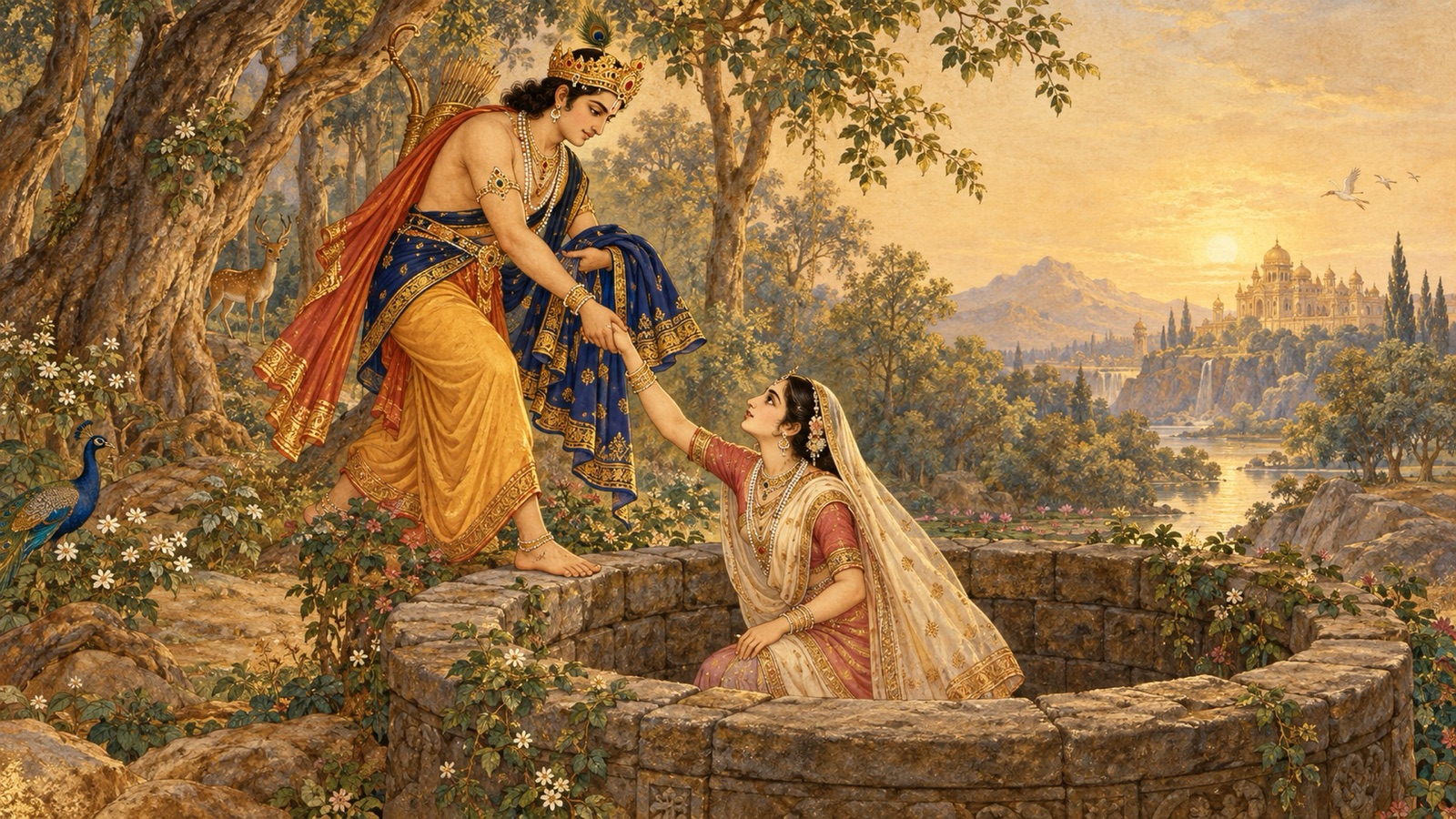
Wandering in search of game and coming to the well for water, King Yayati beheld Devayani within it. Kind-hearted, he gave her his own upper garment and, grasping her hand, lifted her out.
दत्त्वा स्वमुत्तरं वासस्तस्यै राजा विवाससे । गृहीत्वा पाणिना पाणिमुज्जहार दयापर: ॥ १९ ॥
dattvā svam uttaraṁ vāsas tasyai rājā vivāsase gṛhītvā pāṇinā pāṇim ujjahāra dayā-paraḥ
Meaning: Giving her his own upper garment, the compassionate king, grasping her hand with his own, lifted the unclothed maiden out of the well. (Canto 9, Chapter 18, verse 19)
Devayani declared that since he had taken her hand, none else could be her husband, and that this union was ordained by Providence; a brahmana could not be her husband, she said, because of an earlier curse. Recognizing the connection as fated and finding his own mind drawn to her, Yayati agreed.
Devayani complained to her father, and Sukracharya left the demon king’s city in sorrow. Vrishaparva, anxious to placate his preceptor, fell at his feet, and to satisfy Devayani agreed that Sarmishtha, with her thousand companions, would serve as Devayani’s maidservant wherever she went. Giving Devayani to Yayati along with Sarmishtha, Sukracharya warned the king never to share his bed with Sarmishtha. Devayani bore Yadu and Turvasu; but Sarmishtha, longing for a son of her own, secretly approached Yayati at the time of conception, and the king, forgetting the very promise he had made to Sukracharya, gave her Druhyu, Anu and Puru. When Devayani learned of this, she went in anger to her father, and Sukracharya cursed the king.
The Curse of Old Age
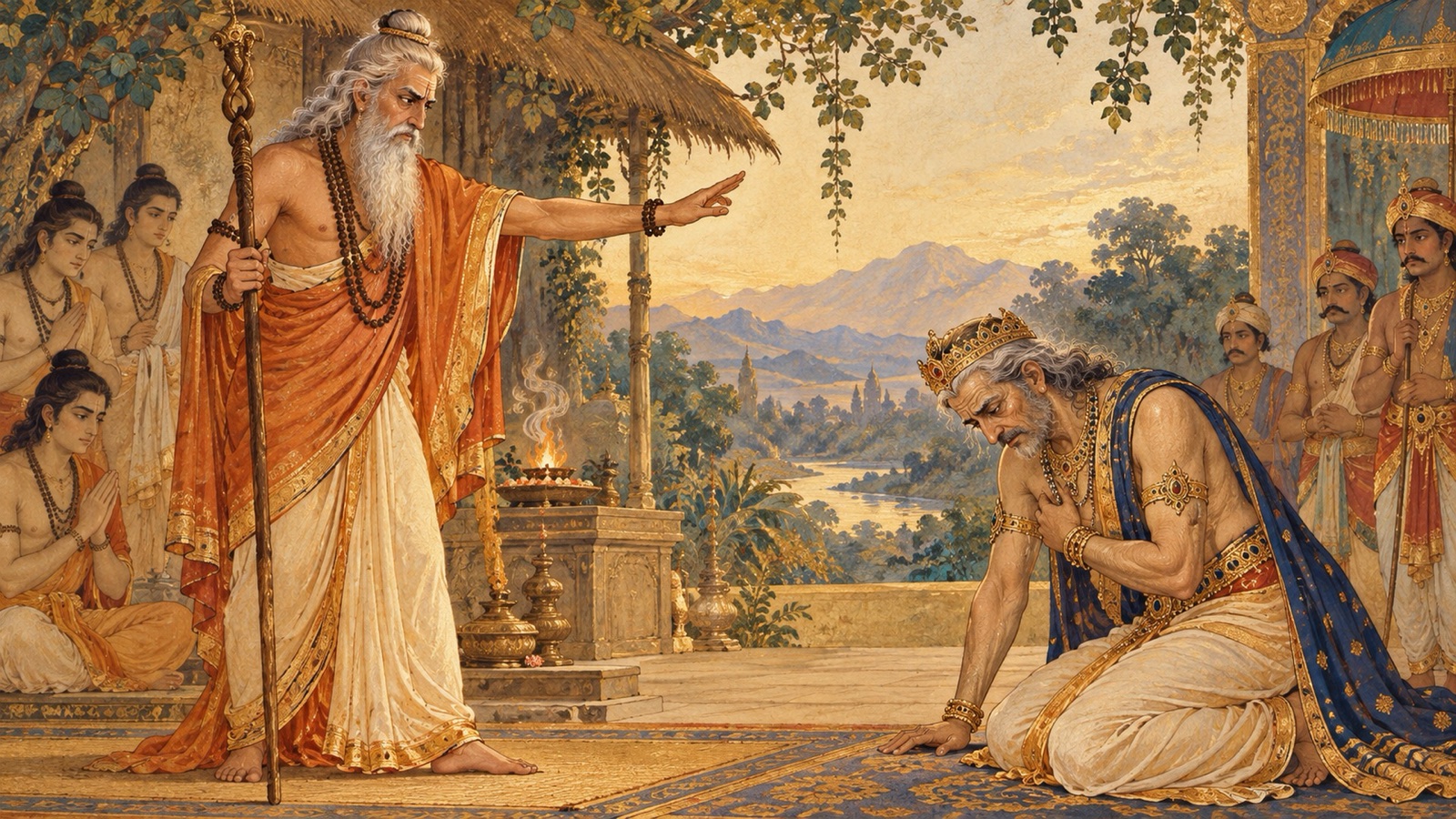
Enraged, Sukracharya condemned Yayati as a deceitful man enslaved by lust, and cursed him with the old age that disfigures.
शुक्रस्तमाह कुपित: स्त्रीकामानृतपूरुष । त्वां जरा विशतां मन्द विरूपकरणी नृणाम् ॥ ३६ ॥
śukras tam āha kupitaḥ strī-kāmānṛta-pūruṣa tvāṁ jarā viśatāṁ manda virūpa-karaṇī nṛṇām
Meaning: The angry Sukracharya said to him: “O foolish man, hankering after women and speaking falsely — let old age, which disfigures a man, overtake you.” (Canto 9, Chapter 18, verse 36)
When Yayati pleaded that he was not yet sated with enjoyment, Sukracharya granted that he might exchange his old age for the youth of anyone willing to accept it.
The Sons Are Asked
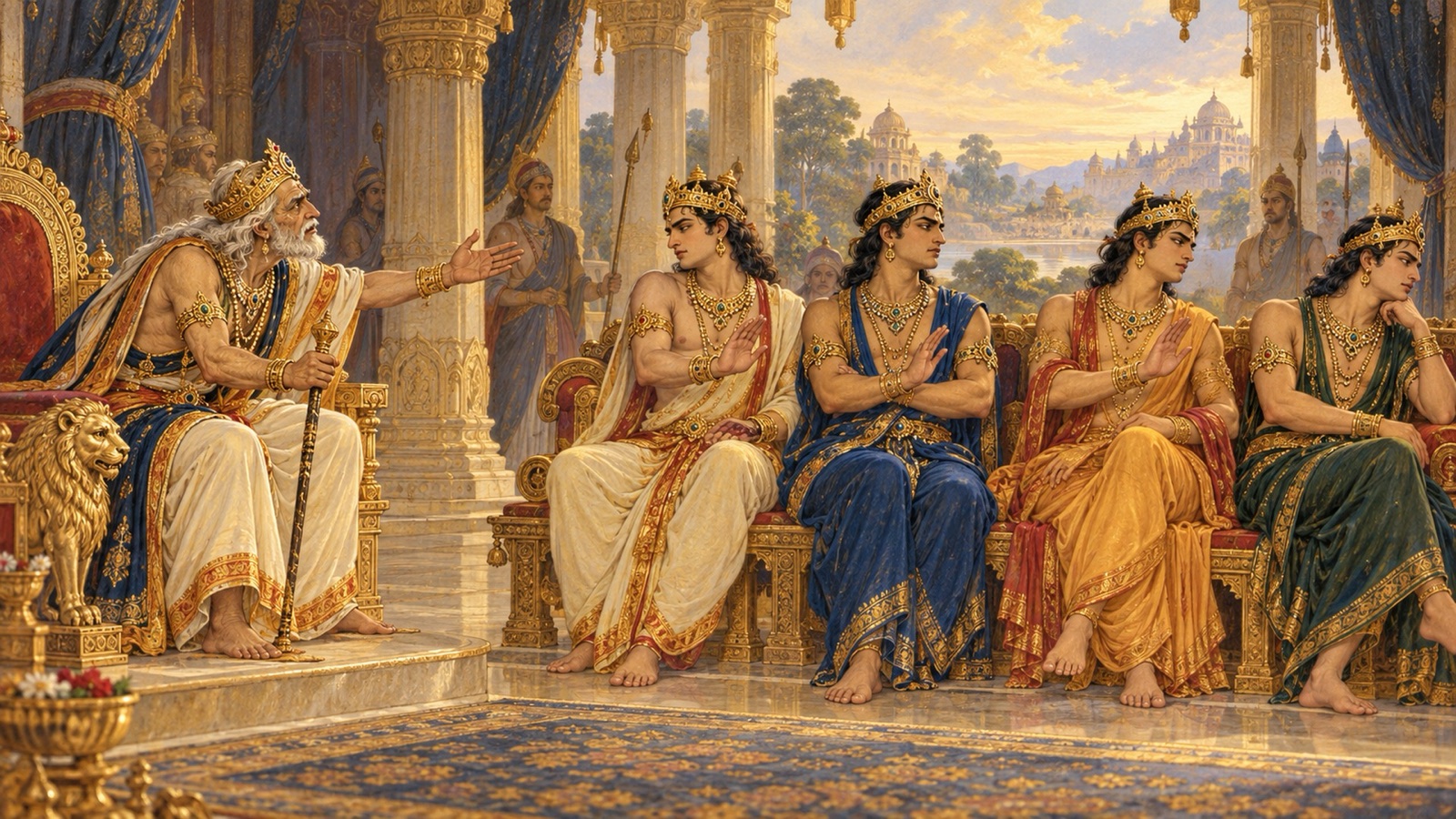
Returning home, Yayati asked his eldest son Yadu to take his old age and give his youth in exchange. But Yadu refused, saying he had no wish to bear old age in the middle of life, for a man who has not tasted enjoyment cannot become free of desire.
श्रीयदुरुवाच नोत्सहे जरसा स्थातुमन्तरा प्राप्तया तव । अविदित्वा सुखं ग्राम्यं वैतृष्ण्यं नैति पूरुष: ॥ ४० ॥
śrī-yadur uvāca notsahe jarasā sthātum antarā prāptayā tava aviditvā sukhaṁ grāmyaṁ vaitṛṣṇyaṁ naiti pūruṣaḥ
Meaning: Yadu said: I have no wish to take on old age in the midst of life; for a man who has not known enjoyment cannot attain freedom from desire. (Canto 9, Chapter 18, verse 40)
Turvasu, Druhyu and Anu likewise refused, not knowing what was right and mistaking the transient body for something eternal. Then Yayati turned to Puru — youngest in age but greatest in virtue.
अपृच्छत् तनयं पूरुं वयसोनं गुणाधिकम् । न त्वमग्रजवद् वत्स मां प्रत्याख्यातुमर्हसि ॥ ४२ ॥
apṛcchat tanayaṁ pūruṁ vayasonaṁ guṇādhikam na tvam agrajavad vatsa māṁ pratyākhyātum arhasi
Meaning: He asked his son Puru — younger in years but greater in virtue: “Dear child, you should not refuse me as your elder brothers have done.” (Canto 9, Chapter 18, verse 42)
The Devotion of Puru
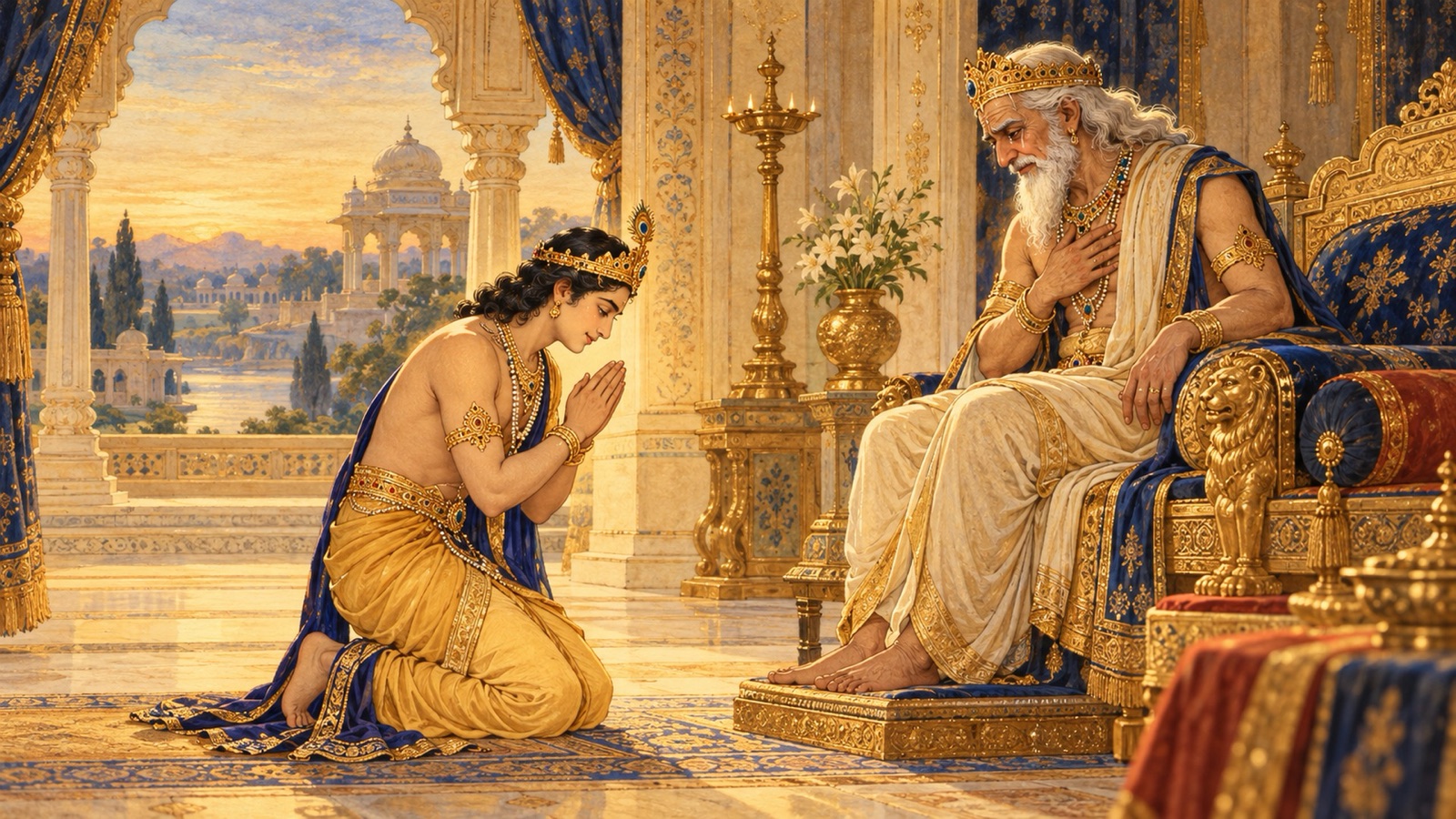
Puru answered that no man can ever fully repay the father who gave him his very body, by whose grace he may attain the highest good; and he taught the measure of a son’s love.
श्रीपूरुरुवाच को नु लोके मनुष्येन्द्र पितुरात्मकृत: पुमान् । प्रतिकर्तुं क्षमो यस्य प्रसादाद् विन्दते परम् ॥ ४३ ॥
śrī-pūrur uvāca ko nu loke manuṣyendra pitur ātma-kṛtaḥ pumān pratikartuṁ kṣamo yasya prasādād vindate param
Meaning: Puru said: What man in this world, O King, can ever repay his father, the giver of his body, by whose grace he may attain the highest goal? (Canto 9, Chapter 18, verse 43)
उत्तमश्चिन्तितं कुर्यात् प्रोक्तकारी तु मध्यम: । अधमोऽश्रद्धया कुर्यादकर्तोच्चरितं पितु: ॥ ४४ ॥
uttamaś cintitaṁ kuryāt prokta-kārī tu madhyamaḥ adhamo ’śraddhayā kuryād akartoccaritaṁ pituḥ
Meaning: The best son does what is desired by his father even before being asked; the mediocre does only what he is told; the lowest does his father’s bidding without reverence; and he who refuses is no better than his father’s refuse. (Canto 9, Chapter 18, verse 44)
So Puru gladly took upon himself his father’s old age, and Yayati, restored to youth, went on to enjoy life for many more years.
A Thousand Years, Still Unsatisfied
With his youth restored, Yayati ruled the whole earth, girded by its seven island-continents, guarding his subjects as tenderly as a father, while Devayani, wholly devoted in body, word and mind, brought him the deepest joy a wife can give. He performed great sacrifices, offering lavish gifts to the brahmanas to honor Hari, the Lord of every god and the essence of all the Vedas — the same Vasudeva within whom this entire creation rests and into whom it withdraws, as unreal as a dream, though it seems real enough while it lasts. Yet enjoying the world’s fullest pleasures for a thousand years with his mind and five senses, the emperor remained unsatisfied still.
एवं वर्षसहस्राणि मन:षष्ठैर्मन:सुखम् । विदधानोऽपि नातृप्यत् सार्वभौम: कदिन्द्रियै: ॥ ५१ ॥
evaṁ varṣa-sahasrāṇi manaḥ-ṣaṣṭhair manaḥ-sukham vidadhāno ’pi nātṛpyat sārva-bhaumaḥ kad-indriyaiḥ
Meaning: Thus, for a thousand years, the emperor of the whole earth pursued pleasure through his mind and five senses — and even so, he was never satisfied. (Canto 9, Chapter 18, verse 51)
This is the chapter’s real teaching, and Yayati himself is its proof. No amount of dominion, wealth or indulgence — not even a thousand years of it, granted by his own son’s youth — could still the hunger of the unpurified senses, because indulgence sharpens appetite rather than ending it. The Bhagavatam sets this failure beside Puru’s success on purpose: one prince tries to conquer desire by feeding it without end, the other conquers it in a single act of selfless giving, seeking nothing in return. Yayati’s exhausted enjoyment and Puru’s effortless love are the chapter’s two answers to the same question — and only one of them actually works.
Principal Teachings of This Chapter
1. Pride sows quarrels and sorrow. The pride of both Devayani and Sarmishtha at the pond leads to insult, injury and a chain of consequences. Where humility would have healed, pride wounds (verses 10-17).
2. Sovereignty can blind the soul. Yati refuses the throne because he knows it can rob a person of Self-realization. The chapter opens with a warning that worldly power, ungoverned, is a peril to the spirit (verse 2).
3. Unquenchable desire cannot be satisfied by indulgence. Even a thousand years as ruler of the whole earth left Yayati unsatisfied still; Yadu’s claim that one who has not tasted enjoyment cannot become free of it is, in the end, disproved by his own father’s fate (verses 36-40, 51).
4. The truest service anticipates the need. Puru’s teaching on the four kinds of sons — the best acting before being asked — sets a standard for all loving service: to give before we are begged, out of reverence and love (verse 44).
5. Selfless love is its own reward. Where the elder sons cling to youth and refuse, Puru freely gives his own and takes his father’s age. His selflessness will, in the next chapter, be crowned with the kingdom — for love that gives is never finally the loser (verses 42-44).
A Devotional Reflection
At the heart of this crowded, very human chapter stands a single luminous act: a young man who gladly gives away his own youth to lift the burden of age from his father. Around it swirls everything that keeps us bound — the pride of Devayani and Sarmishtha, the lust that enslaves even a great king, the desire that Yayati himself confesses can never be satisfied by feeding it. The Bhagavatam does not flinch from showing us how these forces entangle even the noble; Yayati is no villain, but a good man caught in the net of his own cravings. And into this tangle steps Puru, whose love asks for nothing and gives everything. His words about the four kinds of sons are really words about the four kinds of devotees, and the highest — the one who does what is wished before being asked — is the very image of pure devotion to the Lord. We spend our lives, like Yayati, hoping that one more pleasure will finally quiet our restlessness, and it never does. But the way out is shown by Puru: to stop grasping and begin giving, to serve out of love rather than take out of need. The chapter gently promises that the desire we can never satisfy by indulgence, we can transcend by selfless love — and that such love, far from impoverishing us, is the truest wealth of all.
A Daily Devotional Practice
Today, in the spirit of Puru, practise the highest kind of service — the service that gives before it is asked. Look for one need in your home or community that no one has yet named aloud, and quietly meet it, expecting neither thanks nor reward, as an offering to the Lord who dwells in all. And where you feel the pull of Yayati’s restlessness — the craving for one more comfort, one more indulgence — pause and gently turn the longing over to God, repeating, “Om Namo Bhagavate Vasudevaya,” remembering that desire is never stilled by feeding but only by surrender. Let one act of anticipatory, selfless love be your worship today, trusting that the peace no pleasure could give will come instead through the joy of giving.
Conclusion
The eighteenth chapter of Book Nine tells the story of King Yayati — his marriages to Devayani and Sarmishtha, the curse of premature old age laid on him by Sukracharya, and his exchange of that age for the youth of his son. Four sons refused; only Puru, out of pure devotion, gladly took on his father’s age, teaching the measure of a true son’s love. And when Yayati, restored and enthroned over the whole earth, still could not find satisfaction after a thousand years of pleasure, the chapter’s real lesson stands revealed: no indulgence can extinguish desire, but a love that asks for nothing already possesses everything.
May the divine wisdom of Srimad Bhagavatam awaken pure devotion within our hearts.
Om Namo Bhagavate Vasudevaya.
Jay Shree Madhav.
References and Attribution
- Primary edition: Gita Press, Śrīmad Bhāgavata Mahāpurāṇa (English, complete), Book Nine, Discourse 18, pages 72–78.
- Series: Srimad Bhagavatam Wisdom · Biswa Sanatan Dharma Seva Trust.
- Presented following the spiritual guidance and recommendation of Pandit Dr. Shri Kashinath Mishra.
This is an original, faithful retelling in the writer’s own words, with brief quoted verses shown in Devanāgarī and transliteration and their meanings given as summaries. It is not a reproduction of any single publisher’s continuous translation or commentary. No affiliation with or endorsement by any publisher is implied.
Jay Shree Madhav