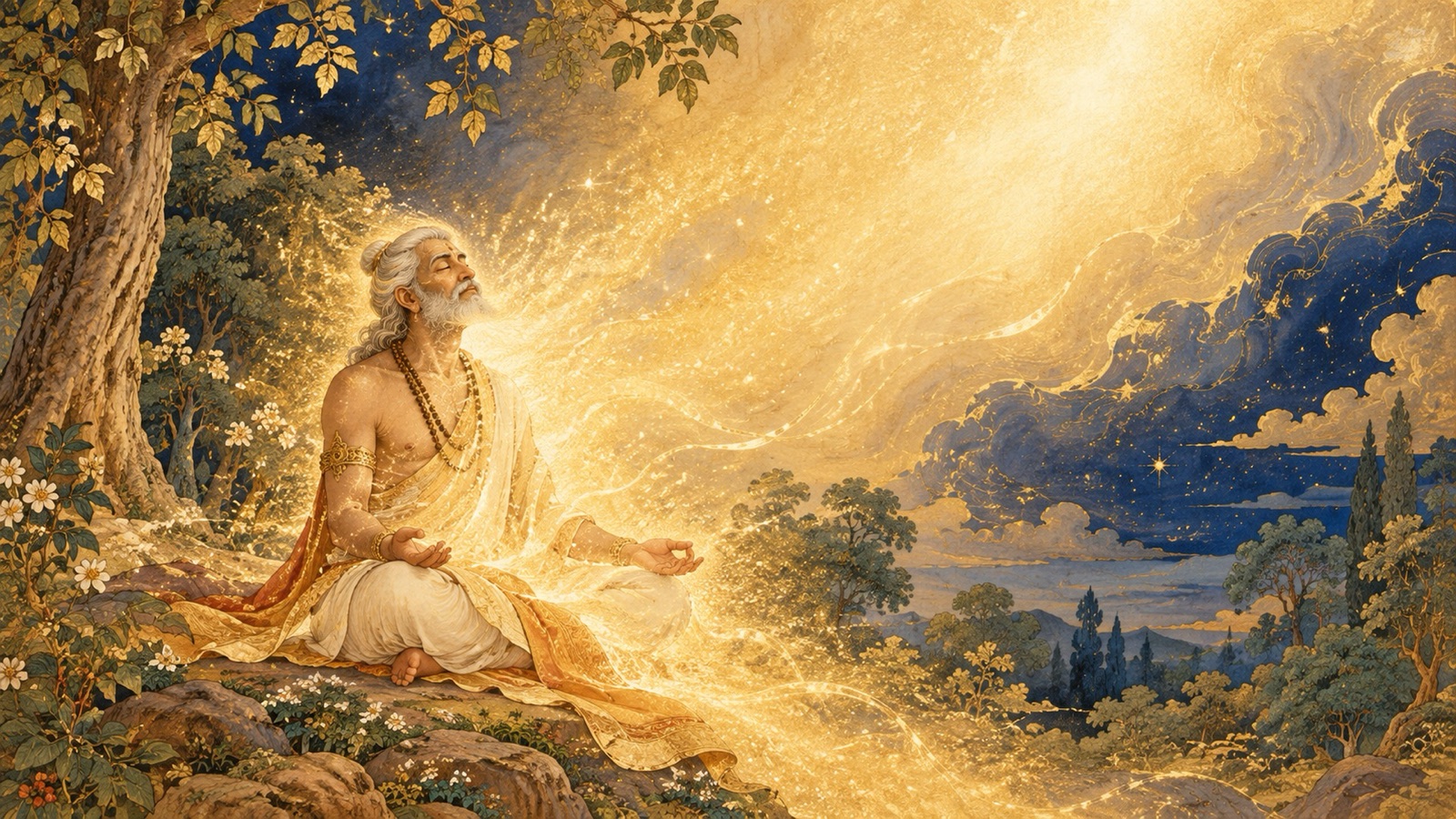
Free at last of every craving, King Yayati returns his son’s youth, retires to the forest, and — casting off all attachment through Self-realization — attains absorption into the supreme Lord Vasudeva.
Om Namo Bhagavate Vasudevaya.
Om Namo Bhagavate Vasudevaya.
Om Namo Bhagavate Vasudevaya.
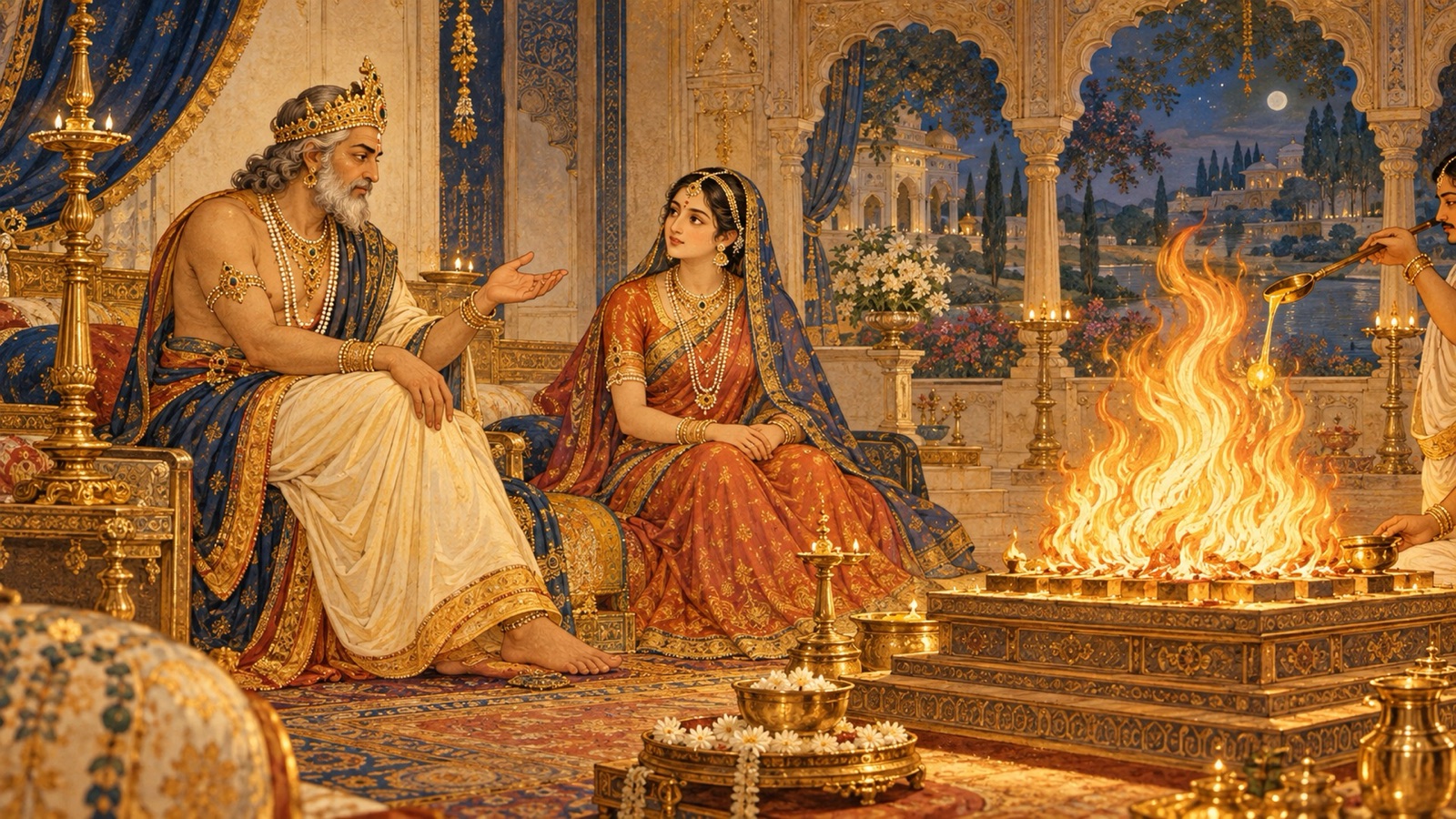
Welcome to Srimad Bhagavatam Wisdom, a devotional journey through the sacred histories and teachings of the Srimad Bhagavat Mahapurana. This nineteenth chapter of Book Nine completes the story of King Yayati. Having enjoyed the pleasures of the senses for a thousand years with his son’s borrowed youth, Yayati at last awakens to the futility of his pursuit. Sukadeva relates for King Parikshit the parable of the goat and the she-goat, by which Yayati confesses his own bondage to Devayani; the timeless truth that desire is never quenched by indulgence but only grows like fire fed with ghee; and Yayati’s resolve to fix his mind on the Absolute. Returning his son’s youth and taking back his own age, the king renounces the world, retires to the forest, and attains absorption into the supreme Lord Vasudeva. Devayani too, awakening to the dreamlike nature of the world, fixes her mind on Sri Krishna and attains liberation. It is a chapter about the emptiness of endless desire and the peace found only in surrender to the Lord.
Chapter Information
- Scripture: Śrīmad Bhāgavata Mahāpurāṇa
- Canto: 9 (Book Nine)
- Chapter: 19 (Discourse 19)
- Chapter title: King Yayati Achieves Liberation
- Principal speaker: Sukadeva Gosvami, narrating to King Parikshit — the whole related by Suta Gosvami to the sage Saunaka and the assembly of sages at Naimisaranya
- Principal listener: King Parikshit
- Main setting: The kingdom of King Yayati in the lunar dynasty; the forest of his renunciation
- Central subject: Yayati’s awakening from sense-enjoyment, the parable of the goat, the truth about desire, and the liberation of Yayati and Devayani
- Principal verse range: Canto 9, Chapter 19, verses 1–29
- Primary edition: Gita Press Śrīmad Bhāgavata Mahāpurāṇa
Yayati Still Unsated
Sukadeva resumed. Enjoying the pleasures of the senses in the grip of his attachment to his wife, Yayati at last awoke to his own spiritual downfall; and, disgusted with the world, he sang to Devayani a parable of one whose conduct was like his own.
श्रीशुक उवाच स इत्थमाचरन् कामान् स्त्रैणोऽपह्नवमात्मन: । बुद्ध्वा प्रियायै निर्विण्णो गाथामेतामगायत ॥ १ ॥
śrī-śuka uvāca sa ittham ācaran kāmān straiṇo ’pahnavam ātmanaḥ buddhvā priyāyai nirviṇṇo gāthām etām agāyata
Meaning: Sukadeva said: Enjoying the senses in this way, but awakening to his own spiritual fall as one enslaved by his wife, the disillusioned Yayati sang this parable to his beloved. (Canto 9, Chapter 19, verse 1)
The Parable of the Goat
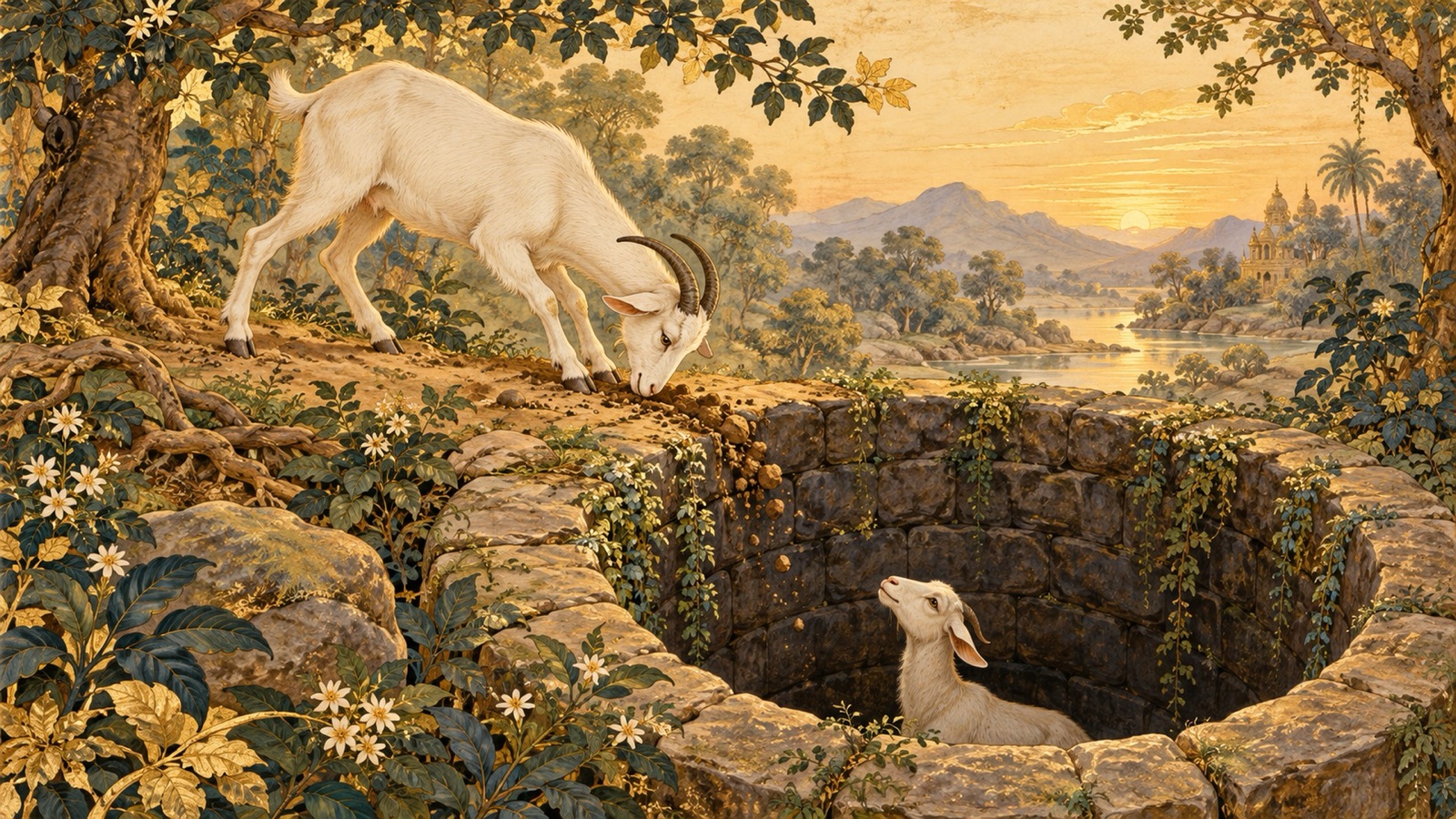
There was once, Yayati said, a lone goat roaming the woodland, pursuing whatever his heart craved, when he came upon a she-goat trapped at the bottom of a well, caught there by the workings of her own past deeds.
बस्त एको वने कश्चिद् विचिन्वन् प्रियमात्मन: । ददर्श कूपे पतितां स्वकर्मवशगामजाम् ॥ ३ ॥
basta eko vane kaścid vicinvan priyam ātmanaḥ dadarśa kūpe patitāṁ sva-karma-vaśagām ajām
Meaning: A certain goat, wandering alone in a forest in search of what he desired, saw a she-goat that had fallen into a well by the force of her own destiny. (Canto 9, Chapter 19, verse 3)
The goat dug an outlet with his horns and rescued her; she fell in love with him, and many other she-goats too were drawn to him, and he revelled among them, lost to himself in lust. When the first she-goat saw him with another, she left him in sorrow and returned to her owner, a brahmana, who punished and then restored the goat; yet even so the goat was never satisfied. In this goat, Yayati confessed, he saw himself — bound by the cords of Devayani’s love, unable to recognize his own true self.
The Truth About Desire
Then Yayati spoke the timeless truth: all the grain, gold, animals and women on earth cannot satisfy the mind of a man consumed by lust. Desire, he said, is never quenched by enjoyment; it only blazes higher, like a fire fed with ghee.
न जातु काम: कामानामुपभोगेन शाम्यति । हविषा कृष्णवर्त्मेव भूय एवाभिवर्धते ॥ १४ ॥
na jātu kāmaḥ kāmānām upabhogena śāṁyati haviṣā kṛṣṇa-vartmeva bhūya evābhivardhate
Meaning: Desire is never satisfied by the enjoyment of its objects; rather, like fire fed with ghee, it only blazes forth again all the more. (Canto 9, Chapter 19, verse 14)
A thousand years, he said, had slipped by in the pursuit of pleasure, and yet each enjoyment only renewed his thirst. Therefore, giving up this craving and fixing his mind on the Absolute, he resolved to roam free with the deer, beyond the pairs of opposites and free of all egotism.
तस्मादेतामहं त्यक्त्वा ब्रह्मण्यध्याय मानसम् । निर्द्वन्द्वो निरहङ्कारश्चरिष्यामि मृगै: सह ॥ १९ ॥
tasmād etām ahaṁ tyaktvā brahmaṇy adhyāya mānasam nirdvandvo nirahaṅkāraś cariṣyāmi mṛgaiḥ saha
Meaning: Therefore, giving up this craving and fixing my mind on the Absolute, free of the pairs of opposites and of egotism, I shall roam about with the deer. (Canto 9, Chapter 19, verse 19)
Yayati Returns His Son’s Youth
Having spoken thus, Yayati returned Puru’s youth to him and took back his own old age, every craving for enjoyment now gone from him forever. He appointed Druhyu, Yadu, Turvasu and Anu as rulers of the several quarters, installed the worthy Puru as emperor of the whole earth, and retired to the forest.
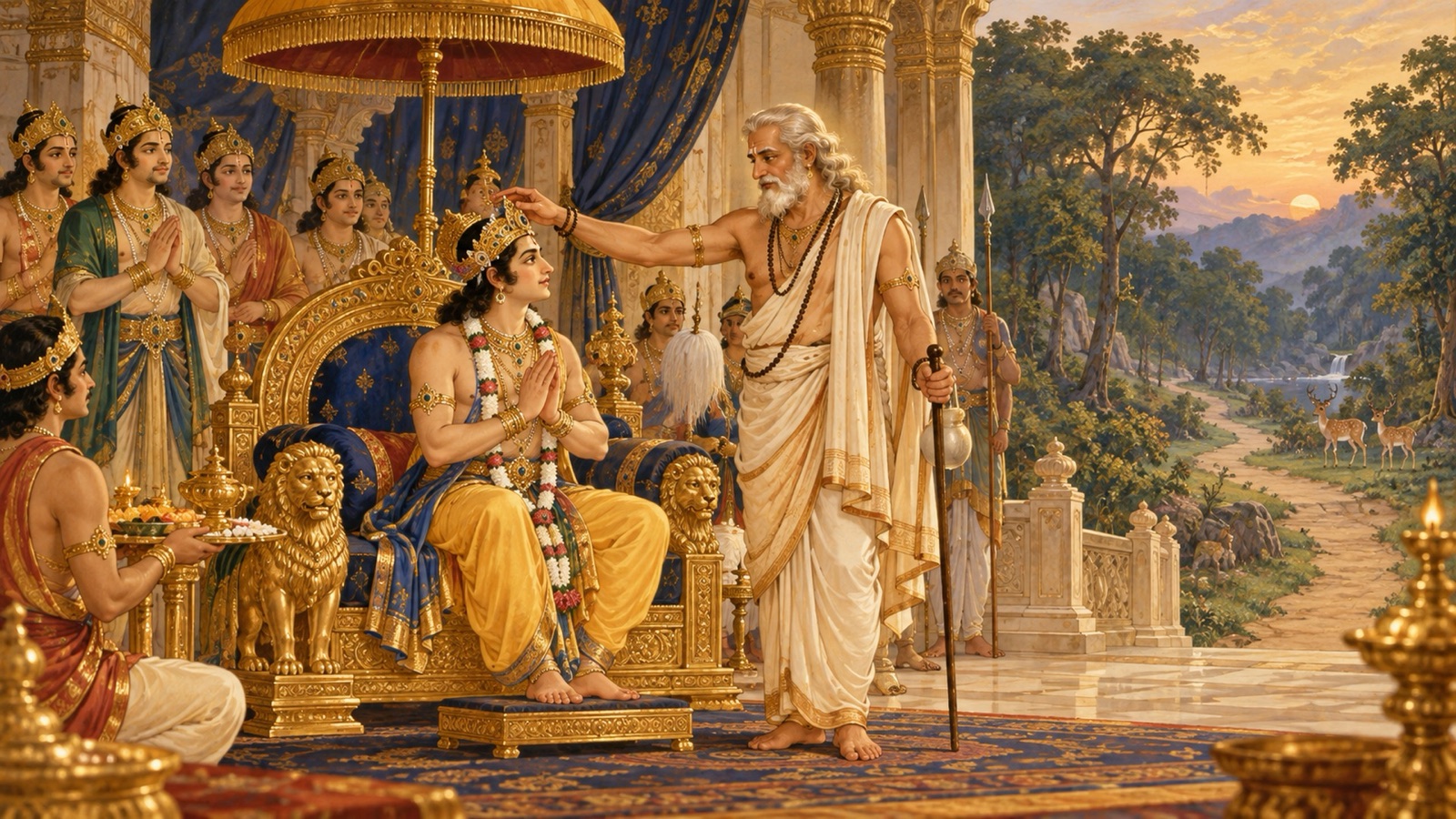
In a single moment he renounced the sense-pleasures he had pursued for so many years, as a bird, once fledged, leaves its nest.
Yayati Attains the Supreme
In the forest, casting off all attachment and dissociating himself from the subtle body through Self-realization, the celebrated Yayati attained absorption into the supreme, taintless Brahman known as Vasudeva — a state obtainable only through devotion to the Lord.
स तत्र निर्मुक्तसमस्तसङ्ग आत्मानुभूत्या विधुतत्रिलिङ्ग: । परेऽमले ब्रह्मणि वासुदेवे लेभे गतिं भागवतीं प्रतीत: ॥ २५ ॥
sa tatra nirmukta-samasta-saṅga ātmānubhūtyā vidhuta-triliṅgaḥ pare ’male brahmaṇi vāsudeve lebhe gatiṁ bhāgavatīṁ pratītaḥ
Meaning: There, freed of all attachment and, through Self-realization, released from the subtle body, Yayati attained the devotional goal — absorption into the supreme, taintless Brahman known as Vasudeva. (Canto 9, Chapter 19, verse 25)
The Liberation of Devayani
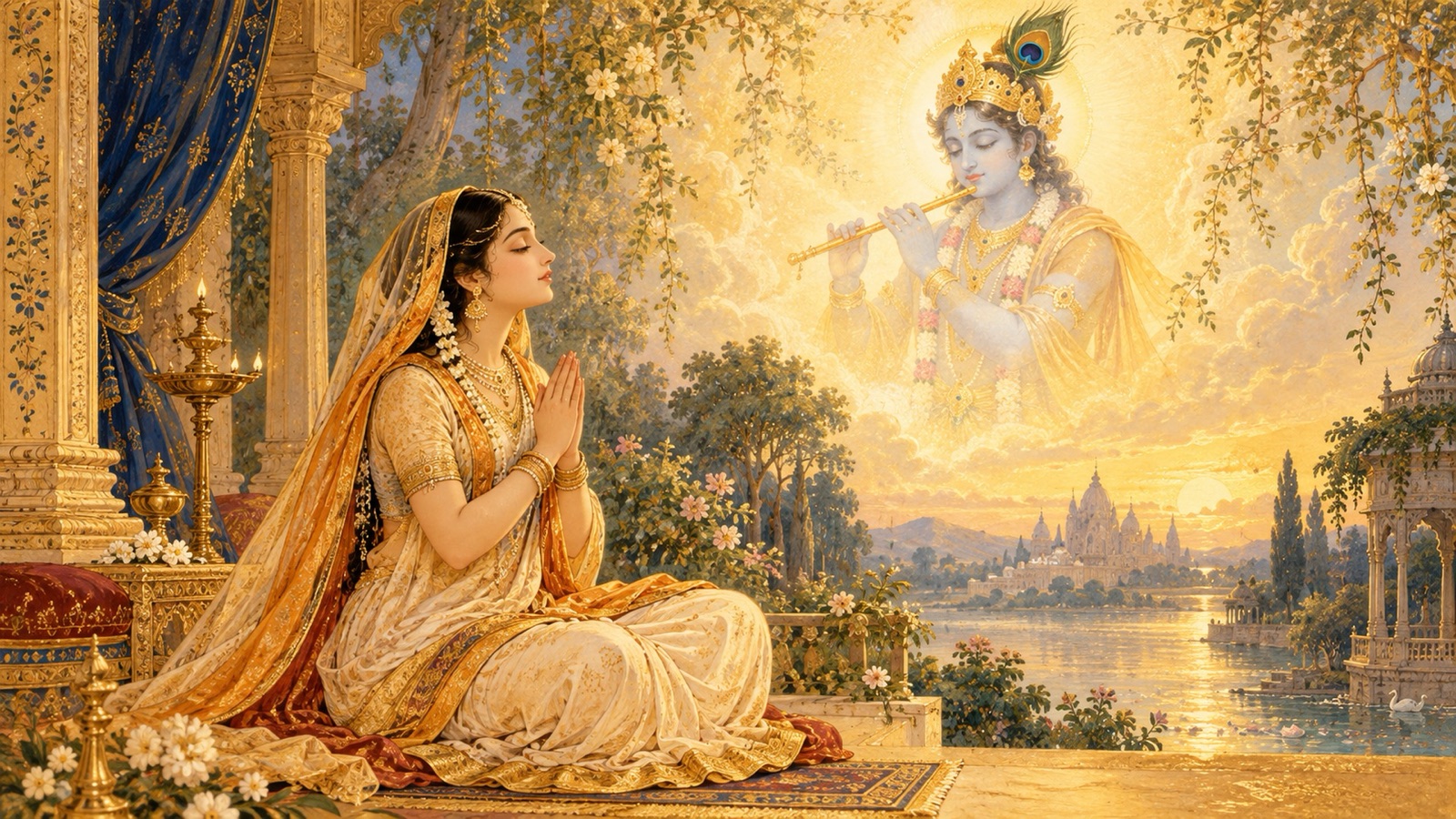
Hearing the parable, Devayani at first took it as a taunt, then as a loving jest; but reflecting on it, she realized that the gathering of dear ones is like the meeting of travellers at a wayside water-station — brought together by the Lord’s will and soon to part. Renouncing all attachment as a dream and fixing her mind on Sri Krishna, she too cast off her subtle body and attained liberation.
सा सन्निवासं सुहृदां प्रपायामिव गच्छताम् । विज्ञायेश्वरतन्त्राणां मायाविरचितं प्रभो: ॥ २७ ॥ सर्वत्र सङ्गमुत्सृज्य स्वप्नौपम्येन भार्गवी । कृष्णे मन: समावेश्य व्यधुनोल्लिङ्गमात्मन: ॥ २८ ॥
sā sannivāsaṁ suhṛdāṁ prapāyām iva gacchatām vijñāyeśvara-tantrāṇāṁ māyā-viracitaṁ prabhoḥ sarvatra saṅgam utsṛjya svapnaupamyena bhārgavī kṛṣṇe manaḥ samāveśya vyadhunol liṅgam ātmanaḥ
Meaning: Realizing that the company of loved ones, all subject to the Lord, is like the gathering of travellers at a wayside water-station, arranged by the Lord’s Maya, Devayani gave up all attachment as a dream, fixed her mind on Sri Krishna, and cast off her subtle body. (Canto 9, Chapter 19, verses 27-28)
Principal Teachings of This Chapter
1. Desire cannot be exhausted by indulgence. Yayati’s own thousand years of enjoyment prove that feeding a craving only strengthens it, as ghee strengthens fire. The way to peace is not more, but enough (verses 13-14).
2. We are all, at times, the goat in the parable. Yayati sees himself in the goat forever chasing and never satisfied — a mirror the chapter holds up to every soul entangled in the pursuit of pleasure (verses 2-12).
3. Renunciation is a joyful release, not a loss. Yayati gives up his pleasures in a single moment, “as a bird leaves its nest when fledged.” True renunciation is the lightness of one at last set free (verse 24).
4. Liberation comes through devotion. Yayati attains Vasudeva not by mere renunciation but by Self-realization rooted in devotion; the goal, the chapter says, is obtainable only through devotion to the Lord (verse 25).
5. All our bonds are the Lord’s brief gathering. Devayani’s insight — that loved ones meet like travellers at a water-station and soon part — frees her to fix her mind on Krishna. To hold our relationships lightly, as the Lord’s gift, is the beginning of freedom (verses 27-28).
A Devotional Reflection
Few passages in all of scripture speak so directly to our own age as Yayati’s confession. Here is a man who had everything — a kingdom, devoted wives, and even the borrowed youth to enjoy them for a thousand years — and who discovers, at the end of it all, that he is exactly as hungry as when he began. His words about desire blazing higher like fire fed with ghee are among the most quoted in the Bhagavatam, because they name a truth we all half-know and half-forget: that the next pleasure will no more satisfy us than the last. But Yayati’s story does not end in despair; it ends in freedom. The moment he stops feeding the fire, it goes out. He returns the youth he had clung to, sets down his crown, and walks into the forest as lightly as a fledged bird leaves its nest — and there, through Self-realization rooted in devotion, he is absorbed into the Lord. And his wife Devayani, hearing the same hard truth, awakens too, seeing all her dearest bonds as a brief meeting of travellers on the road, and fixes her heart on Krishna. The Bhagavatam offers us their example not as a rebuke but as a door: that the restlessness we can never satisfy by getting more can be dissolved, in a single clear moment, by turning to the Lord.
A Daily Devotional Practice
Today, take one honest look at a craving that never seems to be satisfied — for possessions, praise, comfort or pleasure — and, like Yayati, name it truthfully to yourself: that feeding it has only made it stronger. Then, for this one day, practise “enough”: deliberately decline one indulgence you would normally reach for, and offer the small hunger it leaves to the Lord, repeating gently, “Om Namo Bhagavate Vasudevaya.” Call to mind Devayani’s insight that all our dear ones are travellers met briefly on the road, and hold your relationships and possessions a little more lightly, as gifts of God soon to be returned. Let this single day of turning from craving toward the Lord be your practice, and taste, even for a moment, the freedom that Yayati found.
Conclusion
The nineteenth chapter of Book Nine brings the story of King Yayati to its luminous close. After a thousand years of sense-enjoyment that left him as unsated as ever, Yayati awakens through the parable of the goat, speaks the timeless truth that desire is never quenched but only fed by indulgence, and resolves to fix his mind on the Absolute. Returning his son’s youth and setting down his crown, he retires to the forest and, through Self-realization rooted in devotion, attains absorption into the supreme Lord Vasudeva; and Devayani, awakening to the dreamlike nature of all worldly ties, fixes her mind on Sri Krishna and attains liberation with him. The chapter leaves us with one of the Bhagavatam’s clearest and most compassionate teachings — that the peace we seek endlessly in the objects of desire is found, at last and only, in surrender to the Lord.
May the divine wisdom of Srimad Bhagavatam awaken pure devotion within our hearts.
Om Namo Bhagavate Vasudevaya.
Jay Shree Madhav.
References and Attribution
- Primary edition: Gita Press, Śrīmad Bhāgavata Mahāpurāṇa (English, complete), Book Nine, Discourse 19, pages 78–82.
- Series: Srimad Bhagavatam Wisdom · Biswa Sanatan Dharma Seva Trust.
- Presented following the spiritual guidance and recommendation of Pandit Dr. Shri Kashinath Mishra.
This is an original, faithful retelling in the writer’s own words, with brief quoted verses shown in Devanāgarī and transliteration and their meanings given as summaries. It is not a reproduction of any single publisher’s continuous translation or commentary. No affiliation with or endorsement by any publisher is implied.
Jay Shree Madhav