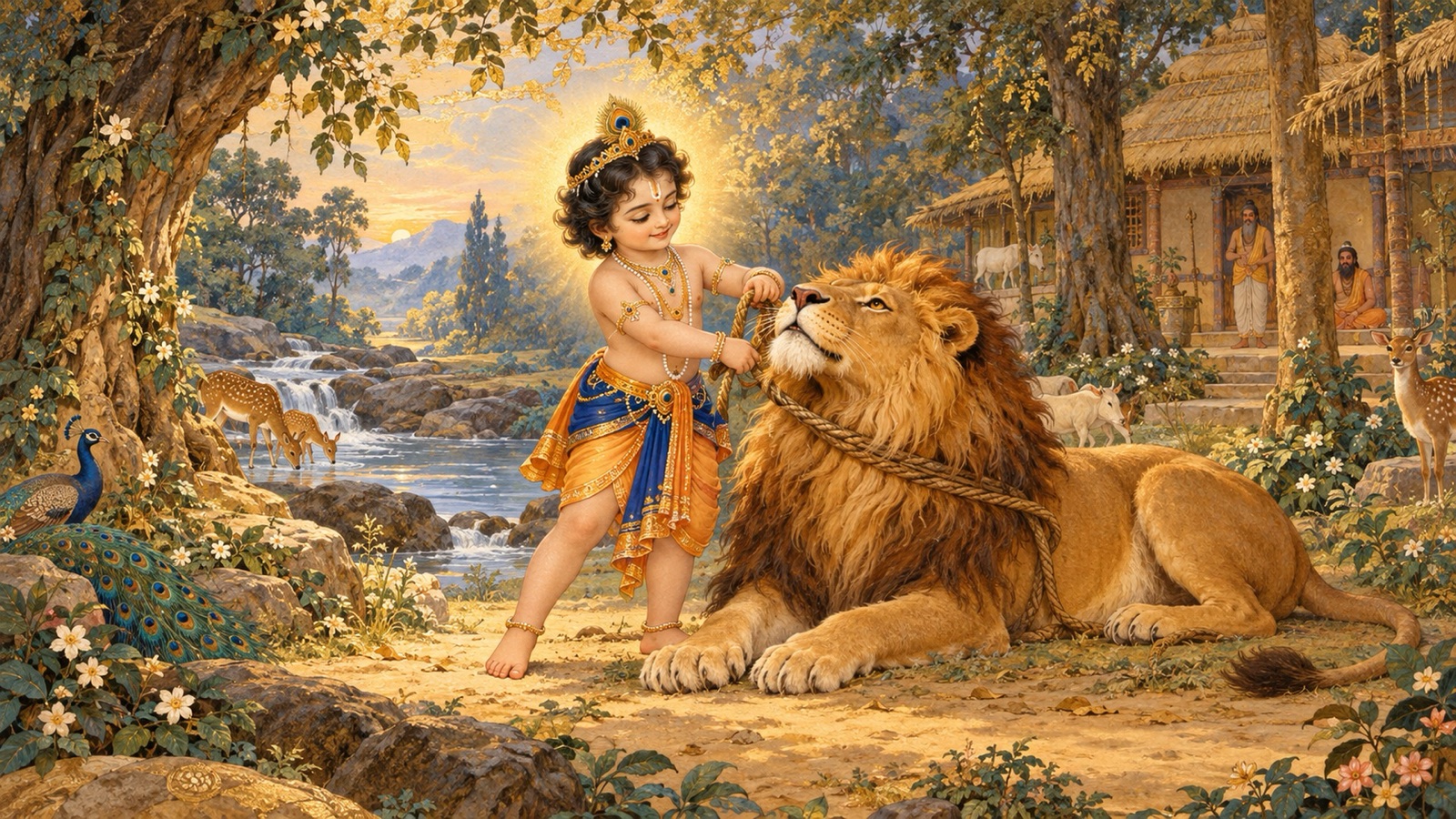
Born with a ray of Sri Hari, the child Bharata plays fearlessly in the forest, binding lions with his own strength — the boy after whom this very land, Bharata-varsha, is named.
Om Namo Bhagavate Vasudevaya.
Om Namo Bhagavate Vasudevaya.
Om Namo Bhagavate Vasudevaya.
Welcome to Srimad Bhagavatam Wisdom, a devotional journey through the sacred histories and teachings of the Srimad Bhagavat Mahapurana. This twentieth chapter of Book Nine traces the line of Puru, the youngest and worthiest son of Yayati — the very line in which King Parikshit himself was born. Sukadeva walks Parikshit through the generations descending from Puru until he reaches King Dushmanta, whose forest encounter with the sage-maiden Shakuntala gave the world their son — a child marked by a ray of Sri Hari, after whom this very land has carried its name ever since. The sage then unfolds this son’s reign as an emperor without equal, crowned with countless sacrifices and unrivalled conquests, before showing him, at the summit of his power, waking to the emptiness of sovereignty itself; the tale closes as the Maruts entrust the sage Bharadwaja to him so his line continues unbroken. It is a chapter about lineage and destiny, the truth that a son belongs to his father, the unmatched glory of Bharata, and the wisdom of withdrawing from even the greatest power.
Chapter Information
- Scripture: Śrīmad Bhāgavata Mahāpurāṇa
- Canto: 9 (Book Nine)
- Chapter: 20 (Discourse 20)
- Chapter title: The Dynasty of Puru
- Principal speaker: Sukadeva Gosvami, narrating to King Parikshit — the whole related by Suta Gosvami to the sage Saunaka and the assembly of sages at Naimisaranya
- Principal listener: King Parikshit
- Main setting: The line of Puru in the lunar dynasty; the hermitage of the sage Kanva; the kingdom of Emperor Bharata
- Central subject: The genealogy of Puru, the union of Dushmanta and Shakuntala, the birth and glory of Emperor Bharata, and the coming of the sage Bharadwaja
- Principal verse range: Canto 9, Chapter 20, verses 1–39
- Primary edition: Gita Press Śrīmad Bhāgavata Mahāpurāṇa
The Line of Puru
Sukadeva began the detailed account of the line of Puru, in which Parikshit himself was born and in which many royal sages and brahmanas appeared. From Puru came Janamejaya, then Pracinvan, Pravira, Manusyu, Charupada, Sudyu, Bahugava, Samyati, Ahamyati, and Raudraswa. Raudraswa had ten sons through the celestial nymph Ghritachi; from the eldest, Rteyu, came Rantibhara, and from his line Apratiratha, whose son was Kanva. Another branch, through Sumati and Raibhya, led to Dushmanta.
Dushmanta Meets Shakuntala
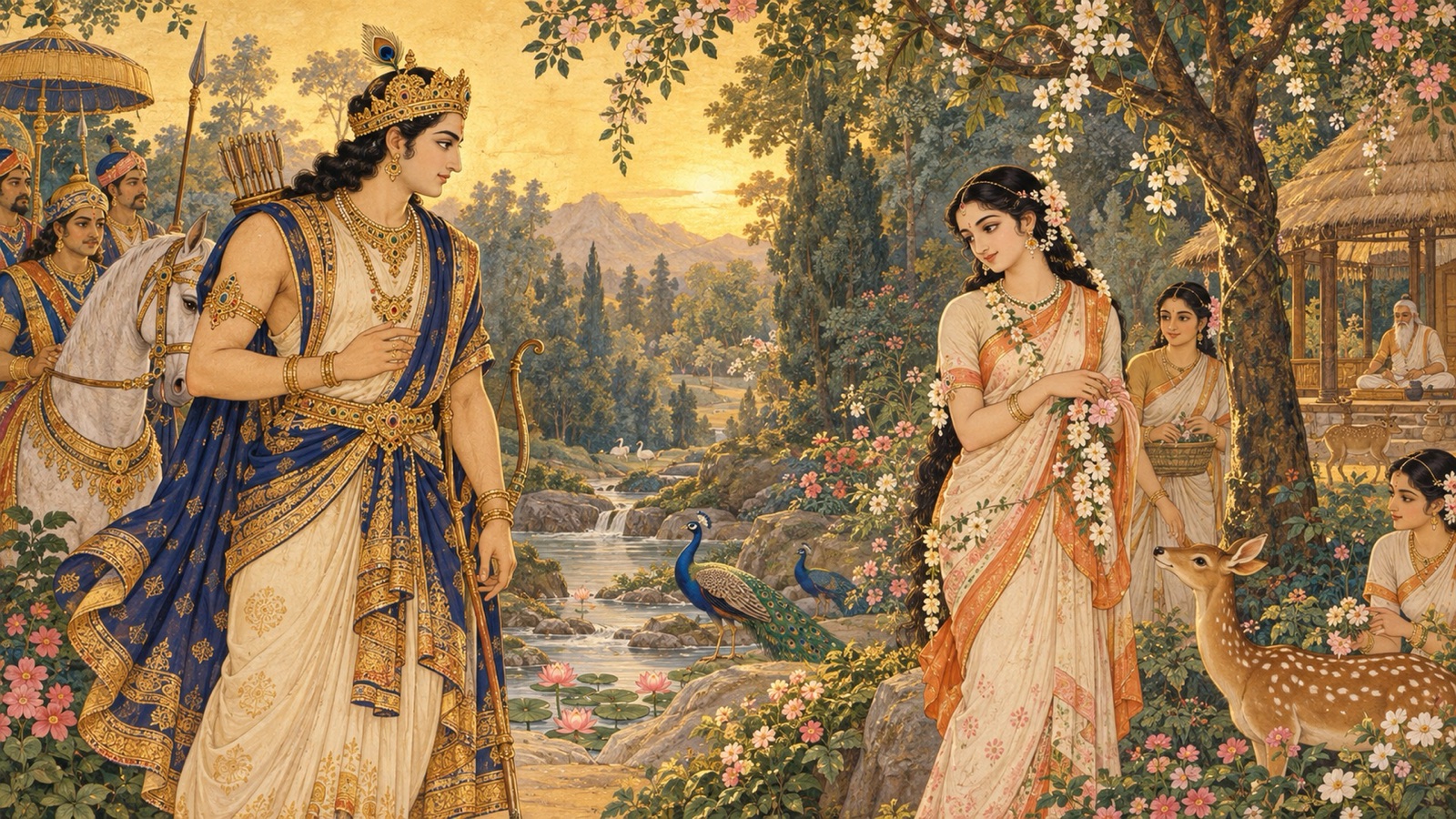
Hunting one day, King Dushmanta came to the hermitage of the sage Kanva and beheld there a maiden of surpassing beauty, radiant as the Goddess of Fortune, illuminating the hermitage with her effulgence. Falling at once in love, he asked who she was; and she answered that she was the daughter of Vishwamitra, abandoned in the forest by Menaka and raised by the sage Kanva.
श्रीशकुन्तलोवाच विश्वामित्रात्मजैवाहं त्यक्ता मेनकया वने । वेदैतद् भगवान् कण्वो वीर किं करवाम ते ॥ १३ ॥
śrī-śakuntalovāca viśvāmitrātmajaivāhaṁ tyaktā menakayā vane vedaitad bhagavān kaṇvo vīra kiṁ karavāma te
Meaning: Shakuntala said: I am the daughter of Vishwamitra, abandoned by Menaka in the forest; the worshipful sage Kanva knows this. What, O hero, may we do for you? (Canto 9, Chapter 20, verse 13)
Knowing the code of righteousness, and with Shakuntala’s tacit consent, Dushmanta married her by the Gandharva rite, and in time she bore a son.
The Birth of Bharata
The sage Kanva performed the birth-rites of the prince in the forest; and even as an infant the boy would play by binding lions with his own superior strength.
कण्व: कुमारस्य वने चक्रे समुचिता: क्रिया: । बद्ध्वा मृगेन्द्रंतरसा क्रीडति स्म स बालक: ॥ १८ ॥
kaṇvaḥ kumārasya vane cakre samucitāḥ kriyāḥ baddhvā mṛgendraṁ tarasā krīḍati sma sa bālakaḥ
Meaning: The sage Kanva performed the appropriate rites for the prince in the forest; and the child would play by binding lions with his own strength. (Canto 9, Chapter 20, verse 18)
The Ethereal Voice
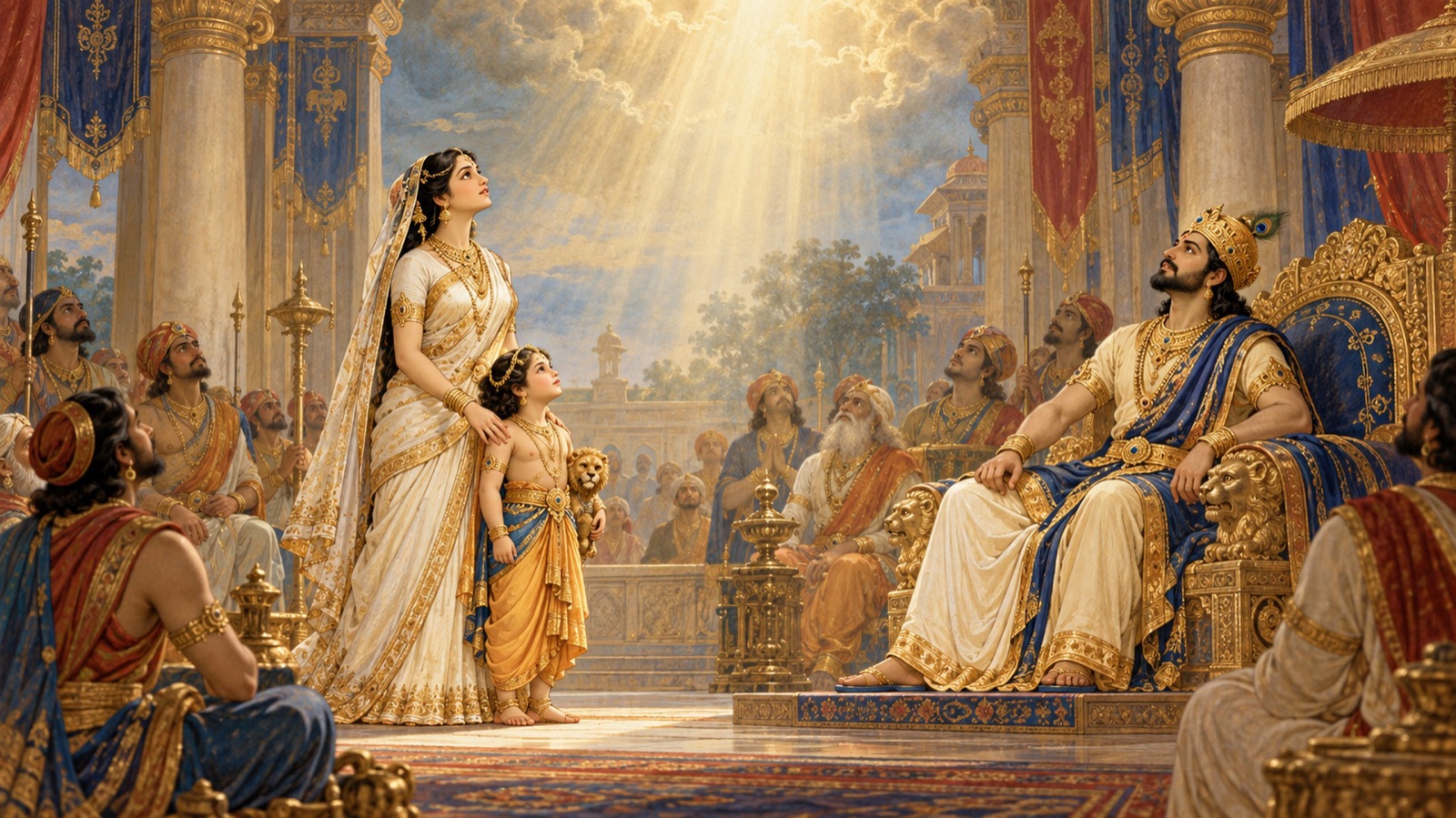
When Shakuntala brought the boy — born with a minute ray of Sri Hari — to Dushmanta, the king at first did not accept her or the child, both irreproachable though they were. Then an ethereal voice spoke from the heavens, that all beings might hear.
माता भस्त्रा पितु: पुत्रो येन जात: स एव स: । भरस्व पुत्रं दुष्मन्त मावमंस्था: शकुन्तलाम् ॥ २१ ॥
mātā bhastrā pituḥ putro yena jātaḥ sa eva saḥ bharasva putraṁ duṣmanta māvamaṁsthāḥ śakuntalām
Meaning: The mother is but a vessel; the son belongs to the father, and is verily the same as the father from whom he was born. Maintain your son, O Dushmanta, and do not spurn Shakuntala. (Canto 9, Chapter 20, verse 21)
Because the voice commanded him to “maintain” (bhara) the child, the boy was named Bharata. Accepting the ethereal command, Dushmanta received his son and honoured Shakuntala.
The Glory of Emperor Bharata
After his father’s death, Bharata became a universal monarch of great renown, bearing the mark of a discus on his right palm and a lotus-bud on the soles of his feet. Consecrated by a grand royal bath, he performed fifty-five horse sacrifices along the Ganga and seventy-eight along the Yamuna, with the sage Dirghatama as his priest, gifting immense wealth.
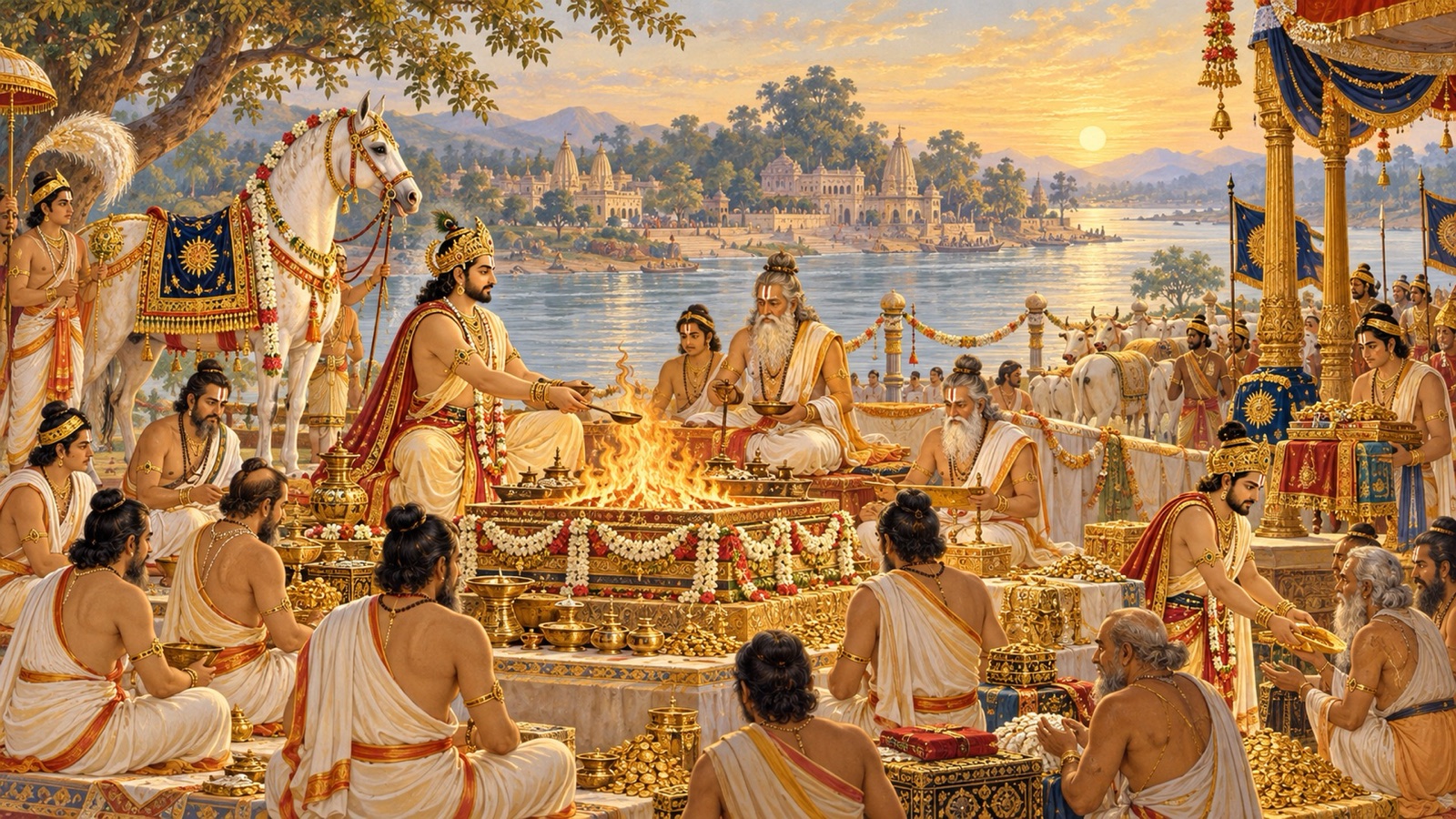
All told, Bharata offered these sacrifices one hundred and thirty-three times over, a feat so staggering that every king who heard of it stood amazed — and through it he rose beyond the Lord’s Maya to reach the divine presence of Sri Hari Himself.
त्रयस्त्रिंशच्छतं ह्यश्वान्बद्ध्वा विस्मापयन् नृपान् । दौष्मन्तिरत्यगान्मायां देवानां गुरुमाययौ ॥ २७ ॥
trayas-triṁśac-chataṁ hy aśvān baddhvā vismāpayan nṛpān dauṣmantir atyagān māyāṁ devānāṁ gurum āyayau
Meaning: Having performed one hundred and thirty-three horse sacrifices, to the astonishment of all kings, the son of Dushmanta overcame the Lord’s Maya and attained the Lord, the adored of the gods. (Canto 9, Chapter 20, verse 27)
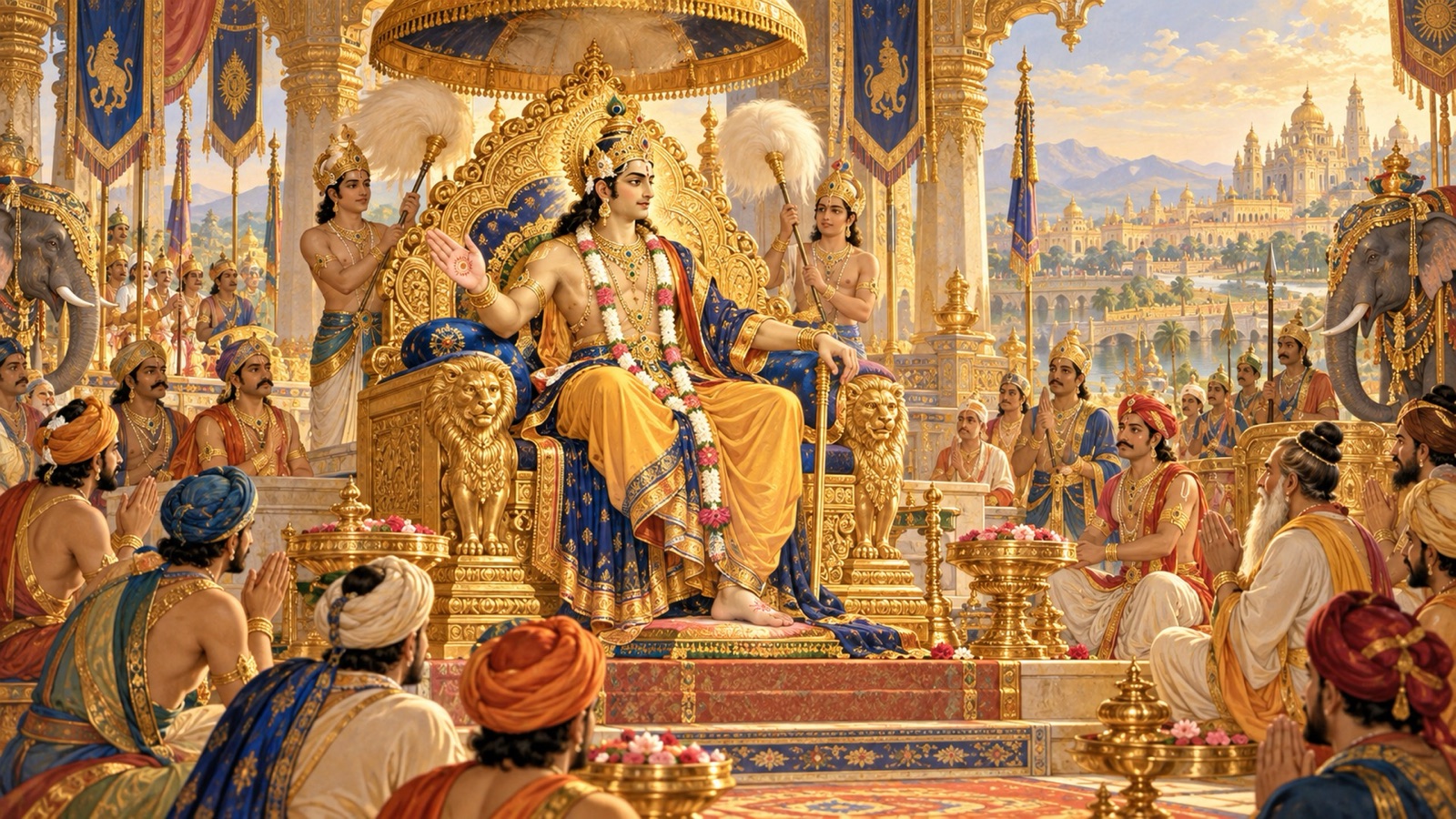
No king before or after, Sukadeva said, could emulate the glory of Bharata, any more than one can touch heaven with one’s hands. He crushed the lawless kings who despised the brahmanas and the Vedas, recovered the wives of the gods carried off by demons to the subterranean regions, and ruled all the quarters for twenty-seven thousand years.
Bharata’s Withdrawal and the Coming of Bharadwaja
Then, at the very height of his reign, something shifted within the great emperor: he saw through the illusion of it all — the throne, the wealth, the untouched command over his domain, even the breath in his own body — and quietly stepped away from the world he had ruled.
स संराड्लोकपालाख्यमैश्वर्यमधिराट् श्रियम् । चक्रं चास्खलितं प्राणान् मृषेत्युपरराम ह ॥ ३३ ॥
sa saṁrāḍ loka-pālākhyam aiśvaryam adhirāṭ śriyam cakraṁ cāskhalitaṁ prāṇān mṛṣety upararāma ha
Meaning: Realizing that his sovereignty, famed even among the guardians of the worlds, his imperial fortune, his unobstructed authority, and his very life were unreal, the great emperor withdrew from the world. (Canto 9, Chapter 20, verse 33)
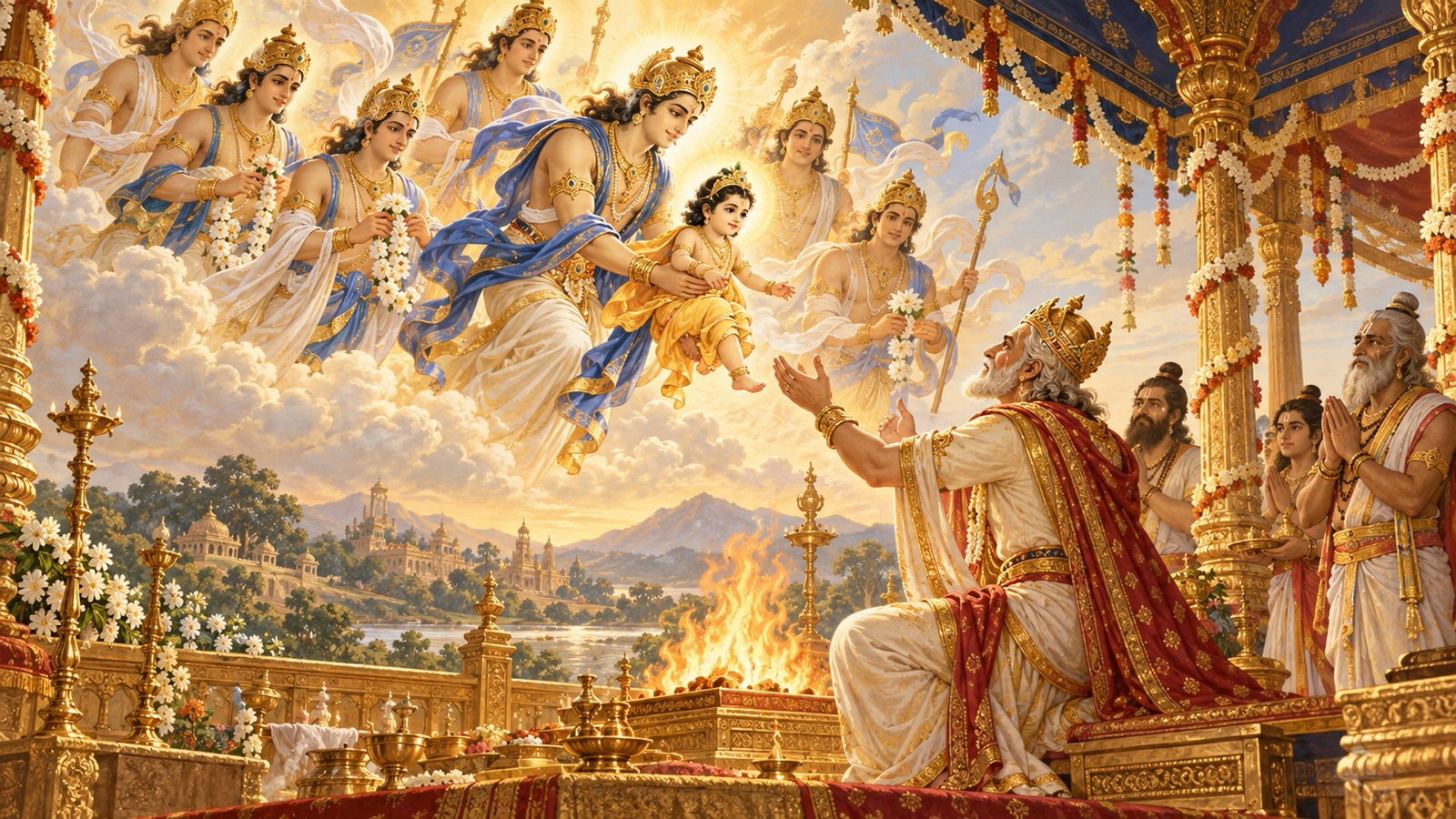
Bharata’s three wives, daughters of the king of Vidarbha, had destroyed their own sons for fear of being forsaken by their husband, who remarked that the sons did not resemble him; so his line was threatened with extinction. As Bharata propitiated the wind-gods through a sacrifice, the Maruts gave him a son, Bharadwaja — a child born of Brihaspati and Mamata and abandoned by both, whom the Maruts had raised and now handed to Bharata to continue his line.
तस्यैवं वितथे वंशे तदर्थं यजत: सुतम् । मरुत्स्तोमेन मरुतो भरद्वाजमुपाददु: ॥ ३५ ॥
tasyaivaṁ vitathe vaṁśe tad-arthaṁ yajataḥ sutam marut-stomena maruto bharadvājam upādaduḥ
Meaning: When Bharata’s line was thus threatened with extinction, the Maruts, propitiated by him through the Marut-stoma sacrifice, gave him a son — Bharadwaja. (Canto 9, Chapter 20, verse 35)
Principal Teachings of This Chapter
1. Every soul is born into a stream far larger than itself. Puru’s line, in which Parikshit himself was born, stretches across countless generations. We are each a link in a lineage the Lord has ordained, and our lives carry forward a story begun long before us (verses 1-7).
2. The Lord upholds truth even through unseen voices. When Dushmanta hesitates, it is an ethereal voice from heaven that vindicates Shakuntala and the child. Truth, the chapter shows, has heaven itself as its witness (verses 20-22).
3. Greatness devoted to the Lord attains the Lord. Bharata’s unmatched sacrifices are not for empty glory; through them he overcomes Maya and attains Sri Hari. Power and wealth, offered to God, become a path to Him (verse 27).
4. Even the greatest empire is finally seen to be unreal. Bharata, master of the whole earth for twenty-seven thousand years, at last recognizes his sovereignty and his very life as unreal and withdraws. The wise hold even the highest fortune lightly (verse 33).
5. The Lord preserves what serves His purpose. When Bharata’s line is threatened, the Maruts provide Bharadwaja to continue it. What is needed for the unfolding of the Lord’s plan is never truly lost (verses 34-39).
A Devotional Reflection
This chapter carries a special weight for every soul born in this land, for it tells of the emperor whose name we still bear — Bharata, the child who played with lions and grew to be a monarch so great that no king before or after could touch his glory. And yet the Bhagavatam does not let us rest in that glory. Having given us Bharata’s discus-marked palm, his hundred and thirty-three sacrifices, his conquest of the quarters and his twenty-seven-thousand-year reign, it turns, in a single quiet verse, to show him setting it all aside — recognizing his sovereignty, his fortune, and even his own life as unreal, and withdrawing from the world. Here is the deepest lesson of the whole dynasty: that the very greatest of men, at the height of the very greatest of empires, found his fulfilment not in holding on but in letting go. Bharata’s true victory was not his conquest of the earth but his conquest of Maya and his attainment of Sri Hari. The land that bears his name is invited, through his example, to seek not merely greatness but the wisdom that sees through greatness to the Lord who alone is real. And in the ethereal voice that vindicated a faithful wife and a rightful son, we are reminded that truth is never finally abandoned, for heaven itself stands as its witness.
A Daily Devotional Practice
Today, in the spirit of Emperor Bharata, offer your own strength and accomplishment to the Lord rather than to your own glory. Whatever you achieve today — a task completed, a duty fulfilled, a success won — dedicate it inwardly to God, repeating gently, “Om Namo Bhagavate Vasudevaya,” as Bharata offered his sacrifices and thereby attained the Lord. And practise, in some small way, Bharata’s final wisdom: hold one thing you are proud of a little more lightly today, remembering that all sovereignty and fortune are, in the end, unreal, and that the only lasting attainment is the Lord Himself. Let your work be worship and your success be surrender, and you will walk, in your own measure, the path of the great emperor whose name this land still carries.
Conclusion
The twentieth chapter of Book Nine traces the line of Puru — the lineage of King Parikshit himself — down to Dushmanta, and gives the beloved story of Dushmanta and Shakuntala and the birth of their son Bharata, born with a ray of Sri Hari and giving his name to this very land. It tells of Bharata’s unmatched glory as a universal monarch, of the hundred and thirty-three sacrifices through which he overcame Maya and attained the Lord, and of his final withdrawal on realizing that all his sovereignty was unreal; and it closes with the Maruts’ gift of the sage Bharadwaja to continue his line. Through it all shines the Bhagavatam’s abiding teaching — that greatness offered to the Lord becomes a path to Him, and that the truest victory of even the mightiest king is to see through the world to the one Reality and surrender to Him.
May the divine wisdom of Srimad Bhagavatam awaken pure devotion within our hearts.
Om Namo Bhagavate Vasudevaya.
Jay Shree Madhav.
References and Attribution
- Primary edition: Gita Press, Śrīmad Bhāgavata Mahāpurāṇa (English, complete), Book Nine, Discourse 20, pages 82–88.
- Series: Srimad Bhagavatam Wisdom · Biswa Sanatan Dharma Seva Trust.
- Presented following the spiritual guidance and recommendation of Pandit Dr. Shri Kashinath Mishra.
This is an original, faithful retelling in the writer’s own words, with brief quoted verses shown in Devanāgarī and transliteration and their meanings given as summaries. It is not a reproduction of any single publisher’s continuous translation or commentary. No affiliation with or endorsement by any publisher is implied.
Jay Shree Madhav