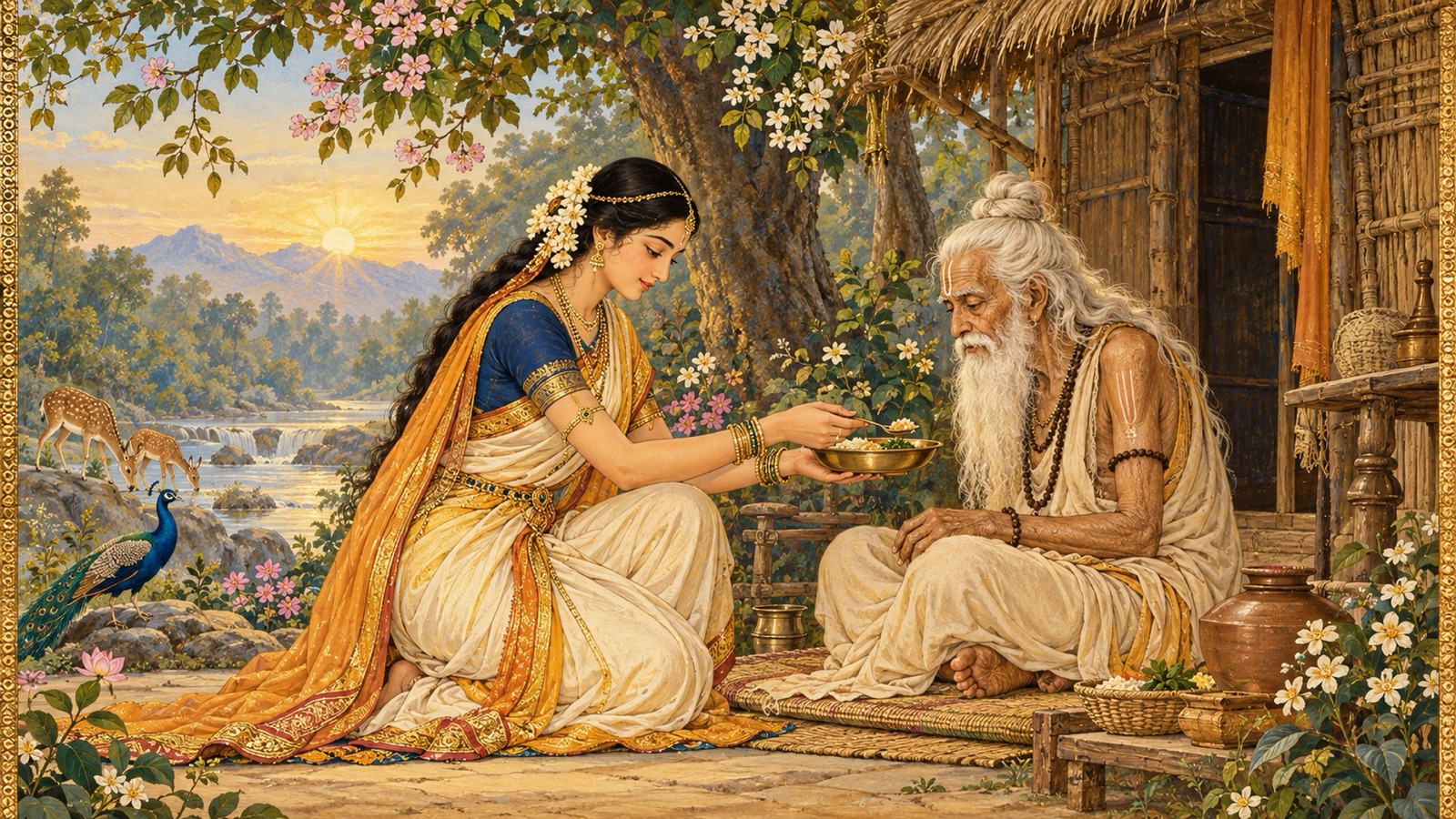
In a quiet forest hermitage, the young princess Sukanya tends the aged and easily-angered sage Cyavana with patient, loving service — a devotion so pure that it will move even the physicians of heaven.
Om Namo Bhagavate Vasudevaya.
Om Namo Bhagavate Vasudevaya.
Om Namo Bhagavate Vasudevaya.
Welcome to Srimad Bhagavatam Wisdom, a devotional journey through the sacred histories and teachings of the Srimad Bhagavat Mahapurana. Turning from the many-branched lines of Manu’s sons, Sukadeva now turns to another of them — Saryati — tracing his line through the beloved story of Sukanya and the sage Cyavana down to King Kakudmi’s astonishing audience with Lord Brahma.
Chapter Information
- Scripture: Śrīmad Bhāgavata Mahāpurāṇa
- Canto: 9 (Book Nine)
- Chapter: 3 (Discourse 3)
- Chapter title: Cyavana, Sukanya and the Line of Saryati
- Principal speaker: Sukadeva Gosvami, narrating to King Parikshit — the whole related by Suta Gosvami to the sage Saunaka and the assembly of sages at Naimisaranya
- Principal listener: King Parikshit
- Main setting: The forest hermitage of the sage Cyavana; later the court of King Saryati and the world of Brahma
- Central subject: The marriage of Sukanya to the sage Cyavana and his restoration to youth; the fidelity of Sukanya; and the posterity of Saryati down to Kakudmi and Revati, given in marriage to Lord Balarama
- Principal verse range: Canto 9, Chapter 3, verses 1–36
- Primary edition: Gita Press Śrīmad Bhāgavata Mahāpurāṇa
King Saryati and the Hermitage of Cyavana
Another son of Vaivaswata Manu was King Saryati, a master of the highest truth taught in the Vedas, who authoritatively guided the ritual of the second day at a sacrifice performed by the descendants of the sage Angira. He had a daughter, Sukanya, whose eyes were as lovely as a pair of lotuses. One day, wandering in the forest with her, the king came upon the hermitage of the sage Cyavana, son of Bhrgu.
सुकन्या नाम तस्यासीत् कन्या कमललोचना । तया सार्धं वनगतो ह्यगमच्च्यवनाश्रमम् ॥ २ ॥
sukanyā nāma tasyāsīt kanyā kamala-locanā tayā sārdhaṁ vana-gato hy agamac cyavanāśramam
Meaning: His daughter, named Sukanya, had eyes as beautiful as lotuses. Going to the forest together with her, the king came to the hermitage of Cyavana. (Canto 9, Chapter 3, verse 2)
The Fateful Anthill
While her companions wandered among the trees of the grove, Sukanya noticed within the hollow of an anthill two bright points shining like a pair of fireflies. These were, in truth, the eyes of the sage Cyavana, who had sat so long in motionless meditation that an anthill had grown up and covered his body. Impelled by destiny, the innocent girl, in her childish naivety, pricked the two glowing points with a thorn — and blood flowed out from them.
ते दैवचोदिता बाला ज्योतिषी कण्टकेन वै । अविध्यन्मुग्धभावेन सुस्रावासृक् ततो बहि: ॥ ४ ॥
te daiva-coditā bālā jyotiṣī kaṇṭakena vai avidhyan mugdha-bhāvena susrāvāsṛk tato bahiḥ
Meaning: Impelled by providence, the innocent girl pricked the two glowing points with a thorn out of childish ignorance, and blood flowed out from them. (Canto 9, Chapter 3, verse 4)
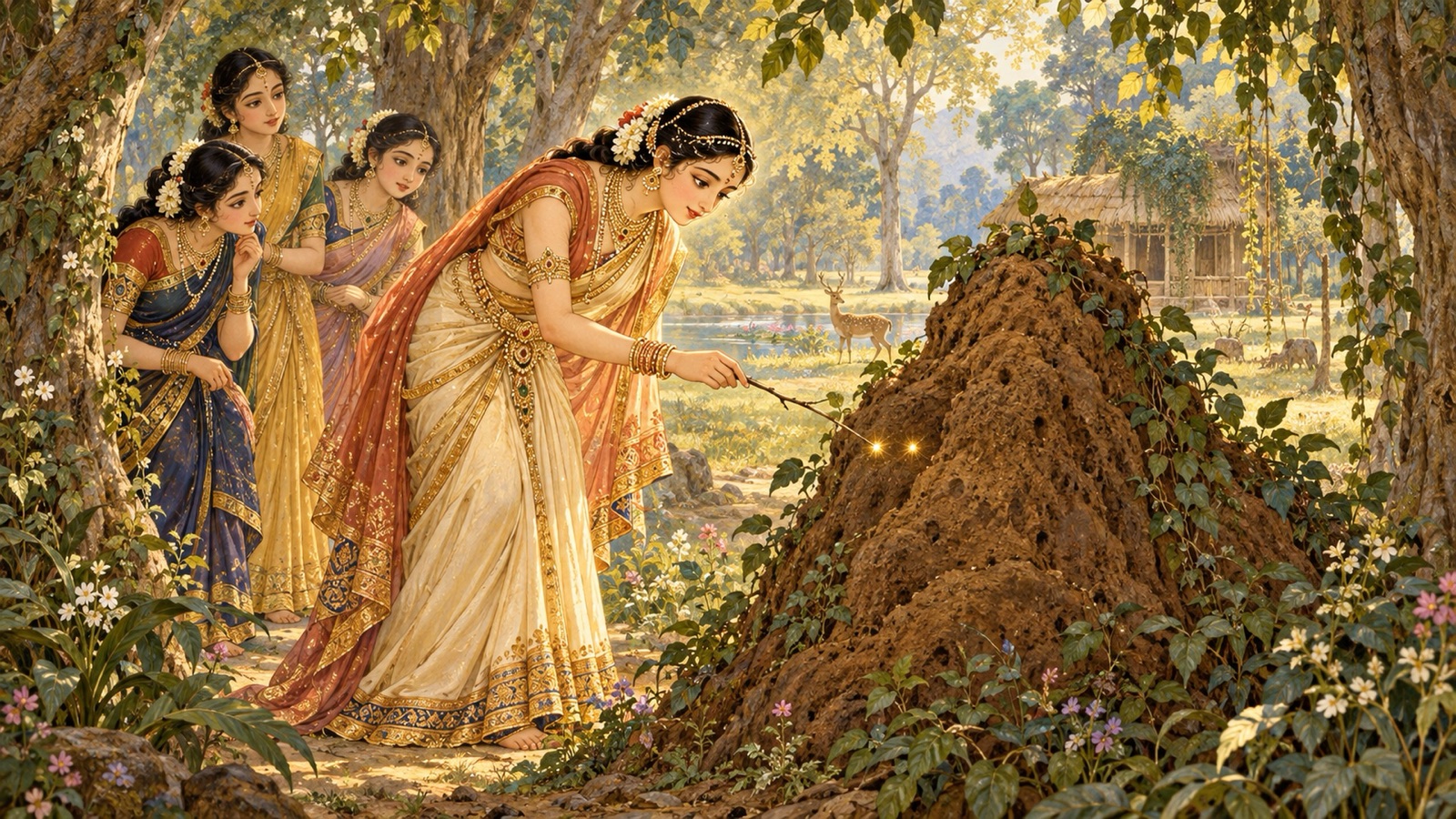
At once a strange affliction fell upon the king’s escort: the passing of stool and urine was blocked among all his men. Astonished, Saryati sensed that some offence had been given to the sage, and asked his people who had disturbed the hermitage. Frightened, Sukanya confessed what she had done in her ignorance. The king then earnestly propitiated the sage buried beneath the anthill, and — perceiving the sage’s wish — gave his daughter to Cyavana in marriage. Freed from the crisis, he took leave and returned to his capital.
A Wife’s Devotion
Now wedded to the exceedingly irascible old sage, Sukanya did not lament her lot. Understanding her husband’s temperament, she pleased him with vigilant, attentive and utterly devoted service.
सुकन्या च्यवनं प्राप्य पतिं परमकोपनम् । प्रीणयामास चित्तज्ञा अप्रमत्तानुवृत्तिभि: ॥ १० ॥
sukanyā cyavanaṁ prāpya patiṁ parama-kopanam prīṇayām āsa citta-jñā apramattānuvṛttibhiḥ
Meaning: Having obtained the exceedingly irritable sage Cyavana as her husband, Sukanya, who understood his mind, pleased him with careful and attentive devoted service. (Canto 9, Chapter 3, verse 10)
The Aswins and the Pool of Youth
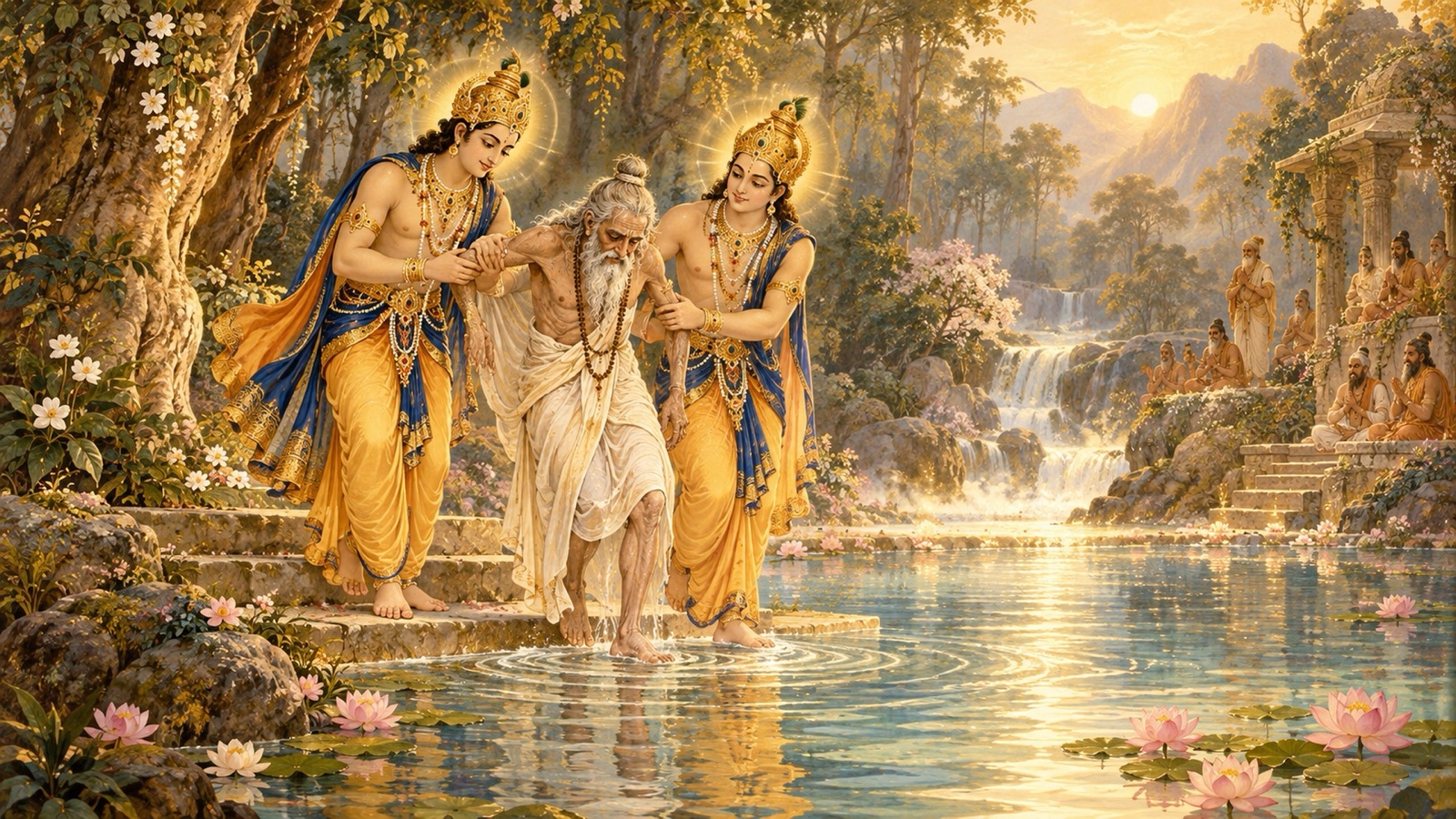
After some time the two Aswinikumaras — the twin physicians of the gods — arrived at the hermitage. Receiving them with respect, Cyavana asked them to bestow youth upon him, promising in return to secure for them a share of the Soma juice in sacrifice, from which they had until then been excluded. Gladly agreeing, the twin gods bade the aged sage plunge into a sacred pool made by the Siddhas.
इत्युक्तो जरया ग्रस्तदेहो धमनिसन्तत: । ह्रदं प्रवेशितोऽश्विभ्यां वलीपलितविग्रह: ॥ १४ ॥
ity ukto jarayā grasta- deho dhamani-santataḥ hradaṁ praveśito ’śvibhyāṁ valī-palita-vigrahaḥ
Meaning: So addressed, Cyavana — his body wasted by old age, covered with protruding veins, wrinkled and grey — was made to enter the pool by the two Aswins. (Canto 9, Chapter 3, verse 14)
Even the highest arts of healing have their limit. The Aswins could restore youth and beauty to Cyavana’s withered body, yet no physician of heaven can free the soul from the deeper old age of ignorance and material bondage. Tucked inside this story of miraculous rejuvenation is a quiet teaching: every skill and science reaches its own kind of perfection, but the highest perfection any soul can reach is loving devotion to the Supreme Lord. Cyavana’s plea for renewed youth, granted almost playfully by the Aswins, points beyond itself to a different order of attainment altogether — not won by ritual or remedy, but received through surrender to the Lord, whose glory scripture exists to reveal (verse 11).
The Test of a Faithful Heart
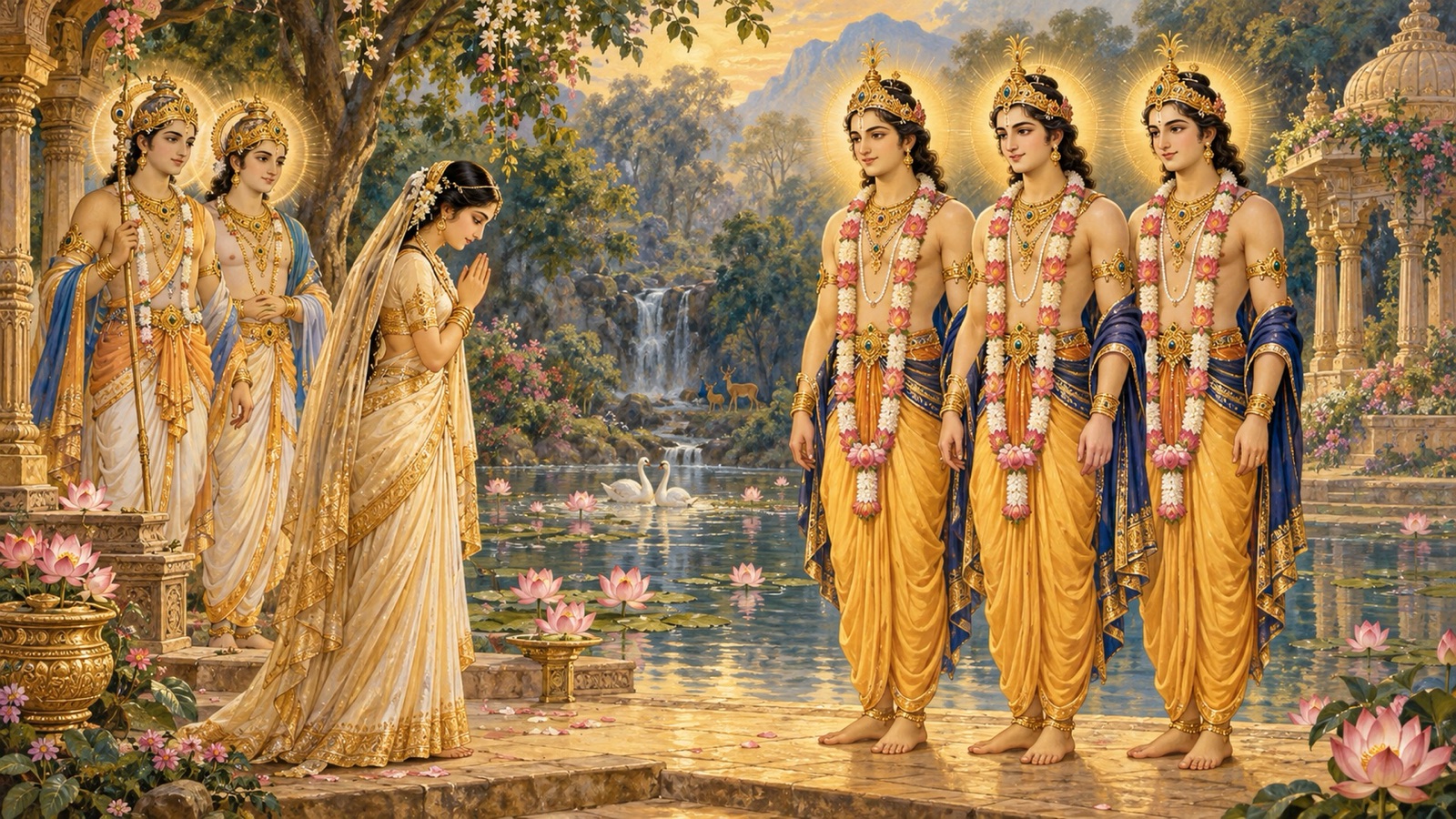
From the pool there emerged three young men of identical form — all beautiful, radiant as the sun, garlanded with lotuses and finely adorned. Unable to tell which one was her own husband, the chaste Sukanya did not choose at random; she took refuge in the two Aswins and prayed to be shown her true lord.
तान् निरीक्ष्य वरारोहा सरूपान् सूर्यवर्चस: । अजानती पतिं साध्वी अश्विनौ शरणं ययौ ॥ १६ ॥
tān nirīkṣya varārohā sarūpān sūrya-varcasaḥ ajānatī patiṁ sādhvī aśvinau śaraṇaṁ yayau
Meaning: Beholding the three of identical form and sun-like radiance, and unable to recognize her husband, the chaste lady took refuge in the two Aswins. (Canto 9, Chapter 3, verse 16)
Pleased with her unwavering fidelity, the two gods revealed her true husband to her, and, taking leave of the sage, returned to heaven in their aerial car. Some time afterward, when King Saryati came again — intending to perform a sacrifice — and saw beside his daughter a youthful man of sun-like splendour, he at first mistook the transformed Cyavana for a stranger and sharply rebuked her, fearing she had betrayed her aged husband. With an innocent smile she told him the whole story, and the astonished, overjoyed king embraced his daughter.
Soma for the Aswins, and the Humbling of Indra
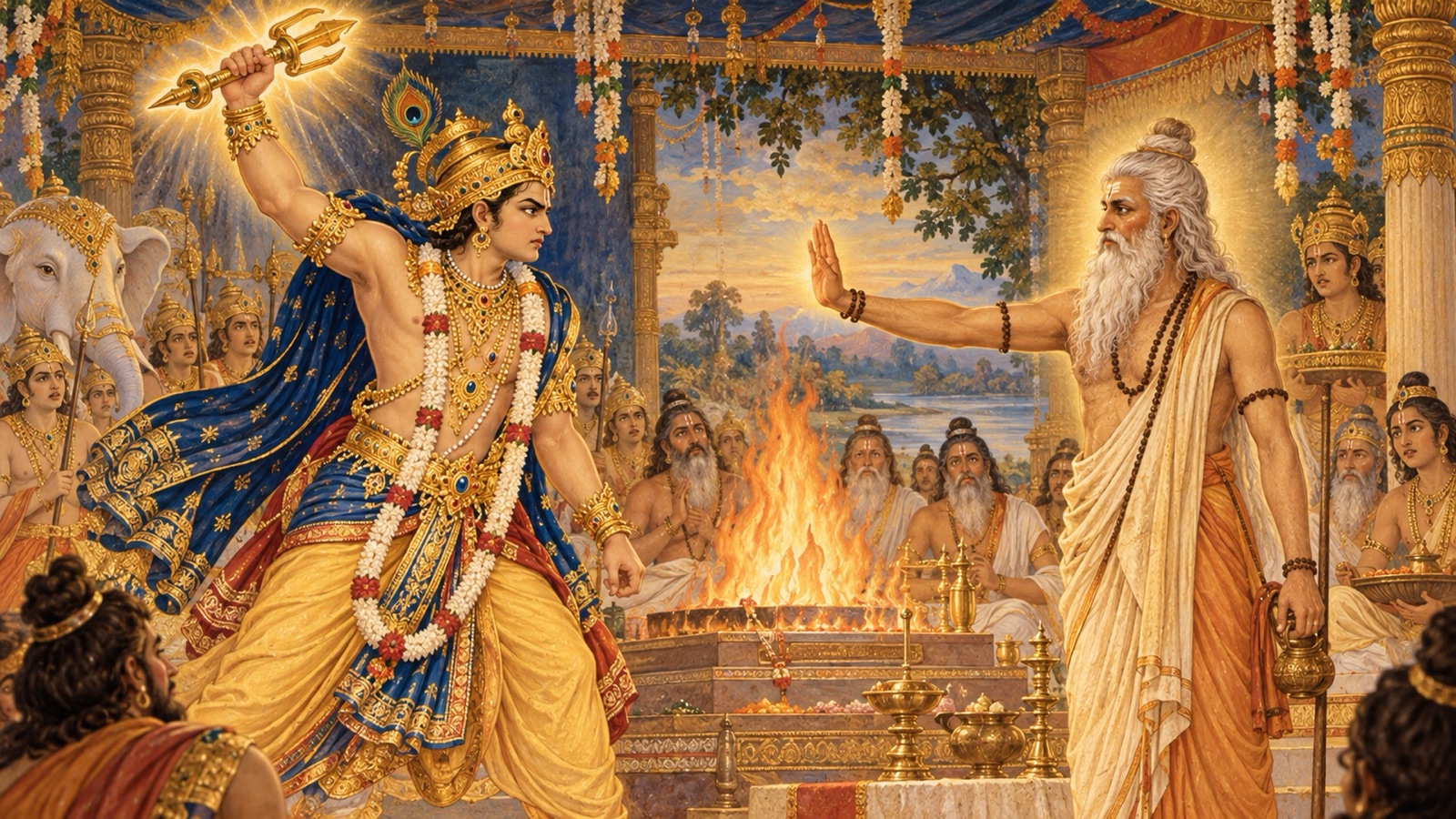
Cyavana then helped the heroic king to worship the Lord through a Soma sacrifice, and by his ascetic power offered a cup of the Soma juice to the two Aswins, even though they had never been permitted such a share. Enraged in an instant, Indra seized his thunderbolt to strike the sage down — but Cyavana, son of Bhrgu, paralyzed Indra’s arm, thunderbolt and all.
हन्तुं तमाददे वज्रं सद्योमन्युरमर्षित: । सवज्रं स्तम्भयामास भुजमिन्द्रस्य भार्गव: ॥ २५ ॥
hantuṁ tam ādade vajraṁ sadyo manyur amarṣitaḥ savajraṁ stambhayām āsa bhujam indrasya bhārgavaḥ
Meaning: Instantly furious and unable to bear it, Indra took up his thunderbolt to slay him; but the son of Bhrgu paralyzed the arm of Indra, thunderbolt and all. (Canto 9, Chapter 3, verse 25)
From that time forward, all consented that the two Aswins — being physicians once barred from the offerings — should receive their cup of Soma.
The Line of Saryati: Kakudmi, Revati and the Flight of Ages
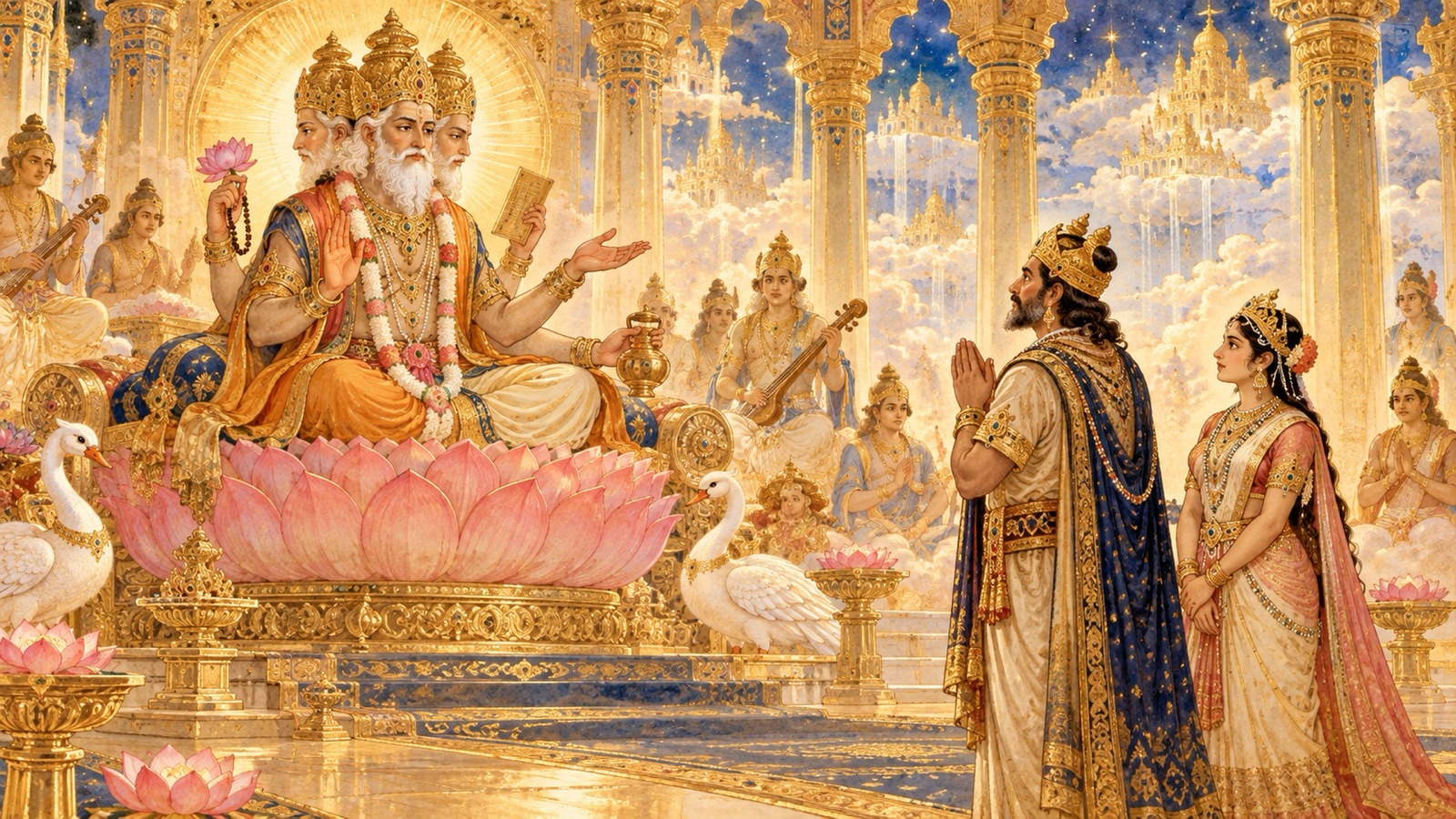
Saryati had three sons — Uttanabarhi, Anarta and Bhurisena. From Anarta came Revata, who built the city of Kusasthali in the heart of the ocean and ruled the land of Anarta and other territories. Revata had a hundred excellent sons, the eldest being Kakudmi. Taking his daughter Revati, Kakudmi journeyed to Brahmaloka, the realm of Brahma, to ask the creator for a worthy husband for her. Because celestial music was in progress, he waited a while; and when at last he made his request, Brahma laughed and told him a humbling truth: everyone Kakudmi might have considered as a match had long since been swept away by Time — even the memory of their descendants was gone.
Twenty-seven cycles of the four ages had passed while he waited. Brahma then pointed him to the age into which he now returned, where the Supreme Lord had descended to relieve the earth’s burden along with His mighty part-manifestation, Balarama.
तद् गच्छ देवदेवांशो बलदेवो महाबल: । कन्यारत्नमिदं राजन् नररत्नाय देहि भो: ॥ ३३ ॥
tad gaccha deva-devāṁśo baladevo mahā-balaḥ kanyā-ratnam idaṁ rājan nara-ratnāya dehi bhoḥ
Meaning: “Therefore go: there is the mighty Baladeva, a part-manifestation of the God of gods. O king, give this jewel of a girl to that jewel among men.” (Canto 9, Chapter 3, verse 33)
Returning to a world utterly changed — his city long deserted by his brothers out of fear of the Yakshas — Kakudmi gave his flawless daughter Revati in marriage to the powerful Balarama, and then retired to the hermitage of the sage Narayana, known as Badarikasrama, to practise austerity.
सुतां दत्त्वानवद्याङ्गीं बलाय बलशालिने । बदर्याख्यं गतो राजा तप्तुं नारायणाश्रमम् ॥ ३६ ॥
sutāṁ dattvānavadyāṅgīṁ balāya bala-śāline badary-ākhyaṁ gato rājā taptuṁ nārāyaṇāśramam
Meaning: Having given his flawless-limbed daughter to the mighty Balarama, the king went to the hermitage of Narayana called Badarikasrama to practise austerity. (Canto 9, Chapter 3, verse 36)
Principal Teachings of This Chapter
1. Faithful service is itself a transforming power. Sukanya, bound to an aged and irritable husband, neither complains nor withdraws; her patient, attentive devotion becomes the ground on which a miracle of renewal takes place (verse 10).
2. Chastity and fidelity draw the grace of heaven. Faced with three identical husbands, the faithful Sukanya does not gamble; she takes refuge in prayer, and her purity moves even the physicians of the gods to reveal her true lord (verses 16-17).
3. Honest confession heals what deceit would worsen. Sukanya’s immediate admission of her innocent fault allows her father to propitiate the sage and turn near-disaster into a blessing (verses 5-9).
4. A true devotee’s tapas can restrain even the gods. Cyavana, keeping his word to the Aswins, calmly paralyzes the arm of Indra himself — showing that spiritual power rooted in truth is greater than the might of heaven (verses 24-26).
5. Everything but the Lord is carried away by Time. Kakudmi returns from a brief wait to find whole ages gone and all he knew forgotten; only by surrendering his treasure to the Lord’s own descent does his journey find its rest (verses 29-36).
A Devotional Reflection
Two images from this chapter stay with the heart. The first is a young woman quietly serving a difficult old man in a lonely hermitage, expecting nothing, asking for nothing — and finding that such faithfulness has a power the world never suspects. The second is a king standing in the hall of the creator, learning that the friends, suitors and kingdoms he left behind “just a little while ago” have all dissolved into the silence of ages. Set side by side, they teach a single lesson. What we cling to as permanent — our youth, our status, the familiar faces of our world — is already slipping through the fingers of Time. What endures is the faithful heart turned toward the Lord: Sukanya’s steadfast love, and Kakudmi’s final act of placing his most precious treasure into the hands of the Supreme. When at last everything else has been swept away, that surrender remains, and in it there is rest.
A Daily Devotional Practice
Today, choose one duty or relationship that feels thankless or difficult — a person hard to please, a task that brings no praise. In Sukanya’s spirit, offer your service there quietly and completely, without waiting to be recognized, doing it as an offering to the Lord who dwells in every heart. As you begin, pray gently: “Om Namo Bhagavate Vasudevaya.” Remember, too, how swiftly Time carries all things away, and let that remembrance loosen your grip on results, leaving only the pure wish to serve and to surrender.
Conclusion
This chapter holds together the tender and the immense in a single hand. A faithful wife’s quiet service, a sage’s tapas that stills the arm of Indra, and a king who returns from Brahmaloka to find whole ages gone all point to the same truth: whatever ritual, medicine or empire can offer is temporary, but loving surrender to the Lord is not. Sukanya’s devotion, Cyavana’s tapas and Kakudmi’s final gift each place something precious in the Lord’s hands rather than the world’s, and each is answered with grace. Fittingly, the chapter closes exactly there — with Revati given to Balarama, and Kakudmi himself retiring to Badarikasrama to seek Narayana alone.
May the divine wisdom of Srimad Bhagavatam awaken pure devotion within our hearts.
Om Namo Bhagavate Vasudevaya.
Jay Shree Madhav.
References and Attribution
- Primary edition: Gita Press, Śrīmad Bhāgavata Mahāpurāṇa (English, complete), Book Nine, Discourse 3, pages 8–11.
- Series: Srimad Bhagavatam Wisdom · Biswa Sanatan Dharma Seva Trust.
- Presented following the spiritual guidance and recommendation of Pandit Dr. Shri Kashinath Mishra.
This is an original, faithful retelling in the writer’s own words, with brief quoted verses shown in Devanāgarī and transliteration and their meanings given as summaries. It is not a reproduction of any single publisher’s continuous translation or commentary. No affiliation with or endorsement by any publisher is implied.
Jay Shree Madhav