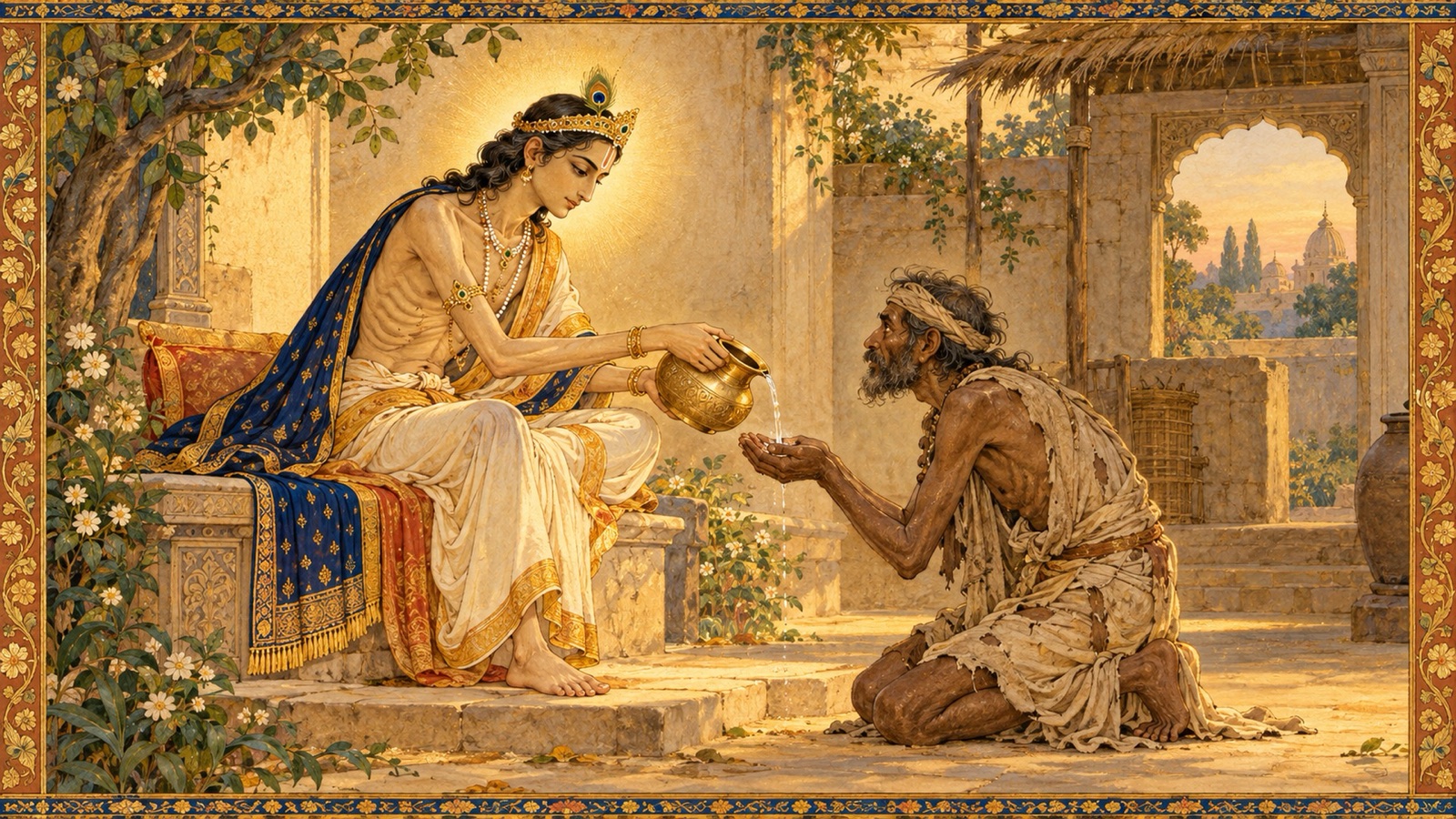
Though dying of thirst after forty-eight days without food or water, King Rantideva gives the last of his water to a starving outcaste — the supreme act of compassion in all the annals of kings.
Om Namo Bhagavate Vasudevaya.
Om Namo Bhagavate Vasudevaya.
Om Namo Bhagavate Vasudevaya.
Welcome to Srimad Bhagavatam Wisdom, a devotional journey through the sacred histories and teachings of the Srimad Bhagavat Mahapurana. This twenty-first chapter of Book Nine continues the line of Bharata and gives, at its heart, the immortal story of King Rantideva — a king whose compassion is sung in this world and the next. Sukadeva relates for King Parikshit how Rantideva, who lived only on what came to him unsought and gave away all he had even while hungry, endured forty-eight days without even water; and how, when at last food and water came, he gave it away piece by piece — to a hungry brahmana, then a Sudra, then a man with his dogs — until, with his own body failing, he offered the last cup to a parched stranger, wishing only to carry the burden of every creature’s pain. The Lords of the three worlds, who had come in disguise to test him, revealed themselves, and Rantideva, asking nothing, fixed his mind on the Lord alone. The chapter then carries the line of Bharata onward through many kings. It is a chapter about compassion as the highest worship, and the soul that sees the Lord in every being.
Chapter Information
- Scripture: Śrīmad Bhāgavata Mahāpurāṇa
- Canto: 9 (Book Nine)
- Chapter: 21 (Discourse 21)
- Chapter title: The Dynasty of Bharata
- Principal speaker: Sukadeva Gosvami, narrating to King Parikshit — the whole related by Suta Gosvami to the sage Saunaka and the assembly of sages at Naimisaranya
- Principal listener: King Parikshit
- Main setting: The line of Bharata in the lunar dynasty; the kingdom of King Rantideva
- Central subject: The descendants of Bharata, and above all the supreme compassion and devotion of King Rantideva
- Principal verse range: Canto 9, Chapter 21, verses 1–36
- Primary edition: Gita Press Śrīmad Bhāgavata Mahāpurāṇa
The Line Leading to Rantideva
Sukadeva resumed. From Vitatha (Bharadwaja) came Manyu, and from him Brhatkshatra, Jaya, Mahavirya, Nara and Garga; Nara’s son was Sankriti, whose sons were Guru and Rantideva — and the glory of Rantideva, Sukadeva said, is sung both in this world and the next.
गुरुश्च रन्तिदेवश्च सङ्कृते: पाण्डुनन्दन । रन्तिदेवस्य महिमा इहामुत्र च गीयते ॥ २ ॥
guruś ca rantidevaś ca saṅkṛteḥ pāṇḍu-nandana rantidevasya mahimā ihāmutra ca gīyate
Meaning: Guru and Rantideva were the sons of Sankriti, O delight of Pandu; and the glory of Rantideva is sung both in this world and the world beyond. (Canto 9, Chapter 21, verse 2)
The Great Trial of Rantideva
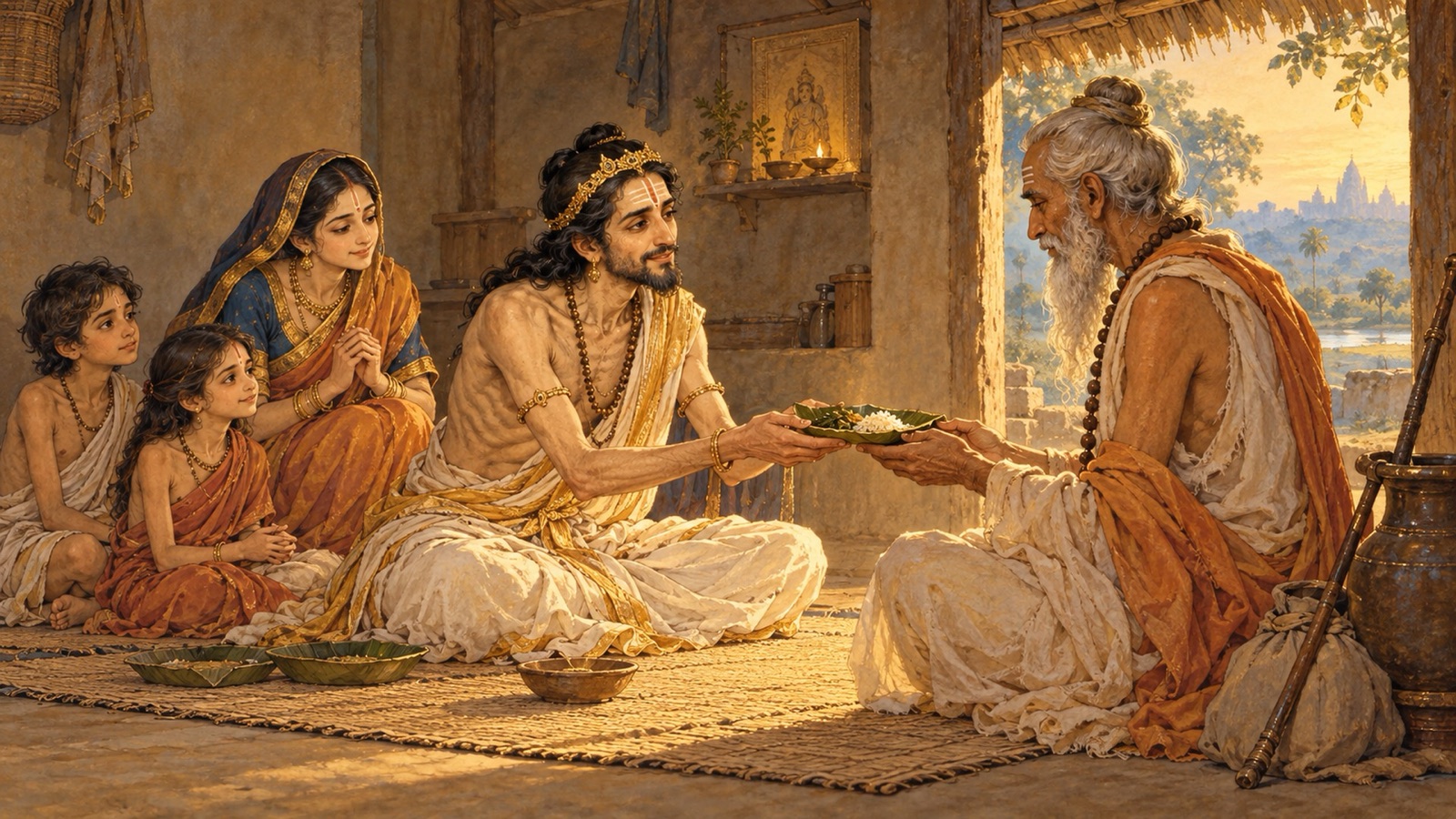
Rantideva lived only on whatever came to him without effort, and gave away all he obtained even while hungry himself; so he and his family were reduced to great hardship, and, trembling with hunger and thirst yet remaining calm, they passed forty-eight days without even water. On the morning of the forty-ninth day, ghee, rice cooked in milk and sugar, wheat porridge and water came to him; but as he was about to eat, a brahmana guest arrived. Seeing the Lord in all, Rantideva reverently gave him a share, and the brahmana ate and departed.
तस्मै संव्यभजत् सोऽन्नमादृत्य श्रद्धयान्वित: । हरिं सर्वत्र संपश्यन् स भुक्त्वा प्रययौ द्विज: ॥ ६ ॥
tasmai saṁvyabhajat so ’nnam ādṛtya śraddhayānvitaḥ hariṁ sarvatra saṁpaśyan sa bhuktvā prayayau dvijaḥ
Meaning: Seeing Sri Hari everywhere, Rantideva reverently and with faith gave the brahmana a share of the food; and the brahmana, having eaten, went away. (Canto 9, Chapter 21, verse 6)
Giving to All
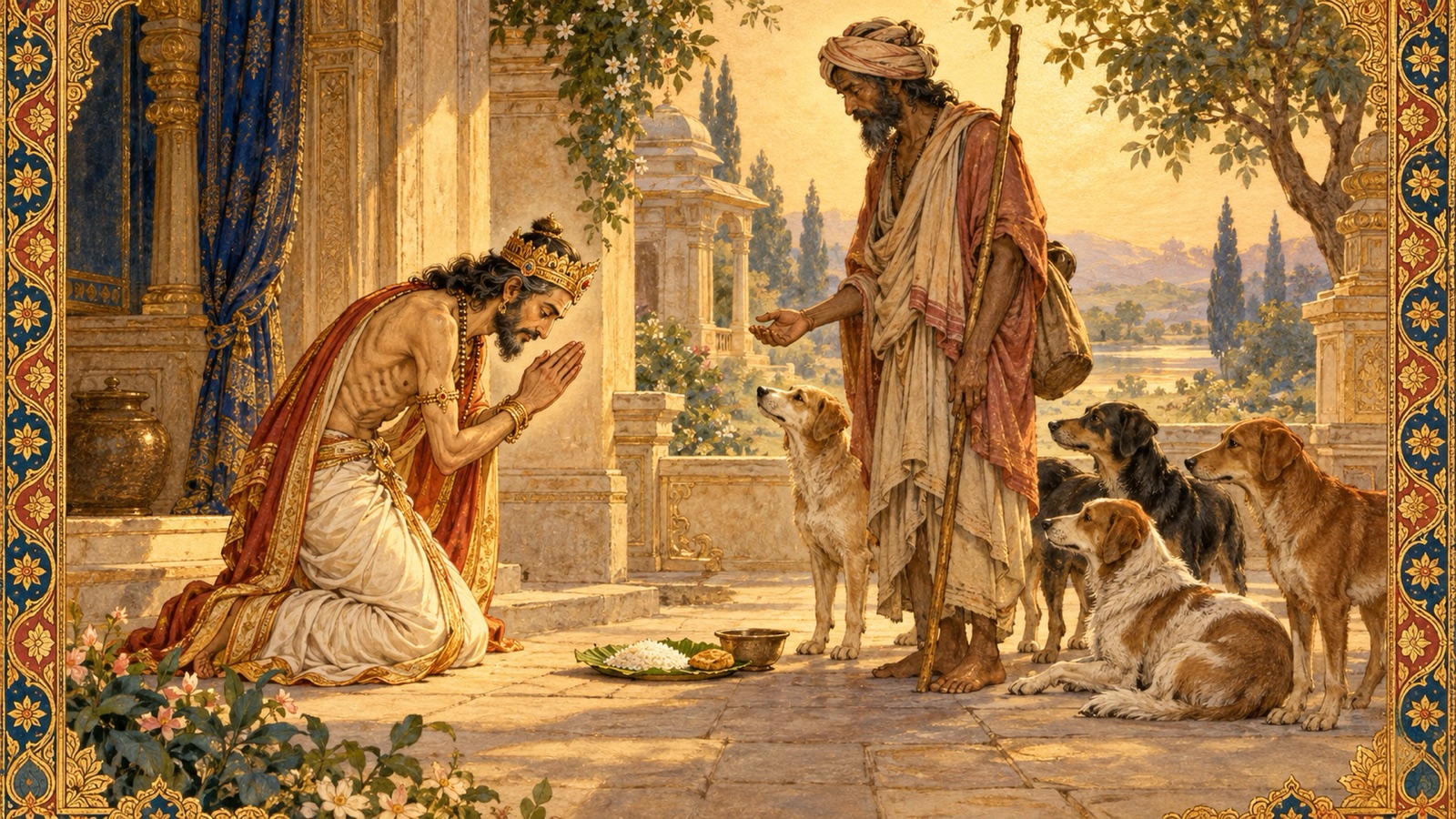
As Rantideva and his family divided the remaining food, a Sudra arrived, and he gave a share to him too. Then came a man followed by dogs, asking food for himself and his dogs; Rantideva reverently gave away all that was left to the dogs and their master, bowing to them as manifestations of the Lord. Now only a little water remained, enough for a single person; and as he was about to drink it, an outcaste appeared, begging piteously for water.
The Prayer of Rantideva
Hearing the outcaste’s pitiful plea, the king, stricken with compassion, spoke words sweet as nectar. He desired from the Lord, he said, not the highest station with all its yogic powers, nor even liberation from rebirth; rather, dwelling within the hearts of all suffering beings, he wished to take their suffering upon himself, that they might be free of misery.
न कामयेऽहं गतिमीश्वरात् परा- मष्टर्द्धियुक्तामपुनर्भवं वा । आर्तिं प्रपद्येऽखिलदेहभाजा- मन्त:स्थितो येन भवन्त्यदु:खा: ॥ १२ ॥
na kāmaye ’haṁ gatim īśvarāt parām aṣṭarddhi-yuktām apunar-bhavaṁ vā ārtiṁ prapadye ’khila-deha-bhājām antaḥ-sthito yena bhavanty aduḥkhāḥ
Meaning: I do not pray to the Lord for the supreme state endowed with the eightfold mystic powers, nor for freedom from rebirth; dwelling within all embodied beings, I would take upon myself their suffering, so that they may be freed from misery. (Canto 9, Chapter 21, verse 12)
Having spoken these words of surrender, the king — steadfast even as his own body failed — placed the water in the outcaste’s hands rather than his own parched lips.
इति प्रभाष्य पानीयं म्रियमाण: पिपासया । पुल्कसायाददाद्धीरो निसर्गकरुणो नृप: ॥ १४ ॥
iti prabhāṣya pānīyaṁ mriyamāṇaḥ pipāsayā pulkasāyādadād dhīro nisarga-karuṇo nṛpaḥ
Meaning: Having spoken thus, the steadfast king, compassionate by his very nature, gave the water to the outcaste, though he himself was dying of thirst. (Canto 9, Chapter 21, verse 14)
The Lords Revealed
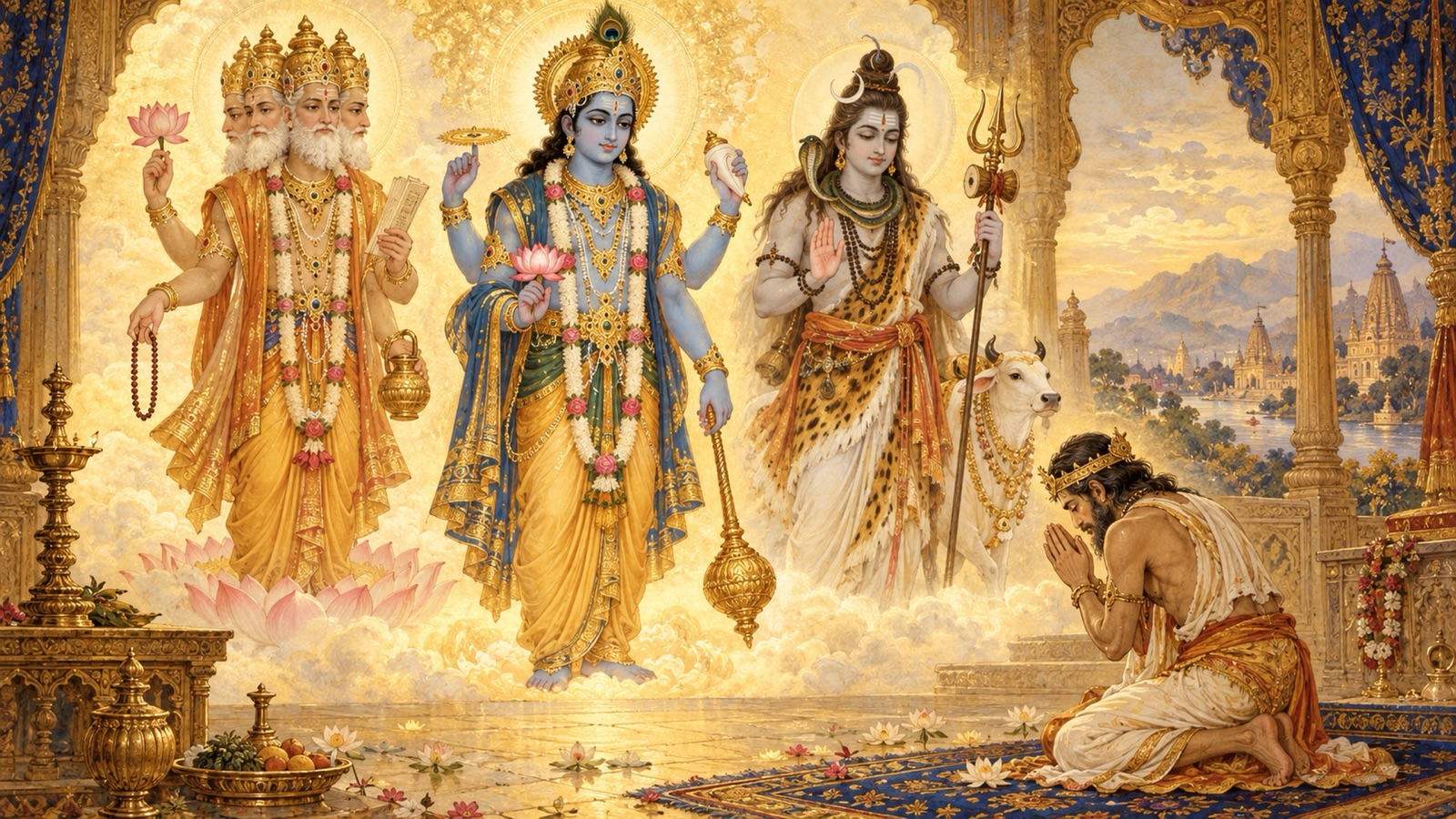
The three Lords of the worlds — Brahma, Vishnu and Siva — who had come in the illusory forms of the brahmana, the Sudra, the man with dogs and the outcaste to test his fortitude, now revealed themselves before him. But Rantideva, free of all attachment and craving, simply greeted them and fixed his mind on Lord Vasudeva with devotion, asking nothing. And for him, who sought no boon but the Lord Himself, the whole illusion of Maya dissolved like a dream.
ईश्वरालम्बनं चित्तं कुर्वतोऽनन्यराधस: । माया गुणमयी राजन्स्वप्नवत् प्रत्यलीयत ॥ १७ ॥
īśvarālambanaṁ cittaṁ kurvato ’nanya-rādhasaḥ māyā guṇamayī rājan svapnavat pratyalīyata
Meaning: For Rantideva, who fixed his mind wholly on the Lord and sought nothing else, the Maya of the three modes dissolved like a dream, O King. (Canto 9, Chapter 21, verse 17)
By their close association with him, all who followed Rantideva became yogis devoted solely to Lord Narayana.
The Line of Bharata Continues
Sukadeva then carried the line onward. From Garga came Sini and Gargya, from whom, though a Kshatriya line, a line of brahmanas arose; from Mahavirya came Duritakshaya and his sons Trayyaruni, Kavi and Pushkararuni, who attained brahmanhood; and from Brhatkshatra came Hasti, who built the city of Hastinapura.
गर्गाच्छिनिस्ततो गार्ग्य: क्षत्राद् ब्रह्म ह्यवर्तत । दुरितक्षयो महावीर्यात् तस्य त्रय्यारुणि: कवि: ॥ १९ ॥ पुष्करारुणिरित्यत्र ये ब्राह्मणगतिं गता: । बृहत्क्षत्रस्य पुत्रोऽभूद्धस्ती यद्धस्तिनापुरम् ॥ २० ॥
gargāc chinis tato gārgyaḥ kṣatrād brahma hy avartata duritakṣayo mahāvīryāt tasya trayyāruṇiḥ kaviḥ puṣkarāruṇir ity atra ye brāhmaṇa-gatiṁ gatāḥ bṛhatkṣatrasya putro ’bhūd dhastī yad-dhastināpuram
Meaning: From Garga came Sini, and then Gargya, from whom, though of a warrior line, a line of brahmanas arose; from Mahavirya came Duritakshaya, whose sons Trayyaruni, Kavi and Pushkararuni attained brahmanhood; and Brhatkshatra’s son was Hasti, by whom the city of Hastinapura was built. (Canto 9, Chapter 21, verses 19-20)
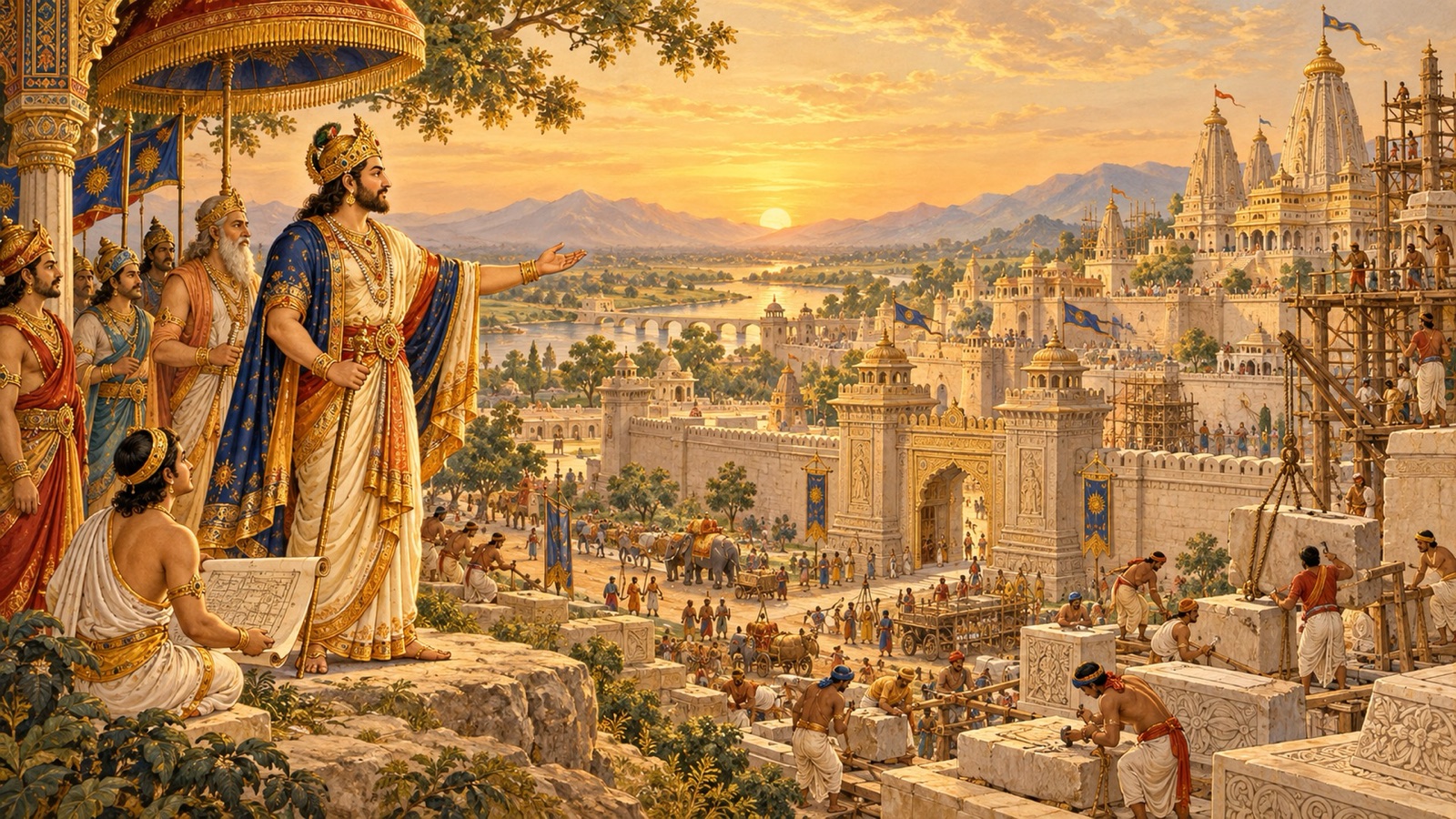
Through Hasti’s sons Ajamidha, Dvimidha and Purumidha, and their many descendants — including the five sons of Bharmyaswa, known as the Panchalas, and the line of the Maudgalya brahmanas from Mudgala — the dynasty of Bharata branched into many noble houses.
Principal Teachings of This Chapter
1. Compassion is the highest worship. Rantideva’s greatness lies not in conquest or sacrifice but in the boundless compassion by which he gives away even his last water. The chapter holds up mercy toward all beings as the truest devotion (verses 12-14).
2. See the Lord in every being. Whether the guest before him is a priest, a labourer, a beggar with his hounds, or a dying stranger, Rantideva meets each one as Sri Hari Himself. To serve any suffering being is to serve the Lord who dwells within all (verses 6-9).
3. The devotee seeks God, not His gifts. When the three Lords offer him any boon, Rantideva asks for nothing, fixing his mind on Vasudeva alone. The truest prayer desires the Giver, not the gift (verses 15-17).
4. Selflessness dissolves the illusion of the world. For Rantideva, who sought nothing for himself, the whole net of Maya dissolves like a dream. Self-forgetful love is itself the doorway to liberation (verse 17).
5. Holy company transforms all who share it. All who followed in Rantideva’s footsteps became devoted yogis. The compassion of one great soul lifts everyone around him toward God (verse 18).
A Devotional Reflection
Of all the kings whose stories fill the ninth book of the Bhagavatam, none is remembered with more tenderness than Rantideva, and his prayer is among the most beautiful ever spoken. Here is a man who has gone forty-eight days without food or water, who at last holds a single cup of water between his cracked lips — and who gives it away to a dying stranger, saying that he does not want heaven, does not want even liberation, but only to bear the suffering of every living being so that they might be free. This is compassion carried to its very furthest point, love so complete that it has forgotten itself entirely. And the Bhagavatam’s quiet miracle is that this self-forgetting is precisely what liberates him: for the one who wants nothing for himself, the whole illusion of the world dissolves like a dream, and the Lord he served in every beggar stands revealed before him. Rantideva teaches us that we do not draw near to God by grasping at His gifts — not even the gift of liberation — but by loving what He loves, which is every suffering creature. His example turns our idea of greatness upside down: the truly great soul is not the one who conquers the earth but the one who would empty himself utterly for the least and the last. To see the Lord in every being, and to serve that being before ourselves — this, the chapter tells us, is the highest worship of all.
A Daily Devotional Practice
Today, in the spirit of King Rantideva, practise compassion that puts another before yourself. Find one being in need — a hungry person, a struggling neighbour, even a thirsty animal — and give what you can before meeting your own comfort, seeing the Lord present within them and offering your act with the prayer, “Om Namo Bhagavate Vasudevaya.” As you give, let go of any wish for reward or recognition, praying instead, in Rantideva’s spirit, simply that the suffering of others may be eased. Let one small act of self-forgetful mercy be your worship today, and taste the truth Rantideva revealed — that the heart which seeks nothing for itself, and serves the Lord in every being, is nearest of all to Him.
Conclusion
The twenty-first chapter of Book Nine carries the line of Bharata onward and enshrines at its heart the immortal example of King Rantideva. Enduring forty-eight days without food or water, he gives away each portion as it comes — to a brahmana, a Sudra, a man with his dogs, and at last his final water to a dying outcaste — praying not for liberation but to take upon himself the suffering of all beings. When the three Lords who tested him reveal themselves, he asks for nothing but the Lord Himself, and for him the whole illusion of Maya dissolves like a dream. The chapter then traces the many branches of Bharata’s line, including the founding of Hastinapura and the rise of the Panchalas. Above all it leaves us with the Bhagavatam’s shining teaching that compassion which sees the Lord in every being, and serves that being before oneself, is the highest worship and the surest path to God.
May the divine wisdom of Srimad Bhagavatam awaken pure devotion within our hearts.
Om Namo Bhagavate Vasudevaya.
Jay Shree Madhav.
References and Attribution
- Primary edition: Gita Press, Śrīmad Bhāgavata Mahāpurāṇa (English, complete), Book Nine, Discourse 21, pages 88–92.
- Series: Srimad Bhagavatam Wisdom · Biswa Sanatan Dharma Seva Trust.
- Presented following the spiritual guidance and recommendation of Pandit Dr. Shri Kashinath Mishra.
This is an original, faithful retelling in the writer’s own words, with brief quoted verses shown in Devanāgarī and transliteration and their meanings given as summaries. It is not a reproduction of any single publisher’s continuous translation or commentary. No affiliation with or endorsement by any publisher is implied.
Jay Shree Madhav