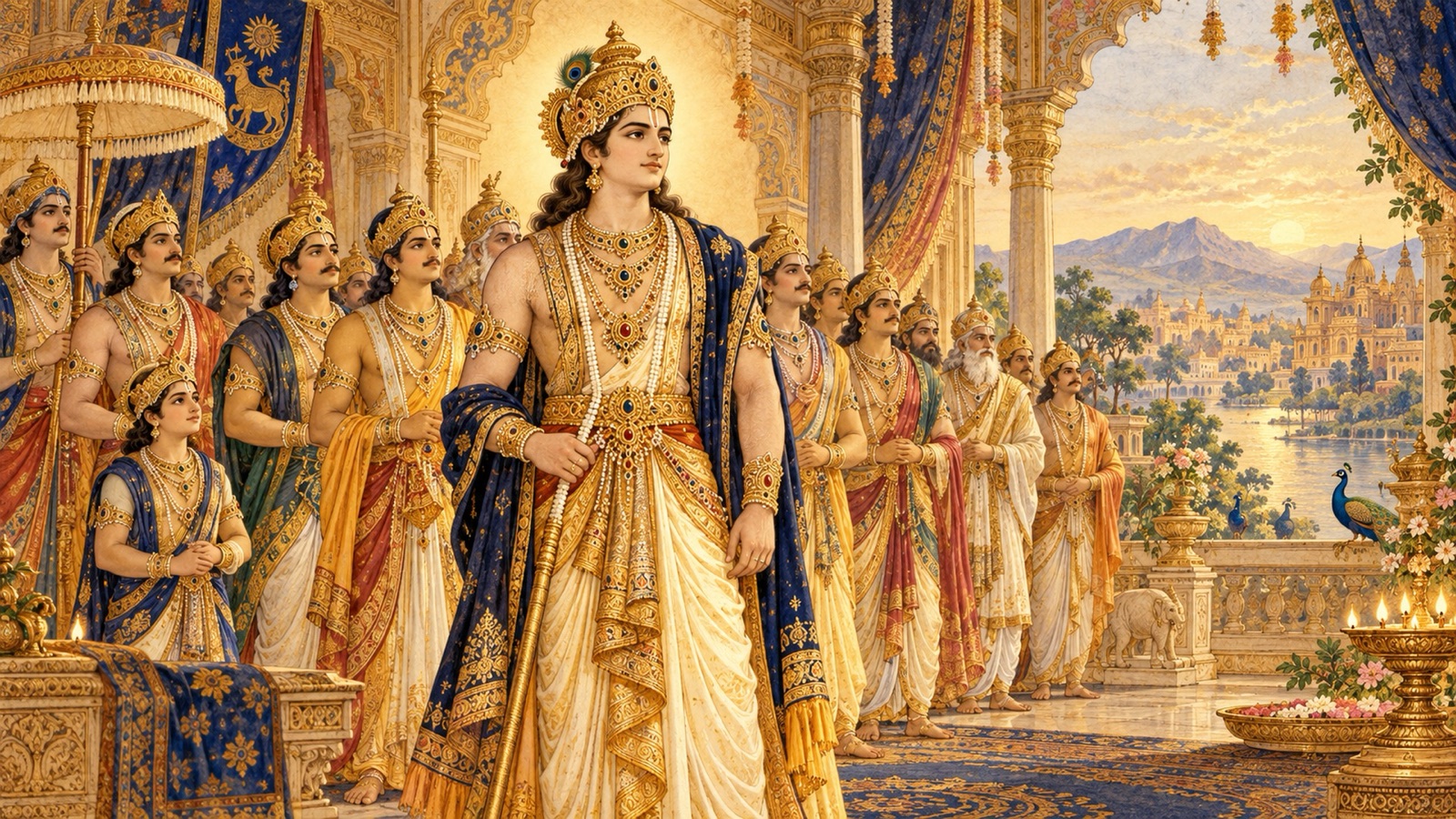
Sukadeva pauses his long roll of kings to glorify one single branch: the house of Yadu, eldest son of Yayati, singled out above every other dynasty because the Supreme Lord Himself would one day walk its halls as Sri Krishna.
Om Namo Bhagavate Vasudevaya.
Om Namo Bhagavate Vasudevaya.
Om Namo Bhagavate Vasudevaya.
Welcome to Srimad Bhagavatam Wisdom, a devotional journey through the sacred histories and teachings of the Srimad Bhagavat Mahapurana. This twenty-third chapter of Book Nine surveys three lesser-known royal lines before settling on the one that truly matters: Anu’s descendants founding the six eastern kingdoms of the Ganga delta, a childless king’s drought broken by a sage born of a deer, and an abandoned infant lifted from the river by a grieving charioteer. Only then does Sukadeva turn to the family he has really been leading us toward, tracing how it branched into great houses bearing proud new names, and closing with a tender tale of a queen’s astonishment at a rescued bride-to-be and the son later born to fulfill that promise. It is a chapter about many branches of one vast family tree, and the single bough among them that heaven itself marked out.
Chapter Information
- Scripture: Śrīmad Bhāgavata Mahāpurāṇa
- Canto: 9 (Book Nine)
- Chapter: 23 (Discourse 23)
- Chapter title: The Dynasties of the Sons of Yayati
- Principal speaker: Sukadeva Gosvami, narrating to King Parikshit — the whole related by Suta Gosvami to the sage Saunaka and the assembly of sages at Naimisaranya
- Principal listener: King Parikshit
- Main setting: The lines of Anu, Druhyu, Turvasu and Yadu, the four elder sons of Yayati, in the lunar dynasty
- Central subject: The dynasties of Yayati’s elder sons, above all the sacred line of Yadu in which Lord Krishna would descend
- Principal verse range: Canto 9, Chapter 23, verses 1–38
- Primary edition: Gita Press Śrīmad Bhāgavata Mahāpurāṇa
The Lines of Anu and the Eastern Kingdoms
Sukadeva resumed. From Anu came Sabhanara and his line, down to Titikshu and Bali. Through Bali’s queen, the sage Dirghatama begot six sons who became rulers of the earth — Anga, Vanga, Kalinga, Suhma, Pundra and Odra — and they founded after their own names six kingdoms in the east.
The Sage Rsyasringa and King Romapada
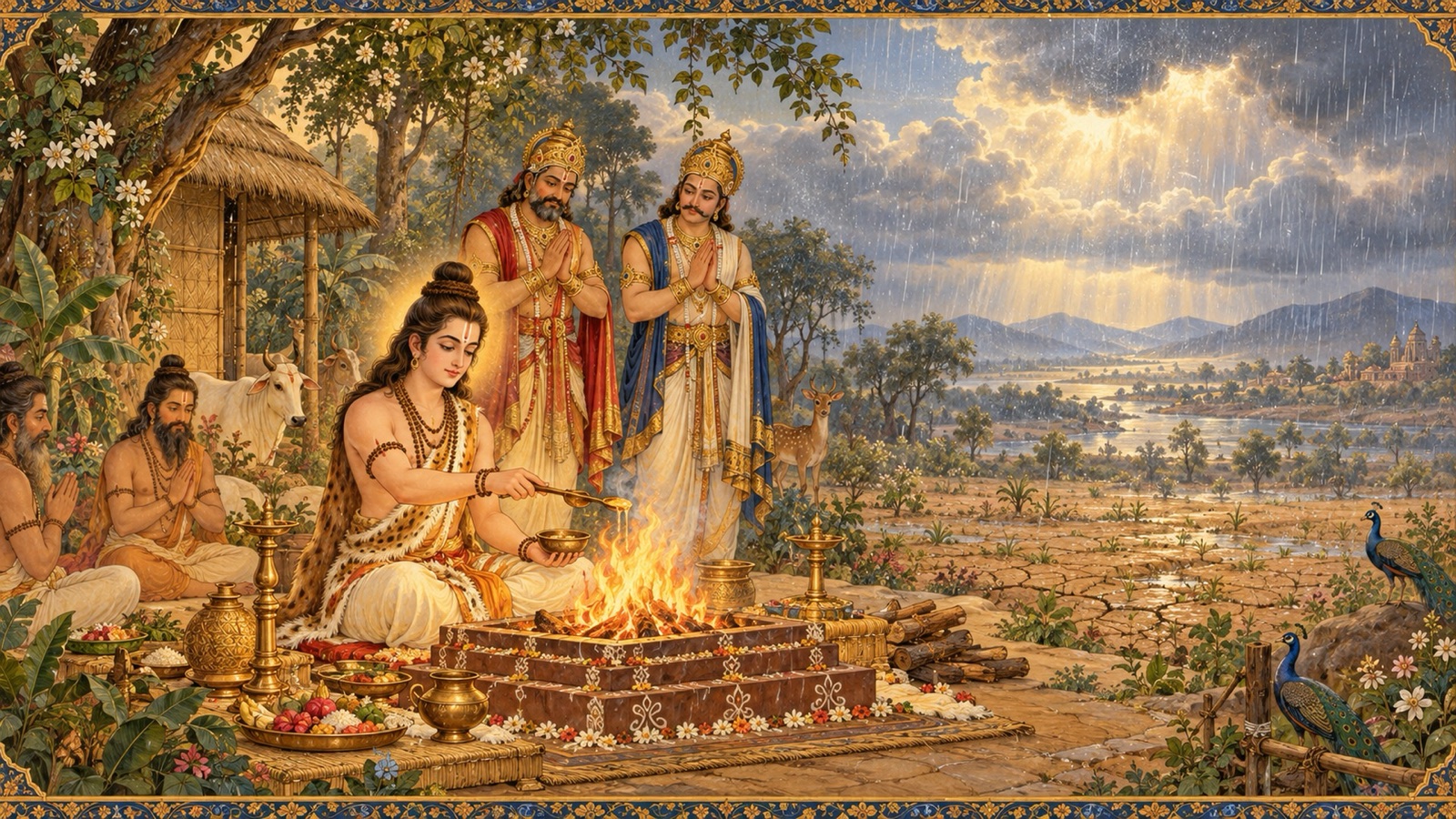
In the line of Anga came Romapada, who was childless. His friend, King Dasaratha, gave him his own daughter Santa, who was married to the sage Rsyasringa. When the god of rain withheld showers, this sage — born of a deer — was drawn to the kingdom by the arts of dancers and singers; and by the sacrifice he performed, both rain and progeny were secured. Through a similar sacrifice by him, the childless Dasaratha too obtained his celebrated sons.
शान्तां स्वकन्यां प्रायच्छदृष्यशृङ्ग उवाह याम् । देवेऽवर्षति यं रामा आनिन्युर्हरिणीसुतम् ॥ ८ ॥
śāntāṁ sva-kanyāṁ prāyacchad ṛṣyaśṛṅga uvāha yām deve ’varṣati yaṁ rāmā āninyur hariṇī-sutam
Meaning: Dasaratha gave his own daughter Santa, whom the sage Rsyasringa married; and when the god of rain withheld showers, it was this sage, born of a deer, whom the women brought to the kingdom. (Canto 9, Chapter 23, verse 8)
The Adoption of Karna
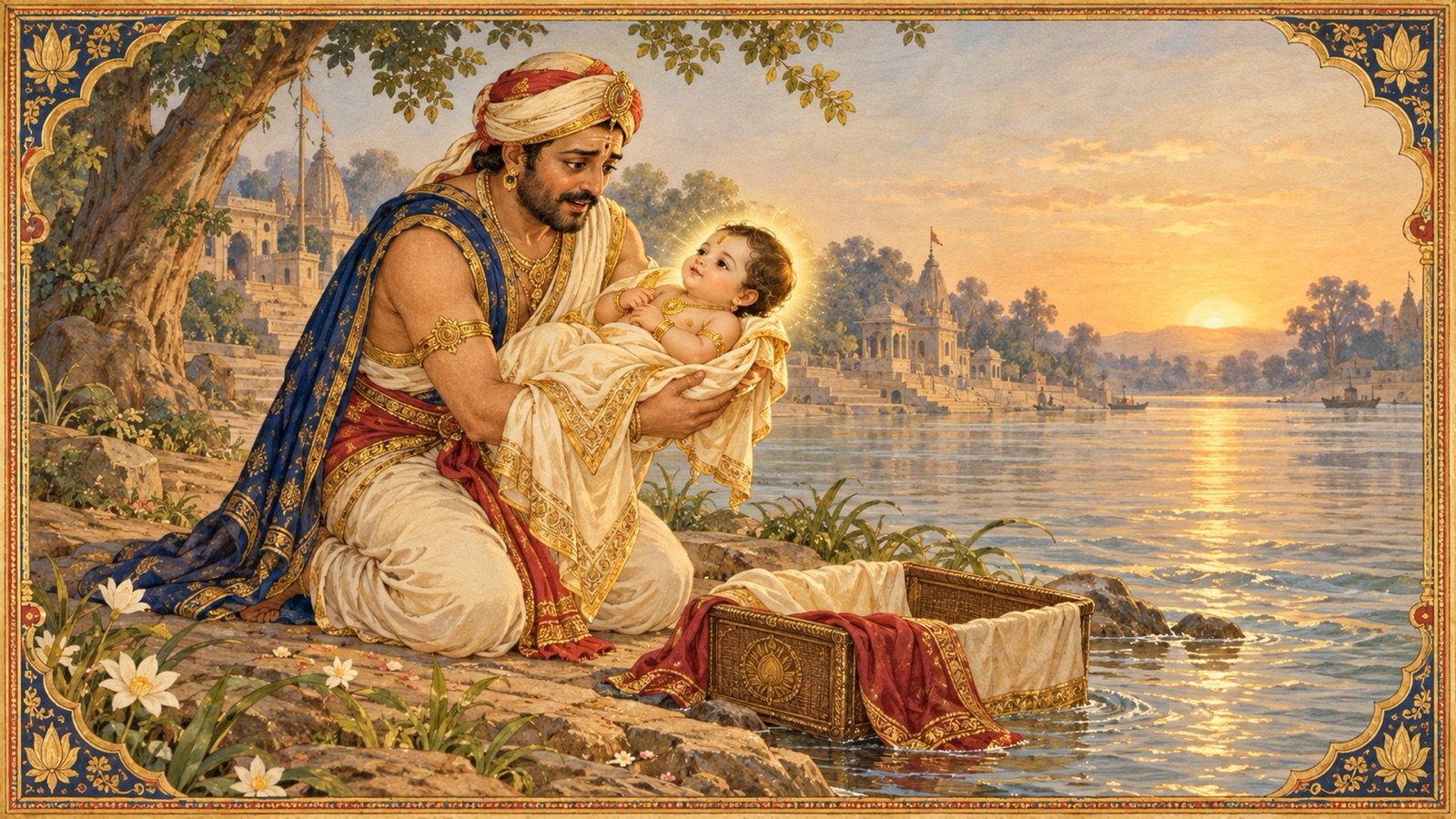
Further down the line of Anga came Adhiratha. Childless, while sporting on the bank of the Ganga he found and adopted as his son the infant Karna — the child born to Kunti before her marriage, and, for fear of censure, set adrift by her in a box.
योऽसौ गङ्गातटे क्रीडन् मञ्जूषान्तर्गतं शिशुम् । कुन्त्यापविद्धं कानीनमनपत्योऽकरोत् सुतम् ॥ १३ ॥
yo ’sau gaṅgā-taṭe krīḍan mañjūṣāntargataṁ śiśum kuntyāpaviddhaṁ kānīnam anapatyo ’karot sutam
Meaning: While sporting on the bank of the Ganga, the childless Adhiratha found an infant enclosed in a box — the child born to Kunti before her marriage and set adrift by her — and adopted him as his own son. (Canto 9, Chapter 23, verse 13)
The lines of Druhyu and Turvasu Sukadeva also related — Druhyu’s descendant Praceta, whose hundred sons ruled the Mlecchas in the north; and Turvasu’s line down to Maruta, who, being childless, adopted Dushyanta of the line of Puru, though Dushyanta later returned to his own dynasty.
The Glorious Line of Yadu
Sukadeva’s voice changed as he reached this point in the genealogy, as if setting aside one subject to announce something of far greater weight — a single royal house, he told King Parikshit, whose very mention has the power to cleanse a listener’s soul entirely.
ययातेर्ज्येष्ठपुत्रस्य यदोर्वंशं नरर्षभ । वर्णयामि महापुण्यं सर्वपापहरं नृणाम् । यदोर्वंशं नर: श्रुत्वा सर्वपापै: प्रमुच्यते ॥ १९ ॥
yayāter jyeṣṭha-putrasya yador vaṁśaṁ nararṣabha varṇayāmi mahā-puṇyaṁ sarva-pāpa-haraṁ nṛṇām yador vaṁśaṁ naraḥ śrutvā sarva-pāpaiḥ pramucyate
Meaning: O best of men, I shall now describe the line of Yadu, the eldest son of Yayati — a line of great merit that removes all the sins of men; hearing of the line of Yadu, a person is freed from all sins. (Canto 9, Chapter 23, verse 19)
यत्रावतीर्णो भगवान् परमात्मा नराकृति: । यदो: सहस्रजित्क्रोष्टा नलो रिपुरिति श्रुता: ॥ २० ॥
yatrāvatīrṇo bhagavān paramātmā narākṛtiḥ yadoḥ sahasrajit kroṣṭā nalo ripur iti śrutāḥ
Meaning: It is in this line that the glorious Lord, the Supreme Self, descended in human form. Yadu’s sons were Sahasrajit, Krosta, Nala and Ripu. (Canto 9, Chapter 23, verse 20)
The Yadavas, Madhavas and Vrishnis
From the line of Yadu, through Haihaya, came the mighty Kartavirya Arjuna, and, through Madhu and Vrishni, the great houses that gave their names to the descendants. Thus, Sukadeva said, they became known as the Yadavas, the Madhavas and the Vrishnis.
माधवा वृष्णयो राजन् यादवाश्चेति संज्ञिता: । यदुपुत्रस्य च क्रोष्टो: पुत्रो वृजिनवांस्तत: ॥ ३० ॥
mādhavā vṛṣṇayo rājan yādavāś ceti saṁjñitāḥ yadu-putrasya ca kroṣṭoḥ putro vṛjinavāṁs tataḥ
Meaning: They became known, O King, as the Madhavas, the Vrishnis and the Yadavas. And the son of Krosta, the son of Yadu, was Vrjinavan. (Canto 9, Chapter 23, verse 30)
From Krosta’s line came the great mystic Sasabindu, a universal monarch possessed of the fourteen kinds of jewels, and, after many generations, King Jyamagha.
Jyamagha and the Birth of Vidarbha
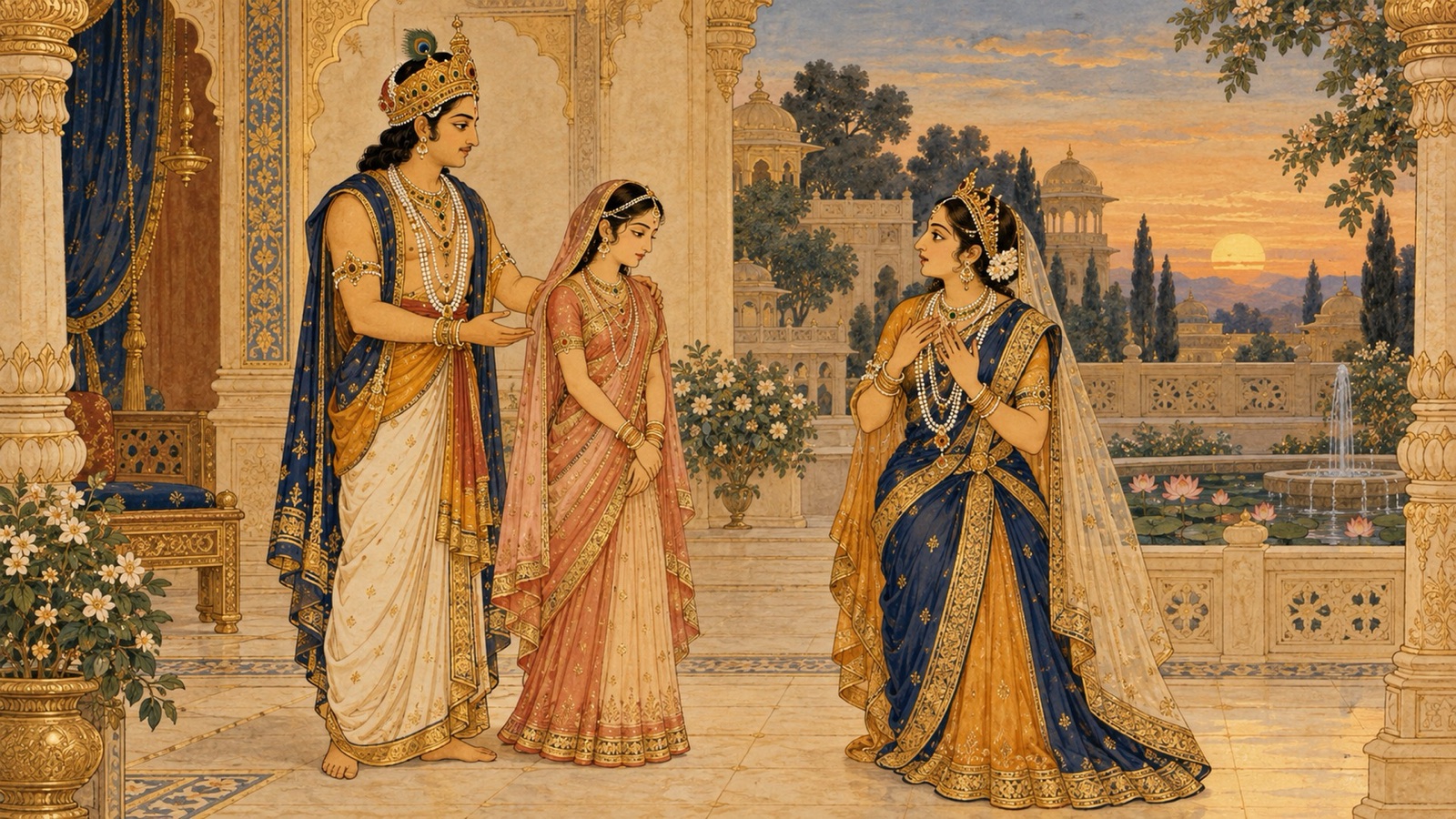
Jyamagha, husband of the queen Saibya, was childless, yet dared not take another wife for fear of her. Once he brought home a princess as a spoil of victory; and when the indignant Saibya asked who the girl was, he replied that she was her daughter-in-law. When Saibya protested that she was barren and had no son, the king answered that the girl would be a fitting match for the son she would yet bear.
अहं बन्ध्यासपत्नी च स्नुषा मे युज्यते कथम् । जनयिष्यसि यं राज्ञि तस्येयमुपयुज्यते ॥ ३७ ॥
ahaṁ bandhyāsapatnī ca snuṣā me yujyate katham janayiṣyasi yaṁ rājñi tasyeyam upayujyate
Meaning: “I am barren and have no co-wife; how can there be a daughter-in-law for me?” And the king replied: “She will be a fitting match, O queen, for the son whom you will bear.” (Canto 9, Chapter 23, verse 37)
The Vishvedevas and the manes approved his words, and in time Saibya conceived and bore a handsome son named Vidarbha, who married that very girl already accepted as a daughter-in-law.
अन्वमोदन्त तद्विश्वेदेवा: पितर एव च । शैब्या गर्भमधात् काले कुमारं सुषुवे शुभम् ॥ ३८ ॥
anvamodanta tad viśve- devāḥ pitara eva ca śaibyā garbham adhāt kāle kumāraṁ suṣuve śubham
Meaning: The Vishvedevas and the manes approved his words; and in due time Saibya conceived and gave birth to a handsome son — Vidarbha, who married that chaste girl already accepted as a daughter-in-law. (Canto 9, Chapter 23, verse 38)
Principal Teachings of This Chapter
1. The Lord’s grace is drawn by sincerity. The pure sage Rsyasringa brings both rain and children to barren kings; where sincerity and holiness are present, the Lord’s blessings flow (verses 6-10).
2. Every soul has its place in the Lord’s plan. The abandoned infant Karna is found and cherished; no life is truly cast away, for the Lord provides even for those set adrift (verse 13).
3. To hear of the Lord’s line is itself purifying. Sukadeva declares that merely hearing the account of Yadu’s dynasty frees a person from all sins — because it is the line the Lord chose for His descent (verses 18-19).
4. The Lord descends among us in human form. In the line of Yadu, the Supreme Self appears “in the semblance of a man” — the supreme blessedness of a lineage, and the supreme grace of God, who comes near to us as one of us (verse 20).
5. A word given in faith is honoured by heaven. Jyamagha’s confident word about a son yet to be born is upheld by the Vishvedevas and the manes. Heaven honours the faith of those who speak and act in trust (verses 37-38).
A Devotional Reflection
This chapter, dense with the names of many royal lines, rises at its center to a single luminous declaration: that in the dynasty of Yadu the Supreme Lord Himself would descend in human form — and that merely to hear of this line is to be freed from all sins. There is something wonderful in the way the Bhagavatam pauses, amid its long genealogies, to mark this one lineage as supremely blessed, not for any earthly glory but because God chose it for His own advent. It reminds us that the greatest privilege is not power or fame but nearness to the Lord — and that the Lord, in His boundless love, does not remain aloof but comes down “in the semblance of a man” to dwell among us. The chapter’s smaller stories quietly echo this grace: the abandoned child Karna, found and cherished on the riverbank; the barren kings granted children through a holy sage; the faithful word of Jyamagha, honoured by heaven itself. Everywhere the Lord is at work, providing, blessing, and drawing near. And to us, who can neither found kingdoms nor perform great sacrifices, the chapter offers the simplest of graces: that simply to hear and cherish the story of the Lord’s own line is itself a purification, a way of drawing near to the God who drew so near to us.
A Daily Devotional Practice
Today, take to heart the chapter’s promise that hearing of the Lord’s line purifies the soul. Set aside a few minutes to hear or read of Sri Krishna — a story of His advent, a verse of His glories, a name of His repeated with love — and let that hearing be your cleansing bath for the day, offered with the prayer, “Om Namo Bhagavate Vasudevaya.” Then, in the spirit of the childless kings blessed with children and of Karna found upon the riverbank, trust that no sincere prayer and no cast-away soul is beyond the Lord’s provision; offer Him some longing of your own heart, and some kindness to one who feels forgotten. Let hearing the Lord’s story and trusting His providence be your practice, drawing you nearer to the God who descended, in the line of Yadu, to draw near to you.
Conclusion
What begins as a catalogue of eastern kingdoms, a rain-making sage, and a foundling plucked from a river turns out to be preparation for something far greater: the moment Sukadeva finally names the one bough of this vast family tree that heaven itself set apart, the line through which the Yadavas, Madhavas and Vrishnis would all one day trace their blood, and through which God Himself would choose to be born. That single fact reframes everything that came before it — every drought ended, every orphan rescued, every barren queen comforted was, in hindsight, leading toward this. The chapter leaves us with the deepest of consolations: that the Lord, in His love, comes near to us as one of us, and that to cherish the story of His advent is itself a purification and a path to Him.
May the divine wisdom of Srimad Bhagavatam awaken pure devotion within our hearts.
Om Namo Bhagavate Vasudevaya.
Jay Shree Madhav.
References and Attribution
- Primary edition: Gita Press, Śrīmad Bhāgavata Mahāpurāṇa (English, complete), Book Nine, Discourse 23, pages 88–92.
- Series: Srimad Bhagavatam Wisdom · Biswa Sanatan Dharma Seva Trust.
- Presented following the spiritual guidance and recommendation of Pandit Dr. Shri Kashinath Mishra.
This is an original, faithful retelling in the writer’s own words, with brief quoted verses shown in Devanāgarī and transliteration and their meanings given as summaries. It is not a reproduction of any single publisher’s continuous translation or commentary. No affiliation with or endorsement by any publisher is implied.
Jay Shree Madhav