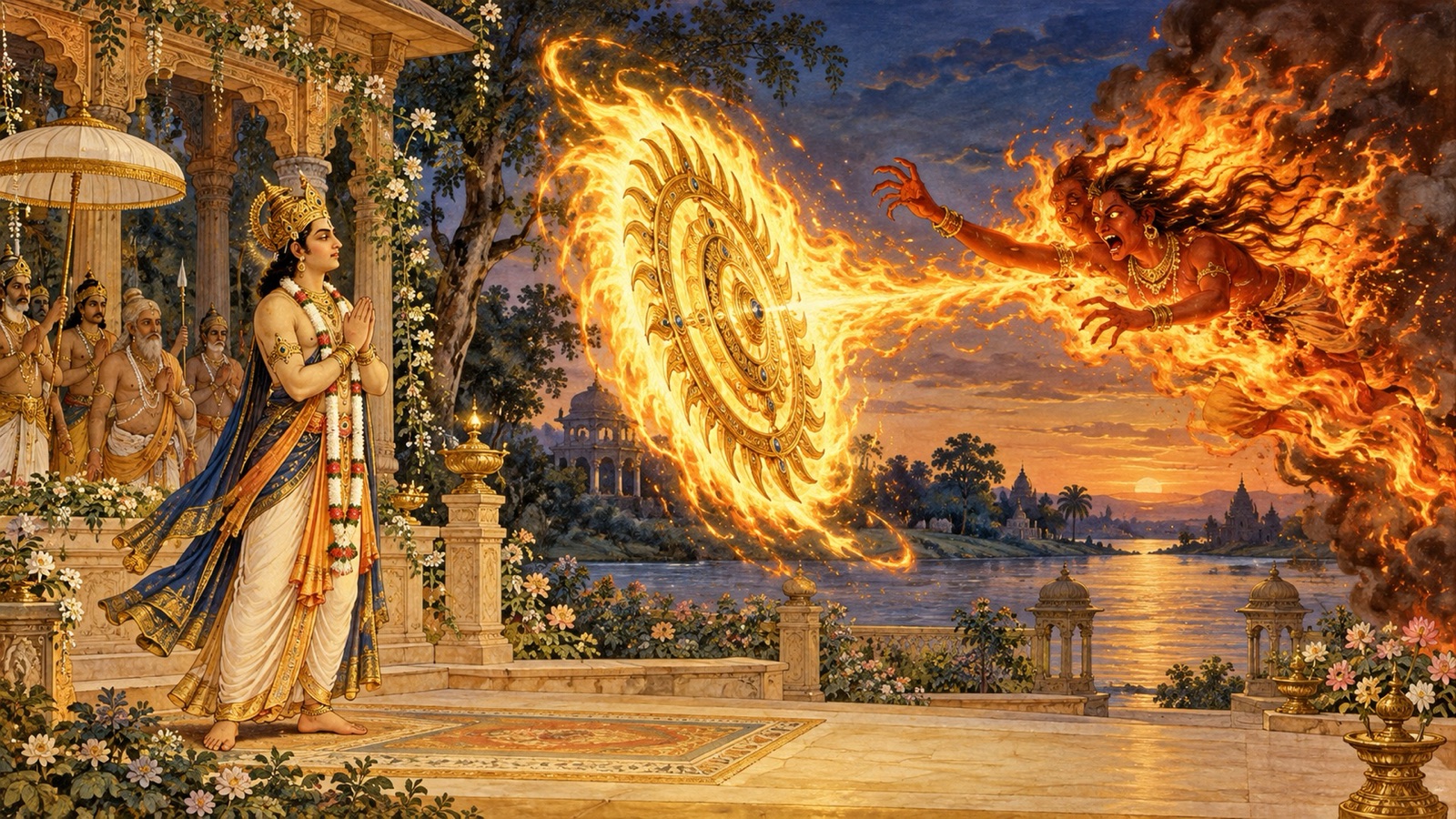
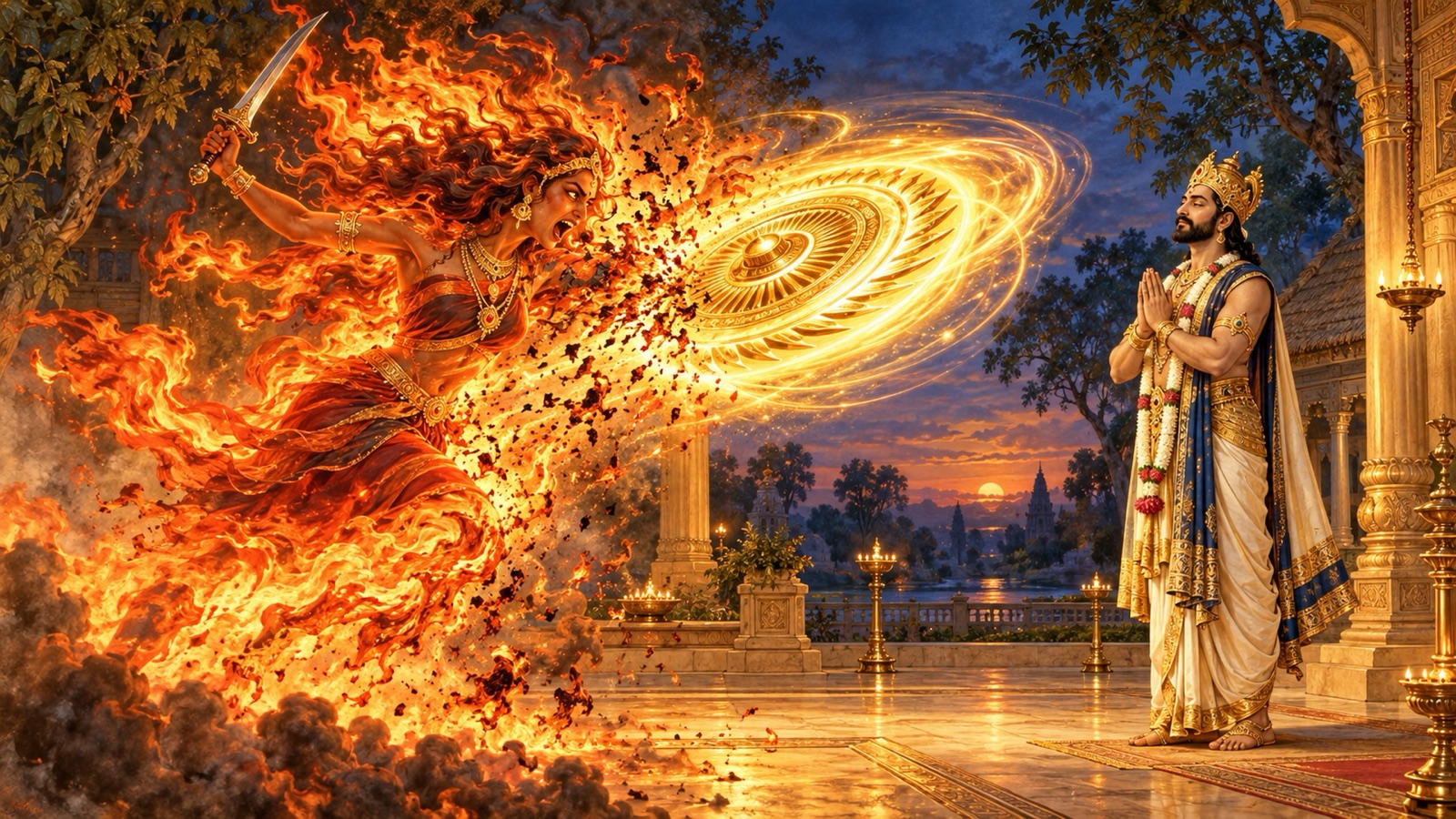
As a fiery curse rushes upon him, sword in hand, King Ambarisha does not stir a single step — for the Lord’s own discus, the Sudarsana, has already been appointed to guard His devotee.
Om Namo Bhagavate Vasudevaya.
Om Namo Bhagavate Vasudevaya.
Om Namo Bhagavate Vasudevaya.
Welcome to Srimad Bhagavatam Wisdom, a devotional journey through the sacred histories and teachings of the Srimad Bhagavat Mahapurana. This fourth chapter of Book Nine tells two joined stories. The first is the story of Nabhaga, a truthful young Brahmana who is left with nothing but honesty — and finds that honesty itself is his inheritance. From his line springs one of the most luminous devotees in all the scriptures: King Ambarisha, who ruled the whole earth yet held its glories to be no more than a dream, and who bent every one of his senses to the service of Lord Vishnu. When the great sage Durvasa, in a fit of anger, hurls a fiery curse at this saintly king, the Lord’s own discus rises to defend His devotee — and the chapter opens into one of the Bhagavatam’s most beloved declarations: that the Supreme Lord makes Himself, as it were, the willing servant of those who have given Him their whole heart.
Chapter Information
- Scripture: Śrīmad Bhāgavata Mahāpurāṇa
- Canto: 9 (Book Nine)
- Chapter: 4 (Discourse 4)
- Chapter title: Nabhaga, and the Devotion of King Ambarisha
- Principal speaker: Sukadeva Gosvami, narrating to King Parikshit — the whole related by Suta Gosvami to the sage Saunaka and the assembly of sages at Naimisaranya
- Principal listener: King Parikshit
- Main setting: The sacrificial grounds of the Angira sages; the kingdom of Ambarisha and the forest of Madhuvana on the Yamuna; and the realms of Brahma, Siva and Vaikuntha
- Central subject: The truthfulness of Nabhaga and the grace of Rudra; the exemplary devotion of King Ambarisha; his Dwadasi vow; the wrath of Durvasa and the protection given by the Sudarsana discus; and the Lord’s teaching that He is bound by love to His devotees
- Principal verse range: Canto 9, Chapter 4, verses 1–71
- Primary edition: Gita Press Śrīmad Bhāgavata Mahāpurāṇa
Nabhaga and the Truthful Inheritance
Another son of Vaivaswata Manu was Nabhaga. His son, also called Nabhaga, was the youngest and most learned of his brothers, and had spent an unusually long time away as a religious student. When at last he returned, his elder brothers had already divided the ancestral property among themselves and, in jest, had “assigned” their aged father to him as his share. Approaching his father, the young man asked what had truly been set apart for him; his father told him to pay no heed to the brothers’ words.
Instead, the father sent him with a real inheritance of wisdom: nearby, the Brahmanas descended from the sage Angira were performing a great sacrifice but stumbling over the ritual on every sixth day. Nabhaga was to teach them two Vedic hymns in propitiation of the Vishvedevas, and in gratitude, as they ascended to heaven, they would leave him the wealth remaining after the sacrifice. It happened just as his father had foretold. But as Nabhaga began to gather that wealth, a dark-complexioned person came up from the north and claimed it.
तं कश्चित् स्वीकरिष्यन्तं पुरुष: कृष्णदर्शन: । उवाचोत्तरतोऽभ्येत्य ममेदं वास्तुकं वसु ॥ ६ ॥
taṁ kaścit svīkariṣyantaṁ puruṣaḥ kṛṣṇa-darśanaḥ uvācottarato ’bhyetya mamedaṁ vāstukaṁ vasu
Meaning: As he was about to take possession of that wealth, a certain dark-looking person came up from the north and said to him, “This wealth left on the sacrificial ground is mine.” (Canto 9, Chapter 4, verse 6)
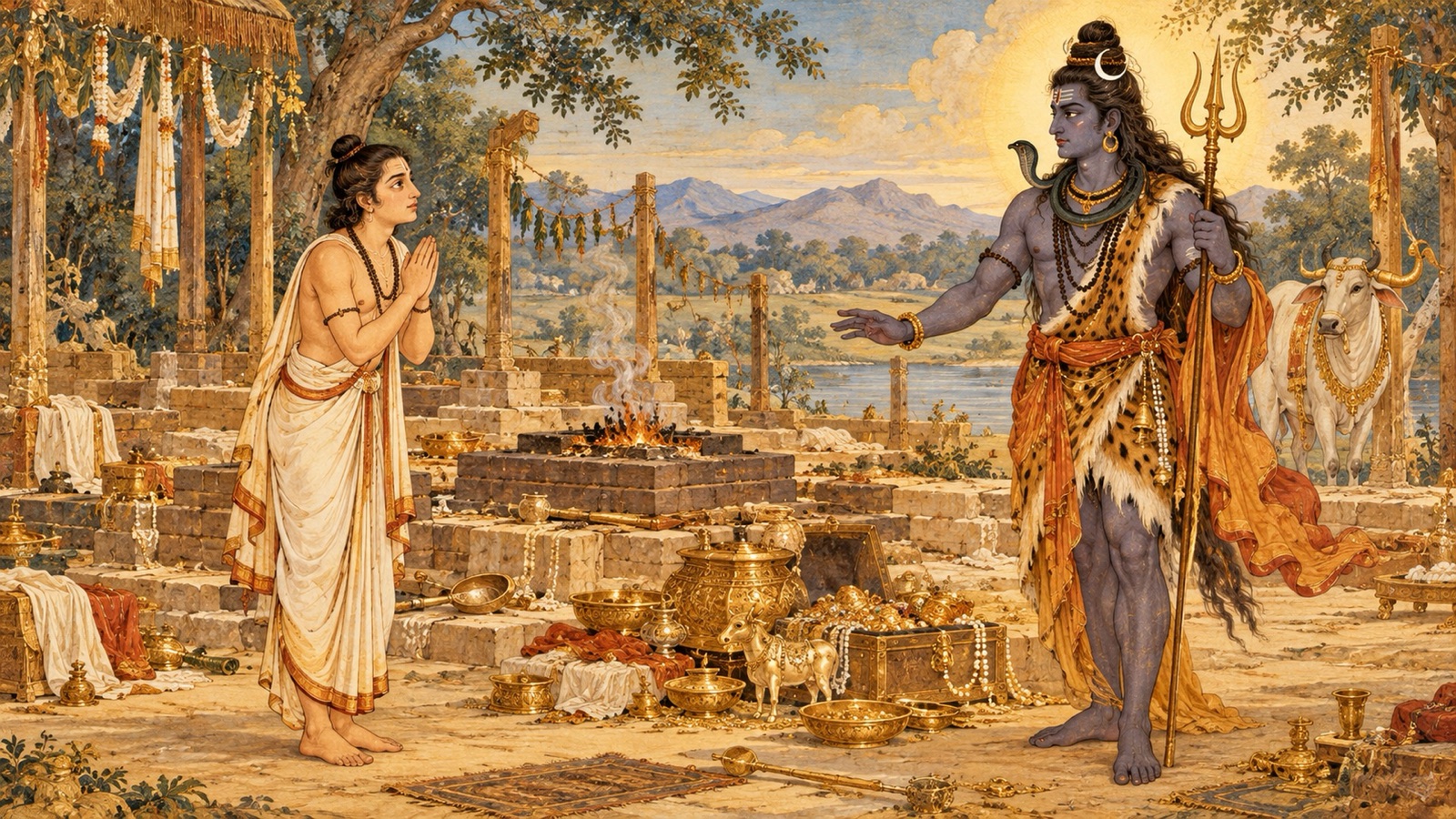
The dispute was referred, by mutual consent, to Nabhaga’s father, who ruled that at a sacrifice performed long ago the sages had set aside everything left on the sacrificial ground as the share of Rudra; hence the wealth was rightly his. Bowing low, Nabhaga honestly conveyed his father’s verdict to the dark figure — who was indeed Lord Rudra. Pleased that both father and son had spoken the truth, Rudra imparted to Nabhaga the knowledge of the eternal Brahma and made him a gift of the very wealth in dispute, and then vanished. From this Nabhaga was born a great devotee of the Lord, Ambarisha, on whom even a Brahmana’s curse — a scourge that had never before failed of its effect — would have no power.
नाभागादम्बरीषोऽभून्महाभागवत: कृती । नास्पृशद् ब्रह्मशापोऽपि यं न प्रतिहत: क्वचित् ॥ १३ ॥
nābhāgād ambarīṣo ’bhūn mahā-bhāgavataḥ kṛtī nāspṛśad brahma-śāpo ’pi yaṁ na pratihataḥ kvacit
Meaning: From Nabhaga was born Ambarisha, a great devotee of the Lord and a man of virtuous deeds, whom even a Brahmana’s curse — which is never elsewhere frustrated — could not touch. (Canto 9, Chapter 4, verse 13)
The Devotion of King Ambarisha
Hearing this, King Parikshit longed to know the story of that royal sage whom an irresistible Brahmana’s curse could not harm. Sukadeva then unfolded it. Ambarisha inherited sovereignty over the entire globe with its seven divisions, together with inexhaustible wealth and unequalled power — yet he regarded all of it as no more valuable than objects seen in a dream, knowing how wealth breeds infatuation and how surely it perishes. Such was his devotion to Lord Vasudeva and to His devotees that all his boundless riches seemed to him no better than a clod of earth.
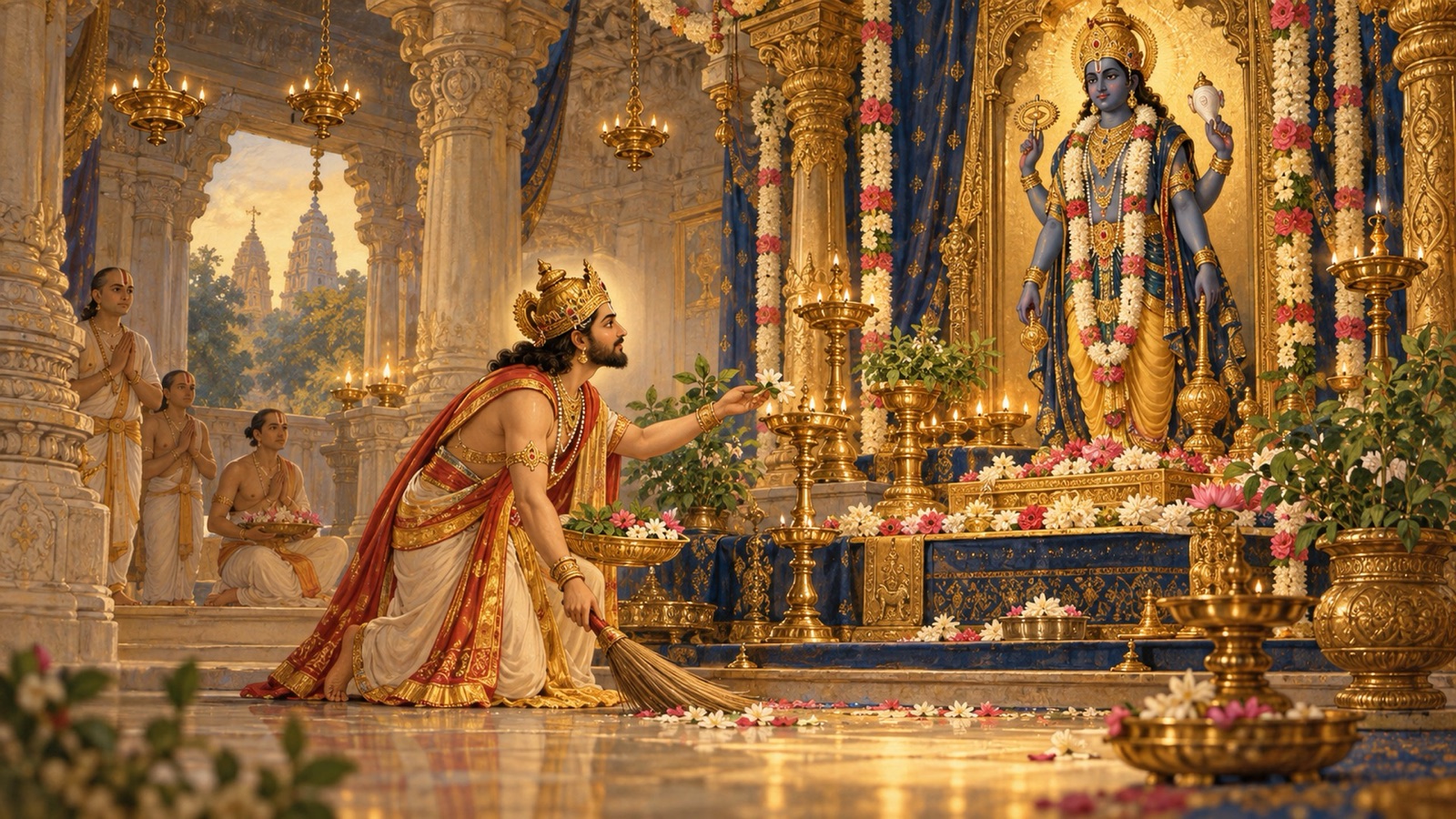
His whole being became an instrument of worship. He fixed his mind upon the lotus-feet of the Lord; he used his words to recount the Lord’s glories, his hands to cleanse the Lord’s temple, his ears to hear the sacred stories, his eyes to behold the deities and holy places, his sense of touch to serve the bodies of the Lord’s devotees, his sense of smell for the fragrance of the tulasi offered at His feet, his tongue for the food consecrated to Him, his feet to walk to the Lord’s holy places, and his head to bow at His feet.
स वै मन: कृष्णपदारविन्दयो- र्वचांसि वैकुण्ठगुणानुवर्णने । करौ हरेर्मन्दिरमार्जनादिषु श्रुतिं चकाराच्युतसत्कथोदये ॥ १८ ॥
sa vai manaḥ kṛṣṇa-padāravindayor vacāṁsi vaikuṇṭha-guṇānuvarṇane karau harer mandira-mārjanādiṣu śrutiṁ cakārācyuta-sat-kathodaye
Meaning: He engaged his mind upon the lotus-feet of Sri Krishna, his words in describing the glories of the Lord of Vaikuntha, his hands in cleansing the Lord’s temple and the like, and his ears in hearing the auspicious stories of the infallible Lord. (Canto 9, Chapter 4, verses 18–20)
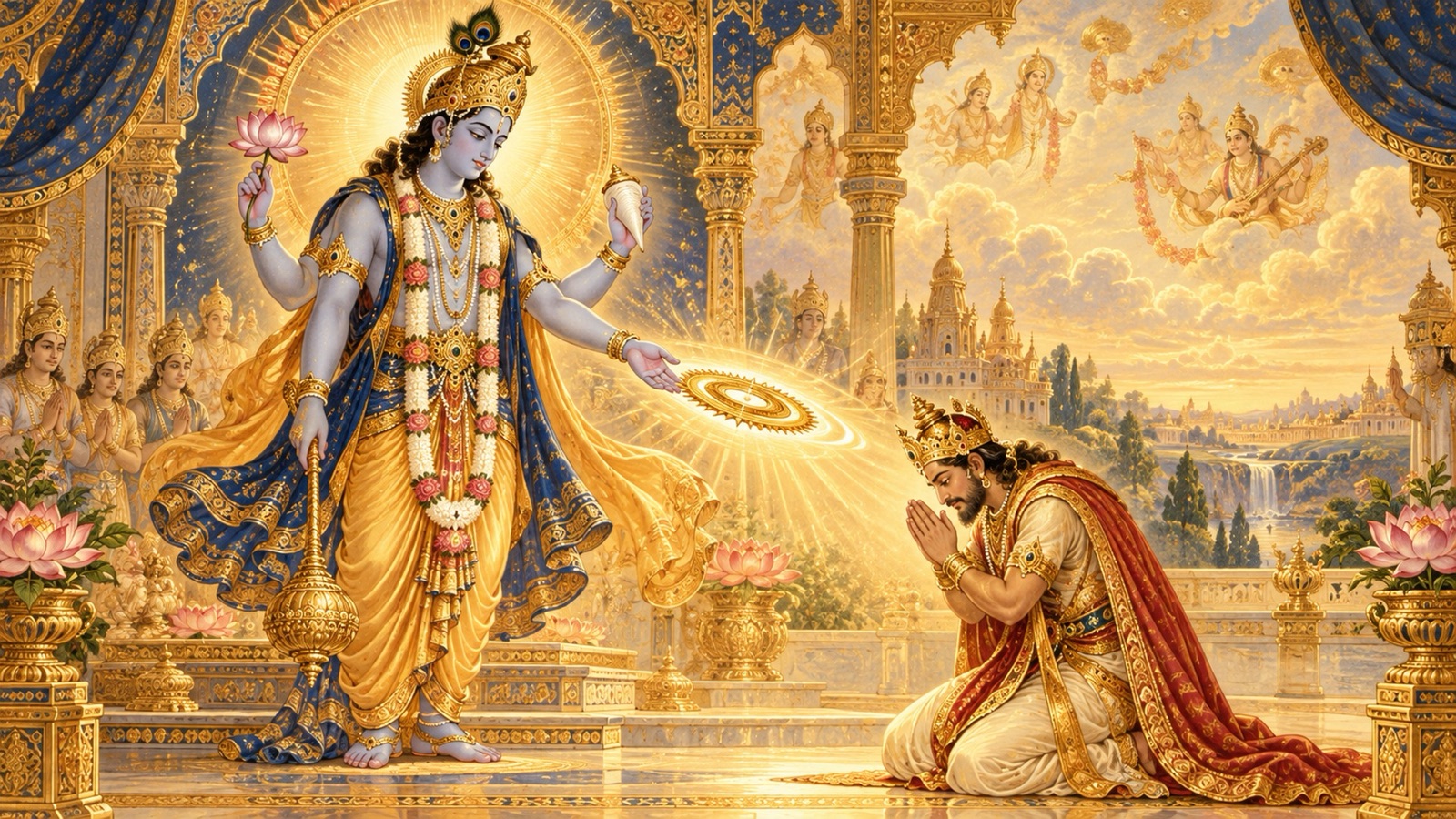
Governing the earth under the guidance of devoted Brahmanas, he performed grand horse-sacrifices on the banks of the Saraswati, conducted by sages such as Vasishtha, Asita and Gautama. Neither he nor his people ever coveted heaven, so absorbed were they in hearing and chanting the Lord’s glories; even pleasures unattainable by the perfected Siddhas held no charm for them, eclipsed by the bliss of the Lord within. Gradually he gave up every attachment — to home, wife, children and kin, to elephants, chariots and treasuries — seeing all of it as unreal. Pleased with his single-hearted love, Sri Hari gave him His own discus, the Sudarsana, terror of His enemies and protector of His servants.
तस्मा अदाद्धरिश्चक्रं प्रत्यनीकभयावहम् । एकान्तभक्तिभावेन प्रीतो भक्ताभिरक्षणम् ॥ २८ ॥
tasmā adād dhariś cakraṁ pratyanīka-bhayāvaham ekānta-bhakti-bhāvena prīto bhaktābhirakṣaṇam
Meaning: Pleased with his one-pointed devotion, Sri Hari gave him His discus, which strikes terror into His adversaries and protects His devotees. (Canto 9, Chapter 4, verse 28)
The Dwadasi Vow and the Coming of Durvasa
To please the Lord, Ambarisha undertook, together with his like-minded queen, a vow to fast on every Dwadasi (the twelfth lunar day) for a whole year. On one such Dwadasi in the month of Kartika, having fasted and bathed in the Yamuna, he worshipped Sri Hari in the sacred forest of Madhuvana with lavish devotion, honoured the assembled Brahmanas, and gifted them sixty crores of cows adorned with gold and silver. As he was about to conclude his own fast with a meal, an unexpected guest arrived — none other than the powerful sage Durvasa.
The king rose, welcomed him with full honour, and begged him to dine. Durvasa gladly accepted and went to the Yamuna to complete his midday devotions. But only half a muhurta — some twenty-four minutes — remained of the Dwadasi, within which the fast had to be broken; to wait longer would be to fail the vow, yet to eat before his guest would be to insult a Brahmana. Consulting the Brahmanas, Ambarisha resolved the crisis by taking only water, which the scriptures count both as breaking a fast and as not truly eating. Then, contemplating the Lord, he waited for the sage’s return.
Durvasa, returning, perceived by his mystic insight what the king had done, and blazed with fury. Denouncing Ambarisha as a proud and irreverent monarch, he tore a matted lock from his head and created from it a fearsome female demon, the Krtya, like the fire of universal dissolution, and sent her rushing at the king, sword in hand.
तामापतन्तीं ज्वलतीमसिहस्तां पदा भुवम् । वेपयन्तीं समुद्वीक्ष्य न चचाल पदान्नृप: ॥ ४७ ॥
tām āpatantīṁ jvalatīm asi-hastāṁ padā bhuvam vepayantīṁ samudvīkṣya na cacāla padān nṛpaḥ
Meaning: Though he clearly saw her rushing upon him, blazing, sword in hand, and making the earth quake beneath her feet, the king did not move a step from his place. (Canto 9, Chapter 4, verse 47)
The reason for his fearlessness was already at work. The Sudarsana discus, appointed by the Lord Himself for the protection of His devotee, burnt the Krtya to ashes as fire consumes an angry serpent.
प्राग्दिष्टं भृत्यरक्षायां पुरुषेण महात्मना । ददाह कृत्यां तां चक्रं क्रुद्धाहिमिव पावक: ॥ ४८ ॥
prāg diṣṭaṁ bhṛtya-rakṣāyāṁ puruṣeṇa mahātmanā dadāha kṛtyāṁ tāṁ cakraṁ kruddhāhim iva pāvakaḥ
Meaning: Already appointed by the Supreme Person for the protection of His devotee, the discus burnt that Krtya to ashes, as fire would burn an enraged serpent. (Canto 9, Chapter 4, verse 48)
The Flight of Durvasa and the Lord’s Refuge
Seeing his own weapon destroyed and the discus now turning upon him, the terrified sage fled through every region — the quarters, the sky, the earth, the subterranean worlds, the oceans and the heavens — but wherever he went, the Sudarsana was close behind. He ran first to Brahma, who confessed that he and all the lords of creation are themselves subject to the Lord’s law and powerless before His weapon. Durvasa then fled to Lord Siva, who likewise declared that neither he nor the greatest sages can penetrate the Lord’s Maya, and counselled him to seek Sri Hari alone as his shelter.
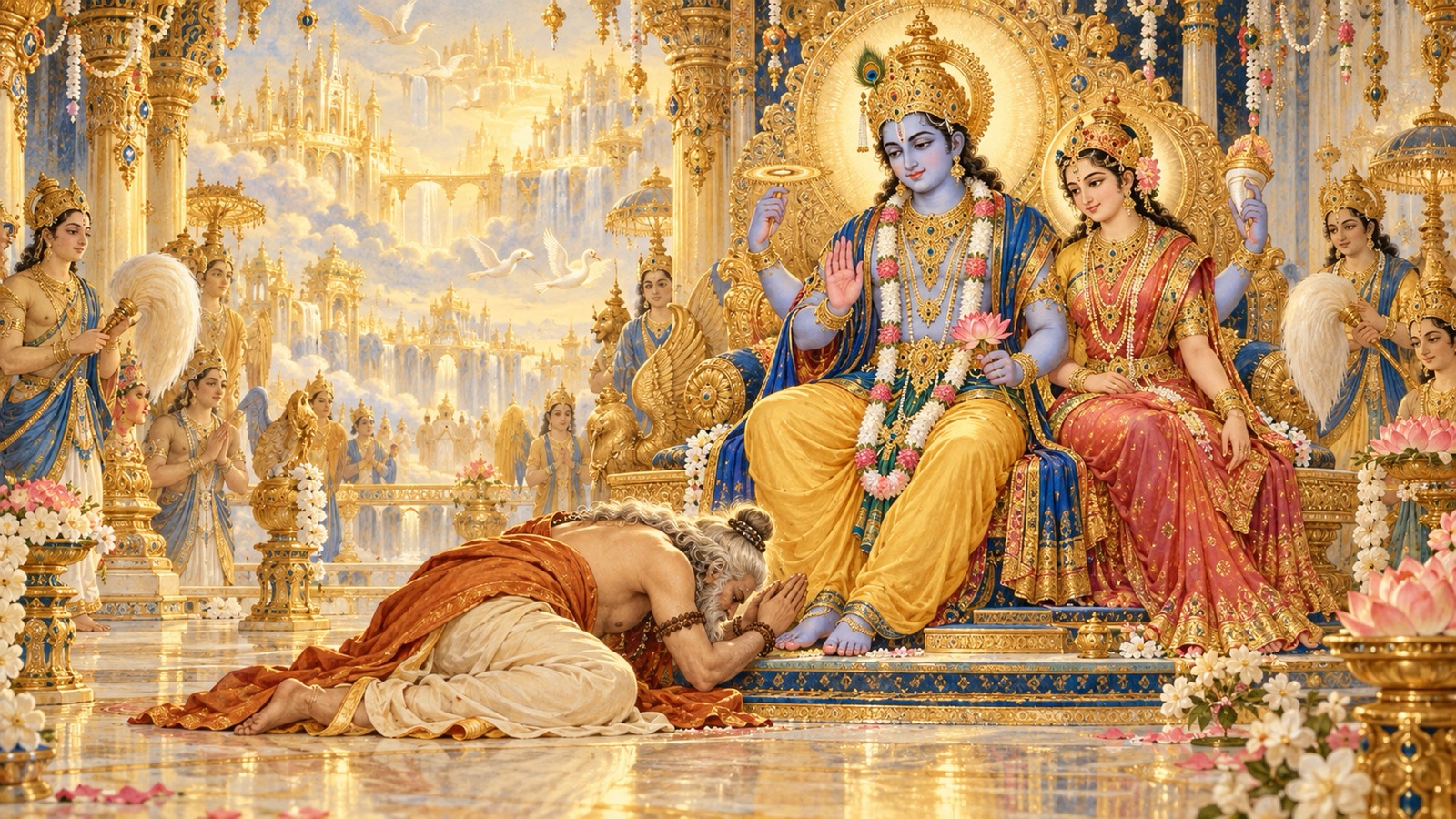
At last, out of every other hope, Durvasa came to Vaikuntha and fell trembling at the feet of Lord Vishnu, seated with the goddess Sri, begging forgiveness for having offended one dear to the Lord.
सन्दह्यमानोऽजितशस्त्रवह्निना तत्पादमूले पतित: सवेपथु: । आहाच्युतानन्त सदीप्सित प्रभो कृतागसं माव हि विश्वभावन ॥ ६१ ॥
sandahyamāno ’jita-śastra-vahninā tat-pāda-mūle patitaḥ savepathuḥ āhācyutānanta sad-īpsita prabho kṛtāgasaṁ māvahi viśva-bhāvana
Meaning: Being scorched by the fire of the invincible Lord’s weapon, he fell trembling at His feet and said, “O infallible and infinite Lord, sought by the righteous, O maker of the universe, protect me, an offender.” (Canto 9, Chapter 4, verse 61)
“I Am Bound by My Devotees”
The Lord’s reply is among the most tender revelations in all scripture. He does not glorify His own supremacy, but declares Himself, as it were, the dependent of His devotees.
अहं भक्तपराधीनो ह्यस्वतन्त्र इव द्विज । साधुभिर्ग्रस्तहृदयो भक्तैर्भक्तजनप्रिय: ॥ ६३ ॥
ahaṁ bhakta-parādhīno hy asvatantra iva dvija sādhubhir grasta-hṛdayo bhaktair bhakta-jana-priyaḥ
Meaning: “I am subject to My devotees, O Brahmana, as if I were not independent at all. My heart is captured by My saintly devotees, and I am dear to them as they are dear to Me.” (Canto 9, Chapter 4, verse 63)
The Lord explained that He does not covet even His own Self or Goddess Sri apart from His devotees; that He can never forsake those who have renounced everything — home, family, life and wealth, this world and the next — to take refuge in Him; and that devotees, sated by their love, do not even desire the four kinds of liberation. Then He spoke the heart of the matter.
साधवो हृदयं मह्यं साधूनां हृदयं त्वहम् । मदन्यत् ते न जानन्ति नाहं तेभ्यो मनागपि ॥ ६८ ॥
sādhavo hṛdayaṁ mahyaṁ sādhūnāṁ hṛdayaṁ tv aham mad-anyat te na jānanti nāhaṁ tebhyo manāg api
Meaning: “The saintly devotees are My very heart, and I am the heart of My devotees. They know nothing other than Me, and I know no one, even slightly, apart from them.” (Canto 9, Chapter 4, verse 68)
The one remedy, the Lord told Durvasa, was to seek out the very devotee he had wronged: force used against the righteous recoils upon the striker himself, and asceticism without humility turns harmful. Therefore he must go to King Ambarisha and beg his forgiveness.
ब्रह्मंस्तद् गच्छ भद्रं ते नाभागतनयं नृपम् । क्षमापय महाभागं तत: शान्तिर्भविष्यति ॥ ७१ ॥
brahmaṁs tad gaccha bhadraṁ te nābhāga-tanayaṁ nṛpam kṣamāpaya mahā-bhāgaṁ tataḥ śāntir bhaviṣyati
Meaning: “Therefore, O Brahmana — may good befall you — go to King Ambarisha, the son of Nabhaga, and beg the forgiveness of that highly blessed soul; then alone will you find peace.” (Canto 9, Chapter 4, verse 71)
Principal Teachings of This Chapter
1. Truthfulness is a real inheritance. Left with nothing but his father’s honest counsel, Nabhaga wins both sacred knowledge and wealth simply by speaking the truth and honouring what belongs to another (verses 6-11).
2. Wealth and power are safe only in the hands of the detached. Ambarisha ruled the whole earth yet counted it as a dream, holding untold riches as no more than a clod of earth — and so its glory never enslaved him (verses 15-17).
3. Devotion is the offering of the whole self. Ambarisha did not reserve one corner of his life for God; mind, speech, hands, eyes, ears, tongue, feet and head were each given a share in the Lord’s service (verses 18-20).
4. The Lord Himself protects His surrendered devotee. Ambarisha does not lift a hand against Durvasa’s fiery curse; he simply stands still, and the Sudarsana, appointed beforehand, defends him (verses 47-48).
5. God makes Himself the servant of His devotees. The Lord will not use His power against the surrendered soul, nor abandon those who have abandoned all for Him — “I am the heart of My devotees, and they are Mine” (verses 63-68).
A Devotional Reflection
There is a quiet greatness in this chapter that has nothing to do with thrones. Nabhaga is cheated of his share and answers with honesty; Ambarisha owns the earth and treats it like a dream; and when a curse of fire comes howling toward him, the emperor of the world simply does not move. His stillness is not helplessness but trust — he has given his heart so completely to the Lord that he has nothing left to defend. And the Lord’s response overturns every idea we have of divine distance: the Supreme, whom no weapon can conquer, calls Himself the willing dependent of those who love Him, saying that His heart is in their keeping. If that is true, then the safest place in all the worlds is not a fortress or a fortune, but the posture of Ambarisha — standing still, wanting nothing, belonging wholly to God. The powerful Durvasa learns this only after circling the universe in terror; the gentle king knew it all along.
A Daily Devotional Practice
Today, following Ambarisha, offer the Lord not merely a moment but your senses one by one. As you go about your day, silently dedicate each act — a kind word as speech offered to Him, an honest dealing as truth offered to Him, a small service to another as service to His devotee, a walk to a temple or a place of prayer as steps taken toward Him. Begin with the prayer, “Om Namo Bhagavate Vasudevaya,” and let the whole day become, quietly, an act of worship. And when something threatens or unsettles you, remember the king who did not move: entrust the outcome to the Lord, who has promised to guard those who take refuge in Him.
Conclusion
The fourth chapter of Book Nine leaves us with one radiant truth: the Lord binds Himself, by His own choice, to the heart of His surrendered devotee. Nabhaga’s honesty and Ambarisha’s total self-offering are different doorways to the same shelter — a life placed wholly in God’s hands needs no other defense, for the Sudarsana itself stands appointed, and even the mightiest curse cannot cross that boundary. Durvasa, circling the three worlds in terror, learns what Ambarisha already knew in stillness: nothing in heaven or earth is safer than belonging, without reservation, to the Lord who calls His devotees His own heart.
May the divine wisdom of Srimad Bhagavatam awaken pure devotion within our hearts.
Om Namo Bhagavate Vasudevaya.
Jay Shree Madhav.
References and Attribution
- Primary edition: Gita Press, Śrīmad Bhāgavata Mahāpurāṇa (English, complete), Book Nine, Discourse 4, pages 11–18.
- Series: Srimad Bhagavatam Wisdom · Biswa Sanatan Dharma Seva Trust.
- Presented following the spiritual guidance and recommendation of Pandit Dr. Shri Kashinath Mishra.
This is an original, faithful retelling in the writer’s own words, with brief quoted verses shown in Devanāgarī and transliteration and their meanings given as summaries. It is not a reproduction of any single publisher’s continuous translation or commentary. No affiliation with or endorsement by any publisher is implied.
Jay Shree Madhav