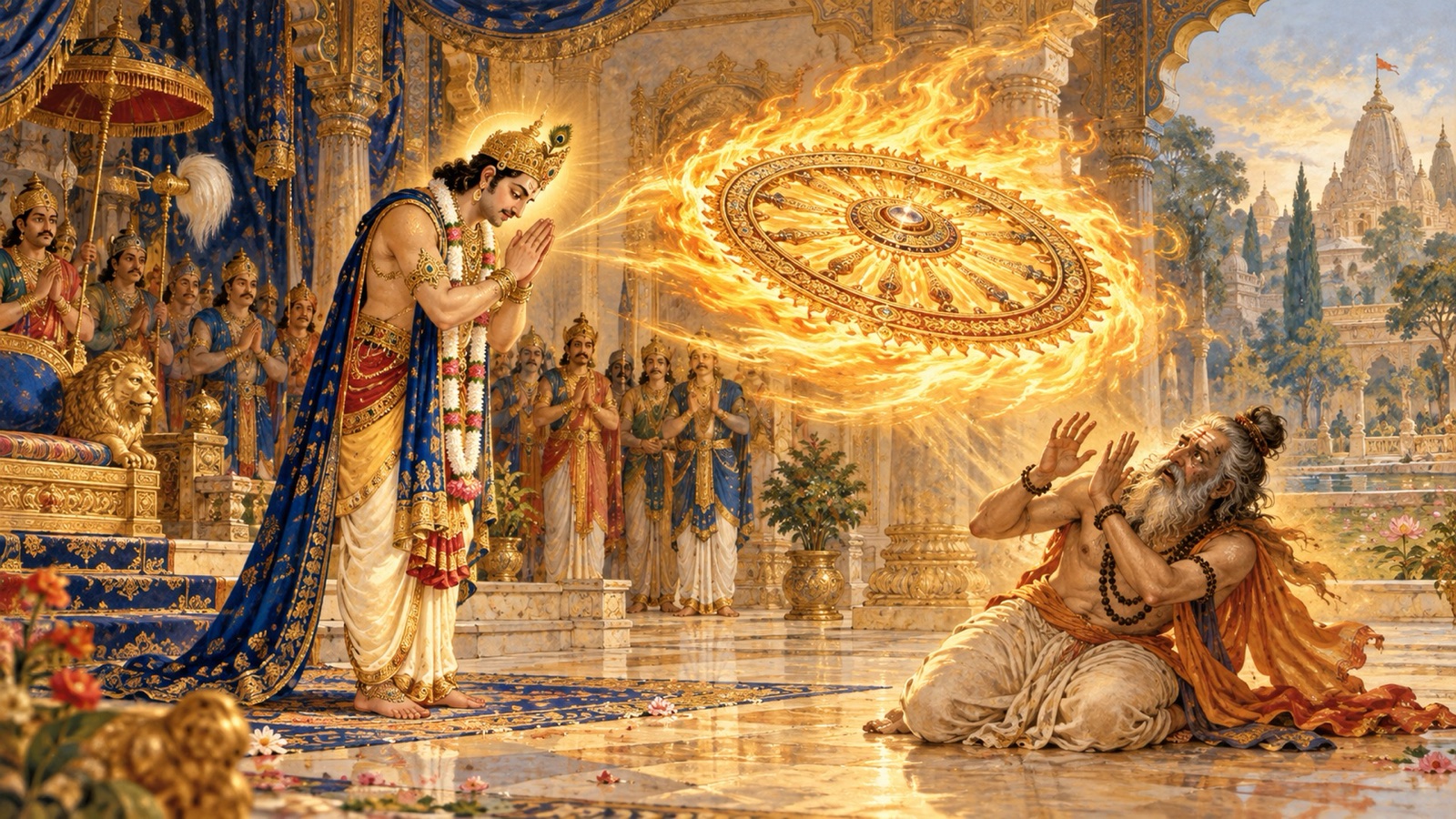
With folded hands, King Ambarisha prays to the blazing Sudarsana discus — not for himself, but for the very sage who sought to destroy him — begging that the Brahmana Durvasa be spared.
Om Namo Bhagavate Vasudevaya.
Om Namo Bhagavate Vasudevaya.
Om Namo Bhagavate Vasudevaya.
Welcome to Srimad Bhagavatam Wisdom, a devotional journey through the sacred histories and teachings of the Srimad Bhagavat Mahapurana. This fifth chapter of Book Nine brings the Durvasa episode begun in the previous discourse to its tender close, as the chased and humbled sage returns to seek Ambarisha’s forgiveness — and the king’s answer reveals the crowning beauty of pure devotion.
Chapter Information
- Scripture: Śrīmad Bhāgavata Mahāpurāṇa
- Canto: 9 (Book Nine)
- Chapter: 5 (Discourse 5)
- Chapter title: The Deliverance of Durvasa and the Glory of Ambarisha
- Principal speaker: Sukadeva Gosvami, narrating to King Parikshit — the whole related by Suta Gosvami to the sage Saunaka and the assembly of sages at Naimisaranya
- Principal listener: King Parikshit
- Main setting: The kingdom and court of King Ambarisha
- Central subject: King Ambarisha’s prayer to the Sudarsana discus to spare the sage Durvasa; the cooling of the discus; Durvasa’s praise of the devotee; the king’s hospitality; the revelation that a whole year had passed; and Ambarisha’s final liberation
- Principal verse range: Canto 9, Chapter 5, verses 1–28
- Primary edition: Gita Press Śrīmad Bhāgavata Mahāpurāṇa
The Prayer of Ambarisha to the Sudarsana
Directed by the Lord and still scorched by the discus, Durvasa returned to Ambarisha and clasped the king’s feet. Deeply pained and ashamed to see so great a sage humbled at his feet, the compassionate king began to glorify the Sudarsana, praying that it withdraw its wrath from the Brahmana. He addressed the discus as the very presence of the Lord in all the elements and powers of creation.
There is a reason the Lord did not simply lift the fire from Durvasa Himself when the sage reached Him in desperation, but sent him back to the very king he had wronged (verses 1-2). An offense against a devotee is not the Lord’s alone to excuse; Krishna keeps Himself, in a sense, bound by love to the mercy of His own servants, and only the injured heart of the devotee can truly release such a debt. This is why all of Durvasa’s power and pilgrimage could not free him, while a single, undemanded prayer from Ambarisha did: the Lord had arranged the whole ordeal so the world would see that the safety of even a mighty sage lies not in any strength of his own, but in the goodwill of the Lord’s devotee.
अम्बरीष उवाच त्वमग्निर्भगवान् सूर्यस्त्वं सोमो ज्योतिषां पति: । त्वमापस्त्वं क्षितिर्व्योम वायुर्मात्रेन्द्रियाणि च ॥ ३ ॥
ambarīṣa uvāca tvam agnir bhagavān sūryas tvaṁ somo jyotiṣāṁ patiḥ tvam āpas tvaṁ kṣitir vyoma vāyur mātrendriyāṇi ca
Meaning: Ambarisha prayed: “You are the god of fire and the glorious sun; you are the moon, lord of the luminaries; you are water, earth and sky, the air, the objects of the senses and the senses themselves.” (Canto 9, Chapter 5, verse 3)
He praised the discus as righteousness itself, as the protector of the worlds and the transcendent effulgence of the Supreme Person, and then made his plea plain: that for the good fortune of his race, and to save it from the sin of causing a Brahmana’s death, the Sudarsana grant safety to Durvasa. If ever his family had honoured the Brahmanas as gods, and if the Lord was pleased with them for seeing all beings as His own, let the Brahmana be freed from his distress.
The Discus Relents
The Lord’s discus, which had been scorching Durvasa on every side, cooled at the king’s entreaty.
श्रीशुक उवाच इति संस्तुवतो राज्ञो विष्णुचक्रं सुदर्शनम् । अशाम्यत् सर्वतो विप्रं प्रदहद् राजयाञ्चया ॥ १२ ॥
śrī-śuka uvāca iti saṁstuvato rājño viṣṇu-cakraṁ sudarśanam aśāmyat sarvato vipraṁ pradahad rāja-yācñayā
Meaning: Sukadeva said: As the king thus prayed, the Sudarsana discus of Lord Vishnu, which had been scorching the Brahmana on all sides, was pacified at the king’s request. (Canto 9, Chapter 5, verse 12)
Durvasa Extols the Devotee
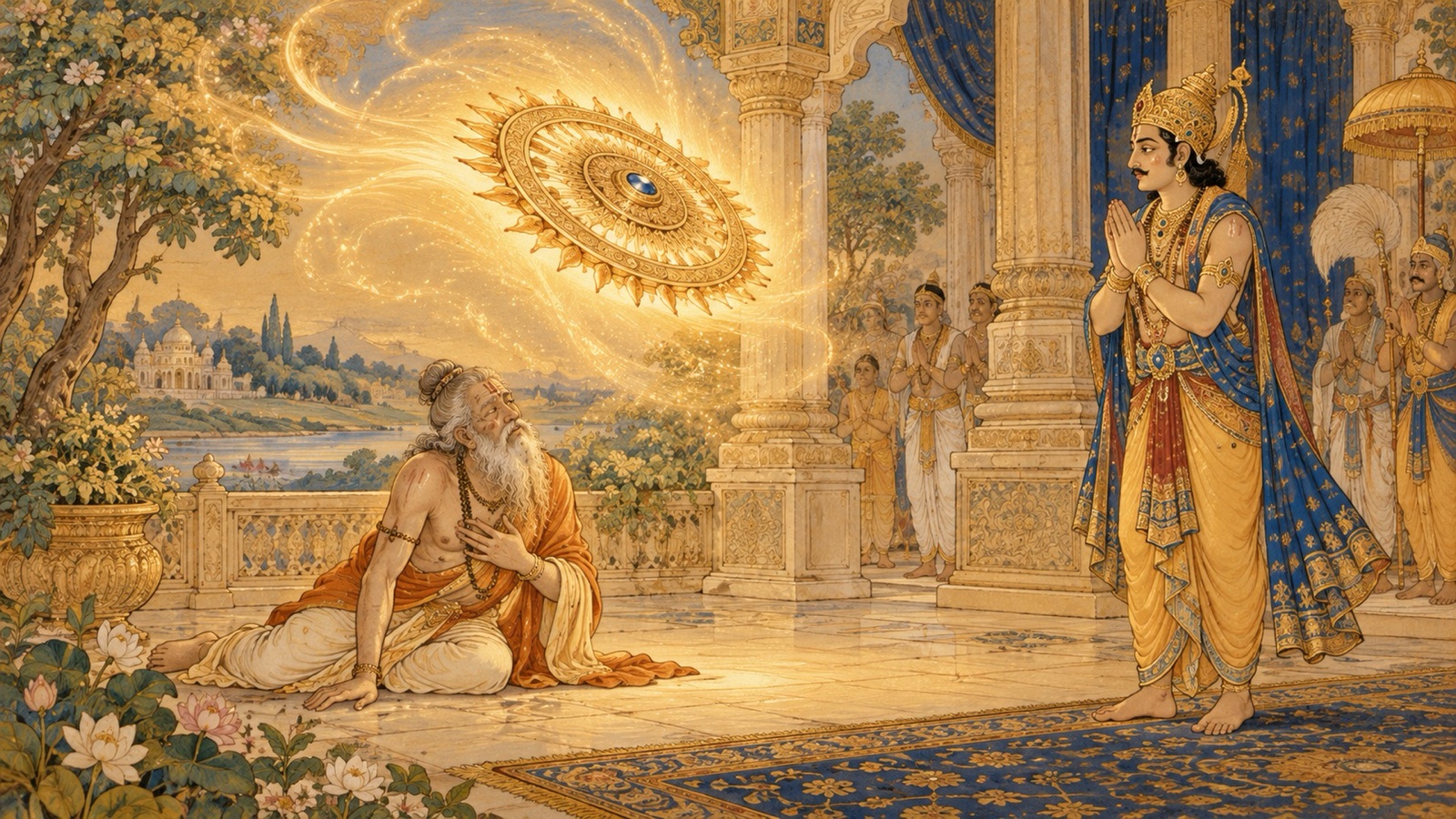
Released from the fire of the missile, Durvasa was overcome — not with resentment, but with wonder at the king who had striven for the welfare of the very man who wronged him. He declared that he had that day witnessed the glory of the Lord’s devotees.
दुष्कर: को नु साधूनां दुस्त्यजो वा महात्मनाम् । यै: संगृहीतो भगवान् सात्वतामृषभो हरि: ॥ १५ ॥
duṣkaraḥ ko nu sādhūnāṁ dustyajo vā mahātmanām yaiḥ saṅgṛhīto bhagavān sātvatām ṛṣabho hariḥ
Meaning: “What is difficult to do for the saintly, and what is hard to renounce for the great souls, by whom Sri Hari, the Lord of the devotees, has been lovingly taken into their hearts?” (Canto 9, Chapter 5, verse 15)
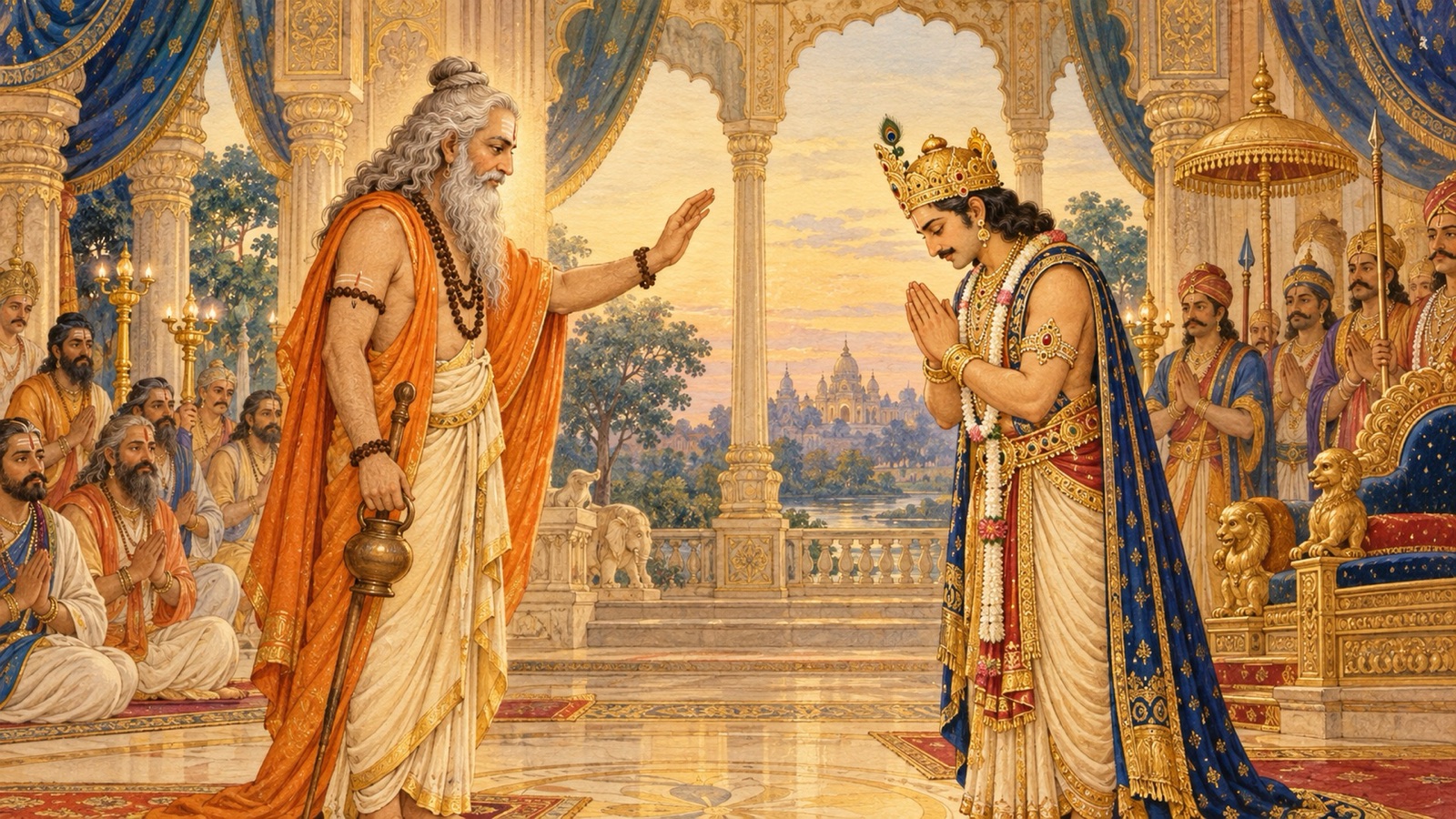
He praised the king for saving his life while overlooking his offence, and blessed him warmly, declaring that nothing is wanting to the servants of the Lord, by hearing whose very Name a person is purified.
The King Feeds His Guest
All this while, Ambarisha had not taken a morsel, waiting in hope for the sage’s return. Now, after gratifying Durvasa by clasping his feet, he sumptuously fed him. Satisfied at heart, the sage graciously bade the king take his own meal, and declared himself deeply obliged.
प्रीतोऽस्म्यनुगृहीतोऽस्मि तव भागवतस्य वै । दर्शनस्पर्शनालापैरातिथ्येनात्ममेधसा ॥ २० ॥
prīto ’smy anugṛhīto ’smi tava bhāgavatasya vai darśana-sparśanālāpair ātithyenātma-medhasā
Meaning: “I am pleased and deeply obliged by you, a devotee of the Lord — by your sight, your touch and your conversation, and by your hospitality offered with a mind fixed on the Supreme Self.” (Canto 9, Chapter 5, verse 20)
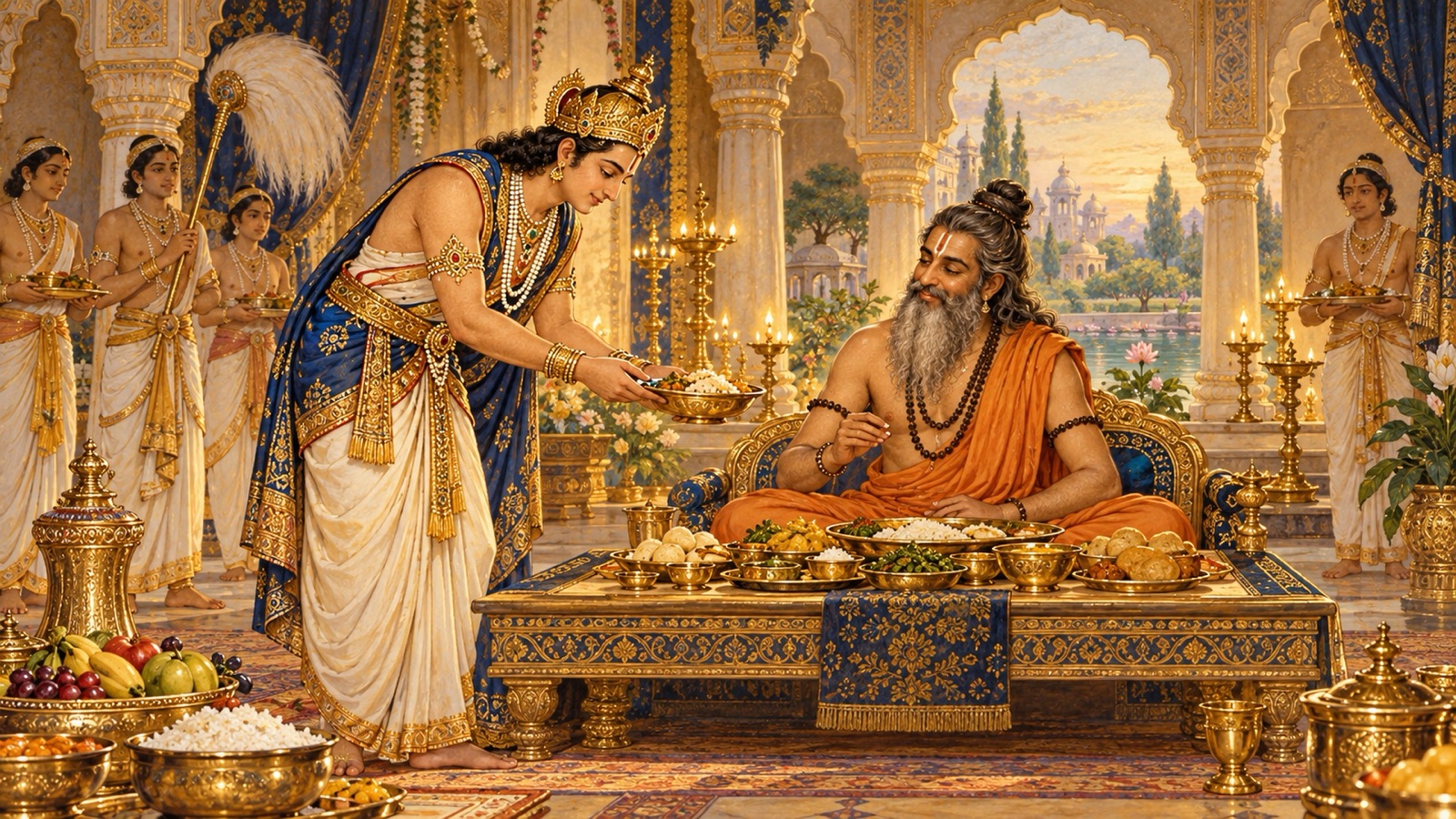
He foretold that celestial ladies would sing of the king’s blemishless deed, and that the earth itself would proclaim his sacred glory.
A Whole Year on Water Alone
Then a marvel of the king’s patience came to light. Durvasa, having asked leave, rose through the heavens to Brahmaloka — and only now was it revealed that a full year had elapsed since he had fled; all that time, longing for the sage’s return, Ambarisha had subsisted on water alone.
संवत्सरोऽत्यगात् तावद् यावता नागतो गत: । मुनिस्तद्दर्शनाकाङ्क्षोत राजाब्भक्षो बभूव ह ॥ २३ ॥
saṁvatsaro ’tyagāt tāvad yāvatā nāgato gataḥ munis tad-darśanākāṅkṣo rājāb-bhakṣo babhūva ha
Meaning: A whole year had passed before the departed sage returned; and the king, longing for a sight of him, had all that while subsisted on water alone. (Canto 9, Chapter 5, verse 23)
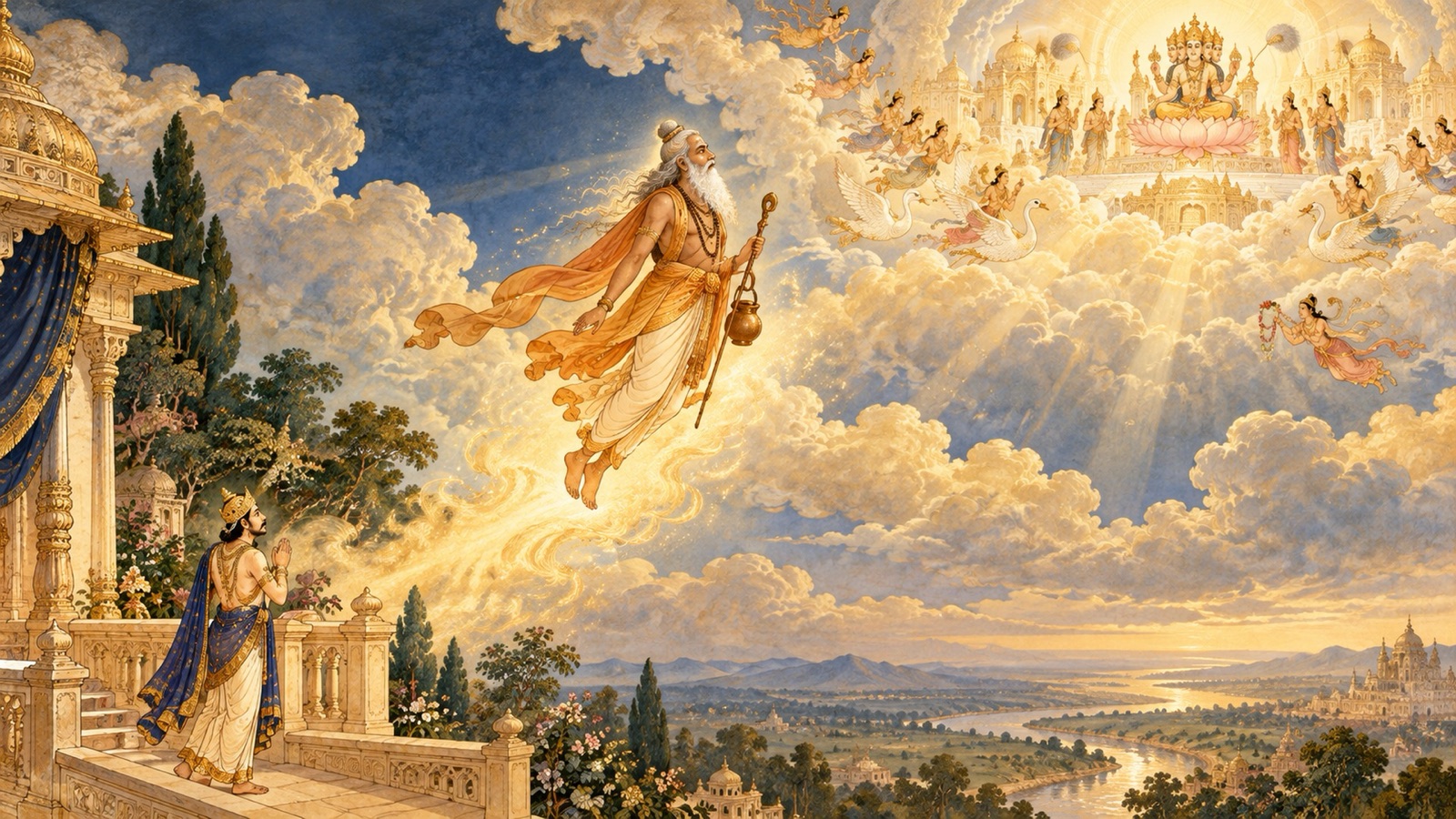
When Durvasa had departed, Ambarisha ate the food sanctified by the sage’s having partaken of it. Reflecting on the sage’s peril and rescue, and on his own steadfastness in fasting for a year, he saw the whole affair as a glory of the Supreme, claiming no credit for himself.
The Final Liberation of Ambarisha
Endowed with such qualities, Ambarisha continued to worship Lord Vasudeva through all his duties, regarding even the exalted post of Brahma as worthless beside devotion. At last, entrusting his kingdom to his sons, who shared his own nature, the wise king retired to the forest, and fixing his mind upon Lord Vasudeva, brought his round of births and deaths to a close.
श्रीशुक उवाच अथाम्बरीषस्तनयेषु राज्यं समानशीलेषु विसृज्य धीर: । वनं विवेशात्मनि वासुदेवे मनो दधद् ध्वस्तगुणप्रवाह: ॥ २६ ॥
śrī-śuka uvāca athāmbarīṣas tanayeṣu rājyaṁ samāna-śīleṣu visṛjya dhīraḥ vanaṁ viveśātmani vāsudeve mano dadhad dhvasta-guṇa-pravāhaḥ
Meaning: Then the steadfast Ambarisha, entrusting his kingdom to his sons of like disposition, entered the forest and, fixing his mind on Lord Vasudeva, brought the flow of the modes of nature — the cycle of birth and death — to an end. (Canto 9, Chapter 5, verse 26)
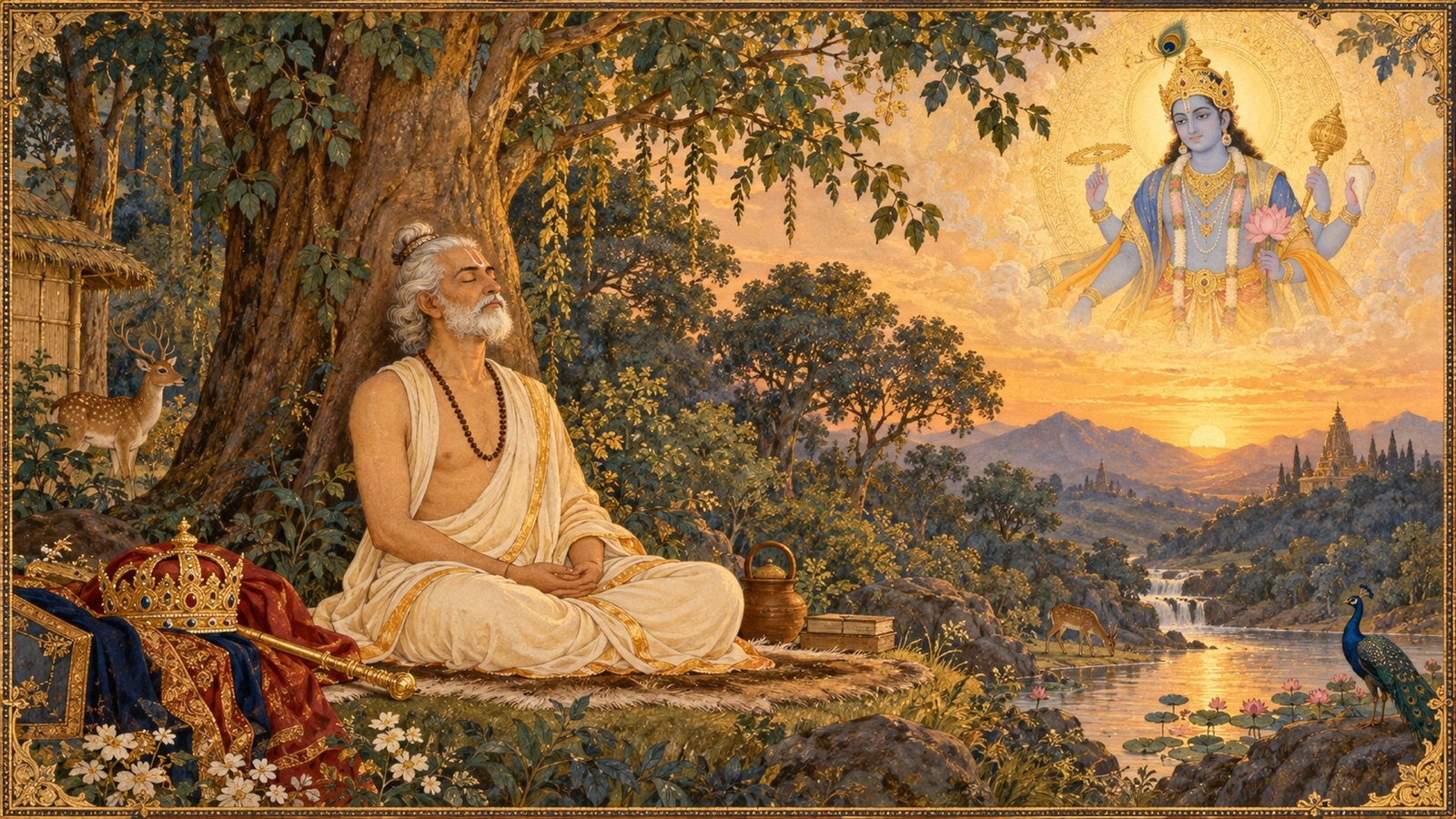
The chapter closes with the assurance that anyone who recites and meditates on this sacred story of Emperor Ambarisha is sure to become a devotee of the Lord.
Principal Teachings of This Chapter
1. A true devotee wishes well even to his enemy. Ambarisha’s first thought, once vindicated, is not triumph but mercy; he prays with all his heart for the safety of the very sage who tried to kill him (verses 3-11).
2. God’s power answers the prayer of the humble. The Sudarsana, unstoppable by Brahma and Siva, grows calm at the entreaty of a loving devotee (verse 12).
3. The greatness of the devotee humbles even the great. The formidable Durvasa is not conquered by force but won over by love, and becomes the devotee’s own praise-singer (verses 14-17).
4. Devotion expresses itself in patient, selfless service. Ambarisha fasts a whole year in hope of his guest’s return, then feeds him first and claims no credit, seeing all as the Lord’s glory (verses 18-24).
5. The goal of devotion is the Lord Himself. Ambarisha counts even the throne of Brahma as nothing, and ends his life absorbed in Vasudeva, freed from birth and death (verses 25-27).
A Devotional Reflection
The deepest note in this chapter is struck not by the burning discus but by the king’s prayer. Ambarisha has done nothing wrong; the whole ordeal was forced upon him. And yet, when the offending sage falls at his feet, the king is not glad to see him punished — he is pained, and he pleads for his rescue. This is the fragrance of a heart that has truly taken God in: it can no longer hold an enemy. Durvasa circled the universe in terror and could not find safety; Ambarisha, standing still in his own city, was safe all along, because he wanted nothing for himself. Even his year-long fast he mentions to no one; it comes to light almost by accident, and he treats it as the Lord’s doing, not his own achievement. Here is a portrait of the devotee we can carry into our own lives: gentle where we would be angry, generous where we would demand our due, and quietly certain that God, not our own effort, is the source of every good.
A Daily Devotional Practice
Today, in the spirit of Ambarisha, offer a prayer for someone who has wronged or troubled you — not a grudging word, but a sincere wish for their welfare, placed before the Lord. As you do, gently recite, “Om Namo Bhagavate Vasudevaya.” If you can, add one small act of patient service given without seeking thanks, and when it is done, offer even that quietly to the Lord, taking no credit, trusting that every good in your life flows from Him alone.
Conclusion
The fifth chapter of Book Nine brings the story of Ambarisha to its close by revealing what pure devotion ultimately looks like: a heart too full of God to hold an enemy, so gentle that even the Lord’s own unstoppable weapon yields to it before it yields to any other power or protest. Durvasa discovers this truth from the outside, humbled; Ambarisha lives it from within, asking nothing for himself. May we learn what he shows us: that surrender to the Lord alone — not throne, heaven, or vindication — is the devotee’s true and final rest. Whoever dwells upon this sacred story is promised to become such a devotee.
May the divine wisdom of Srimad Bhagavatam awaken pure devotion within our hearts.
Om Namo Bhagavate Vasudevaya.
Jay Shree Madhav.
References and Attribution
- Primary edition: Gita Press, Śrīmad Bhāgavata Mahāpurāṇa (English, complete), Book Nine, Discourse 5, pages 18–21.
- Series: Srimad Bhagavatam Wisdom · Biswa Sanatan Dharma Seva Trust.
- Presented following the spiritual guidance and recommendation of Pandit Dr. Shri Kashinath Mishra.
This is an original, faithful retelling in the writer’s own words, with brief quoted verses shown in Devanāgarī and transliteration and their meanings given as summaries. It is not a reproduction of any single publisher’s continuous translation or commentary. No affiliation with or endorsement by any publisher is implied.
Jay Shree Madhav