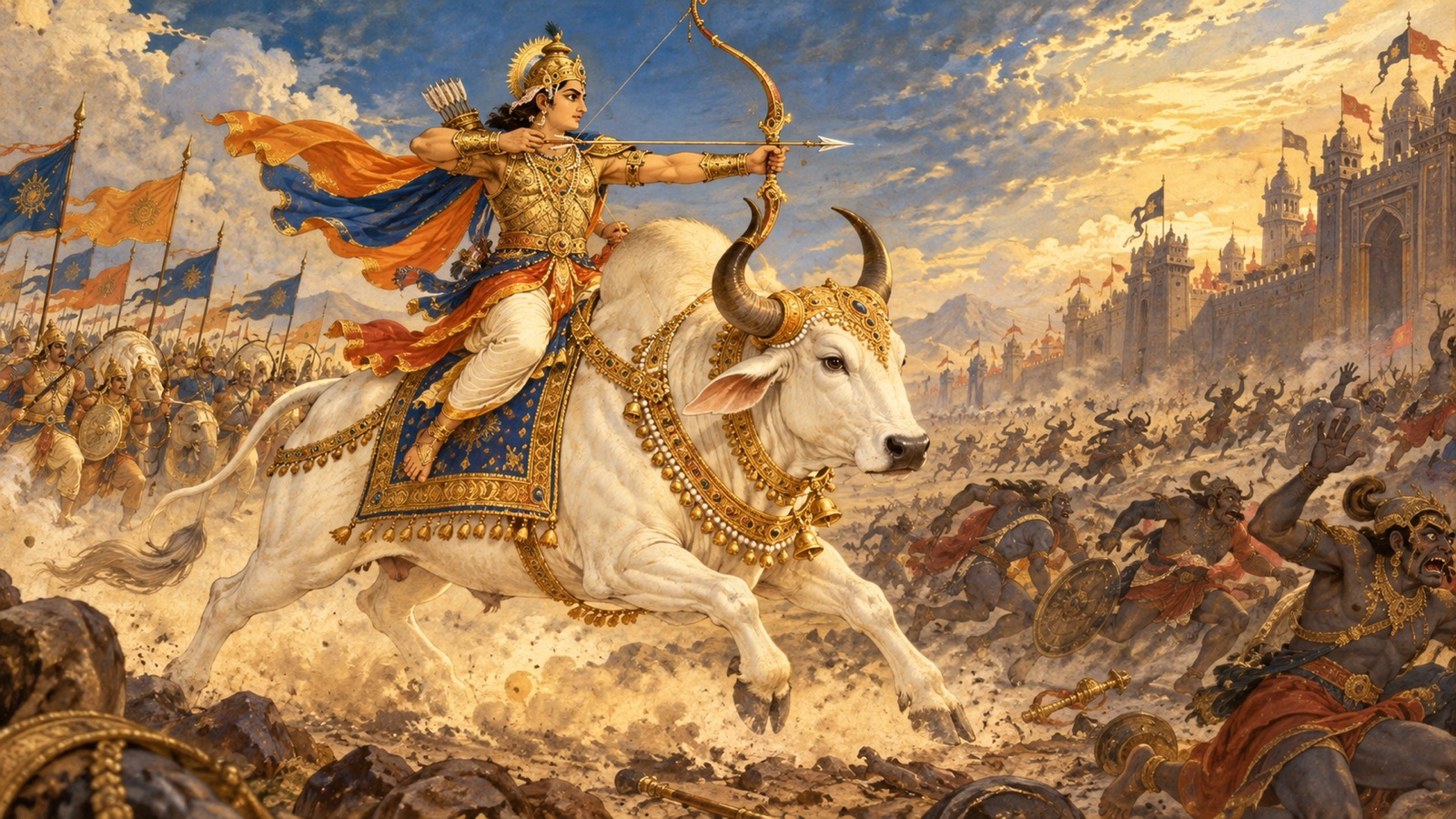
Armoured and eager for battle, the royal hero Puranjaya rides upon the hump of a gigantic bull — Indra himself, transformed at the Lord’s command — to break the power of the demons and win his three famous names.
Om Namo Bhagavate Vasudevaya.
Om Namo Bhagavate Vasudevaya.
Om Namo Bhagavate Vasudevaya.
Welcome to Srimad Bhagavatam Wisdom, a devotional journey through the sacred histories and teachings of the Srimad Bhagavat Mahapurana. This sixth chapter of Book Nine opens the celebrated dynasty of Ikshvaku — the great solar line in which Lord Sri Rama would one day appear — and it is, above all, a chapter about the fragility of self-control and the sure refuge of devotion.
Chapter Information
- Scripture: Śrīmad Bhāgavata Mahāpurāṇa
- Canto: 9 (Book Nine)
- Chapter: 6 (Discourse 6)
- Chapter title: The Line of Ikshvaku: Mandhata and the Sage Saubhari
- Principal speaker: Sukadeva Gosvami, narrating to King Parikshit — the whole related by Suta Gosvami to the sage Saunaka and the assembly of sages at Naimisaranya
- Principal listener: King Parikshit
- Main setting: The kingdoms of the Ikshvaku dynasty; the hermitage on the banks of the Yamuna
- Central subject: The posterity of Ikshvaku — Vikukshi, Puranjaya, Yuvanaswa and the birth of Mandhata; and the story of the sage Saubhari, his fall into household enjoyment and his final renunciation and liberation
- Principal verse range: Canto 9, Chapter 6, verses 1–55
- Primary edition: Gita Press Śrīmad Bhāgavata Mahāpurāṇa
The Line of Ikshvaku
Ambarisha had three sons — Virupa, Ketuman and Sambhu — and from Virupa the line continued through Prshadaswa and Rathitara. Then Sukadeva turned to the founder of the great dynasty: from a sneeze of Vaivaswata Manu was born a son, Ikshvaku, who had a hundred sons, the eldest being Vikukshi, Nimi and Dandaka.
क्षुवतस्तु मनोर्जज्ञे इक्ष्वाकुर्घ्राणत: सुत: । तस्य पुत्रशतज्येष्ठा विकुक्षिनिमिदण्डका: ॥ ४ ॥
kṣuvatas tu manor jajñe ikṣvākur ghrāṇataḥ sutaḥ tasya putra-śata-jyeṣṭhā vikukṣi-nimi-daṇḍakāḥ
Meaning: From Manu, while he was sneezing, a son named Ikshvaku was born from his nostril; of his hundred sons, the eldest were Vikukshi, Nimi and Dandaka. (Canto 9, Chapter 6, verse 4)
These sons were established as rulers over the eastern, western, central, northern and southern regions of Aryavarta.
Vikukshi and the Forbidden Offering
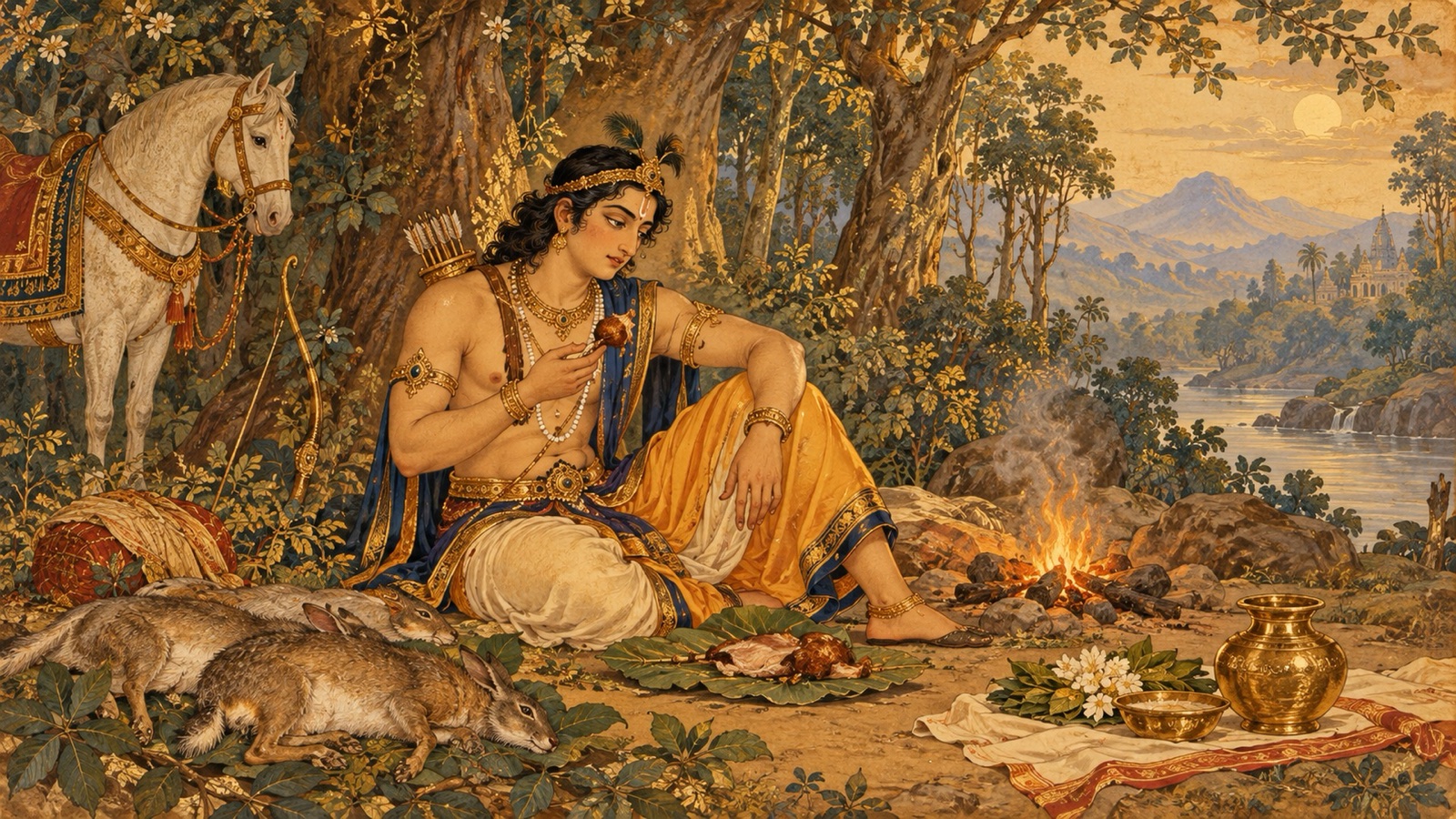
Once, during a Sraddha rite for the departed, Ikshvaku commanded his son Vikukshi to bring flesh fit for offering to the ancestors. The prince went to the forest and hunted the appropriate animals, but, worn out and hungry, thoughtlessly ate the flesh of a hare before returning. When the remainder was brought to Ikshvaku’s preceptor, the sage Vasishtha, to be consecrated, he declared it defiled and unfit for the rite.
Learning from his preceptor what his son had done, the king angrily exiled Vikukshi for having abandoned the conduct of good men. Ikshvaku himself, after discoursing with Vasishtha on the highest truth, became established in the path of knowledge and attained the supreme on leaving his body. Vikukshi then returned, ruled the earth, worshipped Sri Hari through many sacrifices, and became known as Sasada — “the eater of a hare.”
Puranjaya, the Rider of the Bull
Vikukshi’s son was Puranjaya, who earned three names — Indravaha, Kakutstha and Puranjaya — through a single great deed. In those days a war between the gods and the demons all but destroyed creation, and the defeated gods enlisted Puranjaya as their champion. He agreed to fight on one condition: that Indra himself become his mount. At the bidding of Lord Vishnu, the soul of the universe, Indra took the form of a gigantic bull, and the hero climbed onto its hump.
स सन्नद्धो धनुर्दिव्यमादाय विशिखाञ्छितान् । स्तूयमानस्तमारुह्य युयुत्सु: ककुदि स्थित: ॥ १५ ॥ तेजसाप्यायितो विष्णो: पुरुषस्य महात्मन: । प्रतीच्यां दिशि दैत्यानां न्यरुणत् त्रिदशै: पुरम् ॥ १६ ॥
sa sannaddho dhanur divyam ādāya viśikhāñ chitān stūyamānas tam āruhya yuyutsuḥ kakudi sthitaḥ tejasāpyāyito viṣṇoḥ puruṣasya mahātmanaḥ pratīcyāṁ diśi daityānāṁ nyaruṇat tridaśaiḥ puram
Meaning: Armoured, taking up a celestial bow and sharp arrows, and praised by the gods, he mounted the bull and sat upon its hump, eager to fight; invigorated by the power of Lord Vishnu, the supreme Person, he besieged with the gods the city of the demons in the west. (Canto 9, Chapter 6, verses 15-16)
Strengthened by the might of the Lord, Puranjaya scattered the demons, driving them back to their realm, and restored the conquered city and its wealth to Indra. For riding Indra (Indravaha), for sitting on the bull’s hump (Kakutstha), and for conquering the enemy city (Puranjaya), the three names became his.
From Puranjaya to the Slayer of Dhundhu
The line continued through Anena, Prthu, Viswagandhi, Candra and Yuvanaswa to Sravasta, who built the city of Sravasti, and then to Brhadaswa and Kuvalayaswa. To oblige the sage Utanka, the powerful Kuvalayaswa, accompanied by his twenty-one thousand sons, slew the demon Dhundhu and so became renowned as Dhundhumara, “the slayer of Dhundhu” — though nearly all his sons perished in the fire that issued from the demon’s mouth, only three surviving. Through these survivors the dynasty passed down once more to a king named Yuvanaswa.
Yuvanaswa and the Birth of Mandhata
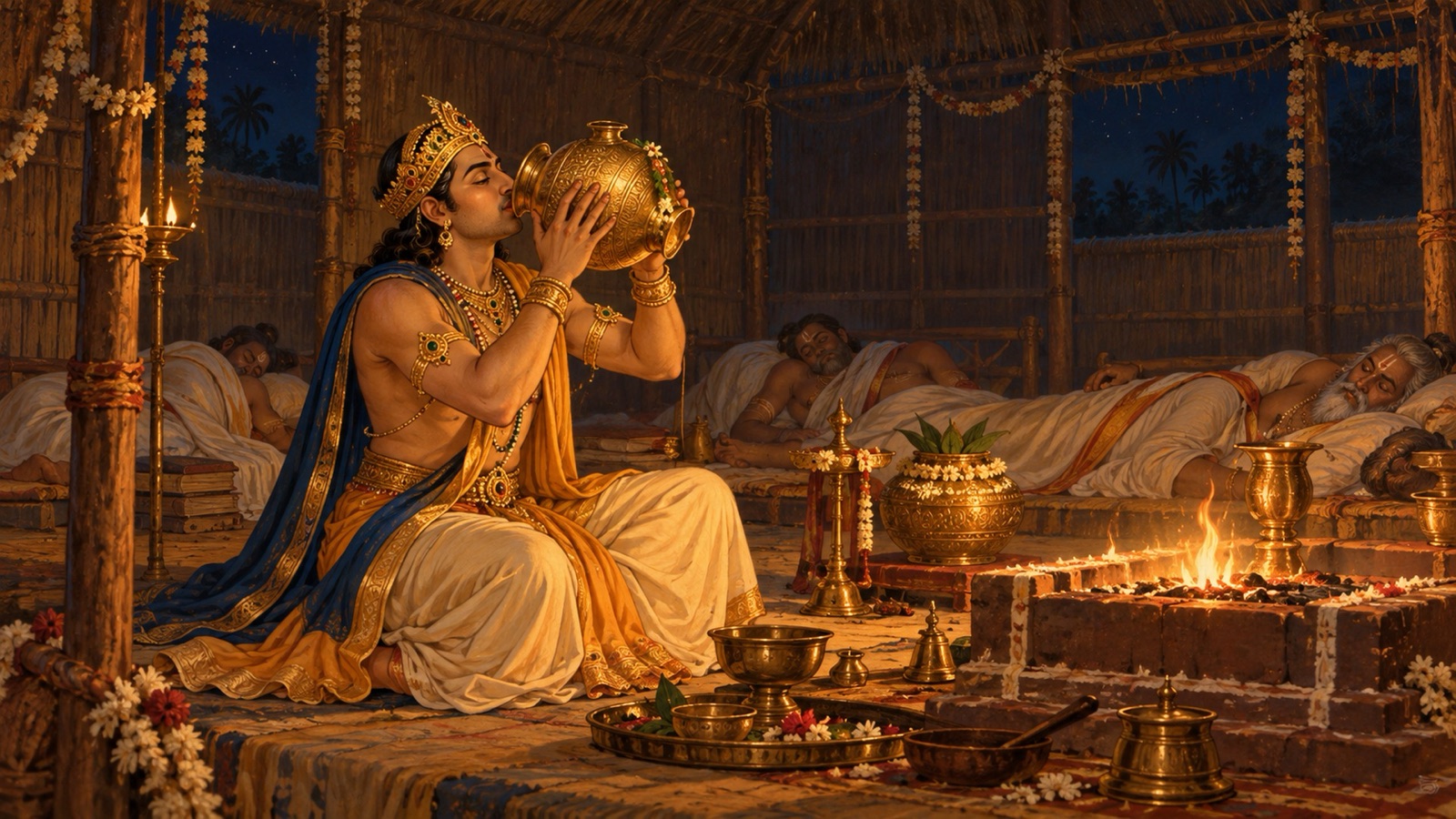
This Yuvanaswa was childless, and in his despair he retired to a forest hermitage with his hundred wives. The compassionate sages there undertook a great sacrifice to Indra on his behalf, to obtain him a son, consecrating with sacred mantras a pot of water for his queen to drink. But one night the thirsty king, entering the sacrificial hut and finding the Brahmanas asleep, unknowingly drank the consecrated water himself.
राजा तद् यज्ञसदनं प्रविष्टो निशि तर्षित: । दृष्ट्वा शयानान् विप्रांस्तान् पपौ मन्त्रजलं स्वयम् ॥ २७ ॥
rājā tad-yajña-sadanaṁ praviṣṭo niśi tarṣitaḥ dṛṣṭvā śayānān viprāṁs tān papau mantra-jalaṁ svayam
Meaning: Thirsty in the night, the king entered the sacrificial hall and, seeing the Brahmanas asleep, himself drank the water consecrated with mantras. (Canto 9, Chapter 6, verse 27)
When the priests found the pot empty and learned that the king had drunk the water, they bowed to the Lord, marvelling, “Oh, the power of destiny alone is the real strength!” In due course a son was born by splitting open the right side of Yuvanaswa’s body. When the infant cried for milk and the Brahmanas wondered who would nurse him, Indra placed his own nectar-dripping finger in the baby’s mouth, saying, “He shall suck me” — and so the child was named Mandhata.
कं धास्यति कुमारोऽयं स्तन्ये रोरूयते भृशम् । मां धाता वत्स मा रोदीरितीन्द्रो देशिनीमदात् ॥ ३१ ॥
kaṁ dhāsyati kumāro ’yaṁ stanye rorūyate bhṛśam māṁ dhātā vatsa mā rodīr itīndro deśinīm adāt
Meaning: “Whom will this child suck, crying so bitterly for milk?” Saying, “He shall suck me — do not weep, my child,” Indra gave him his index finger. (Canto 9, Chapter 6, verse 31)
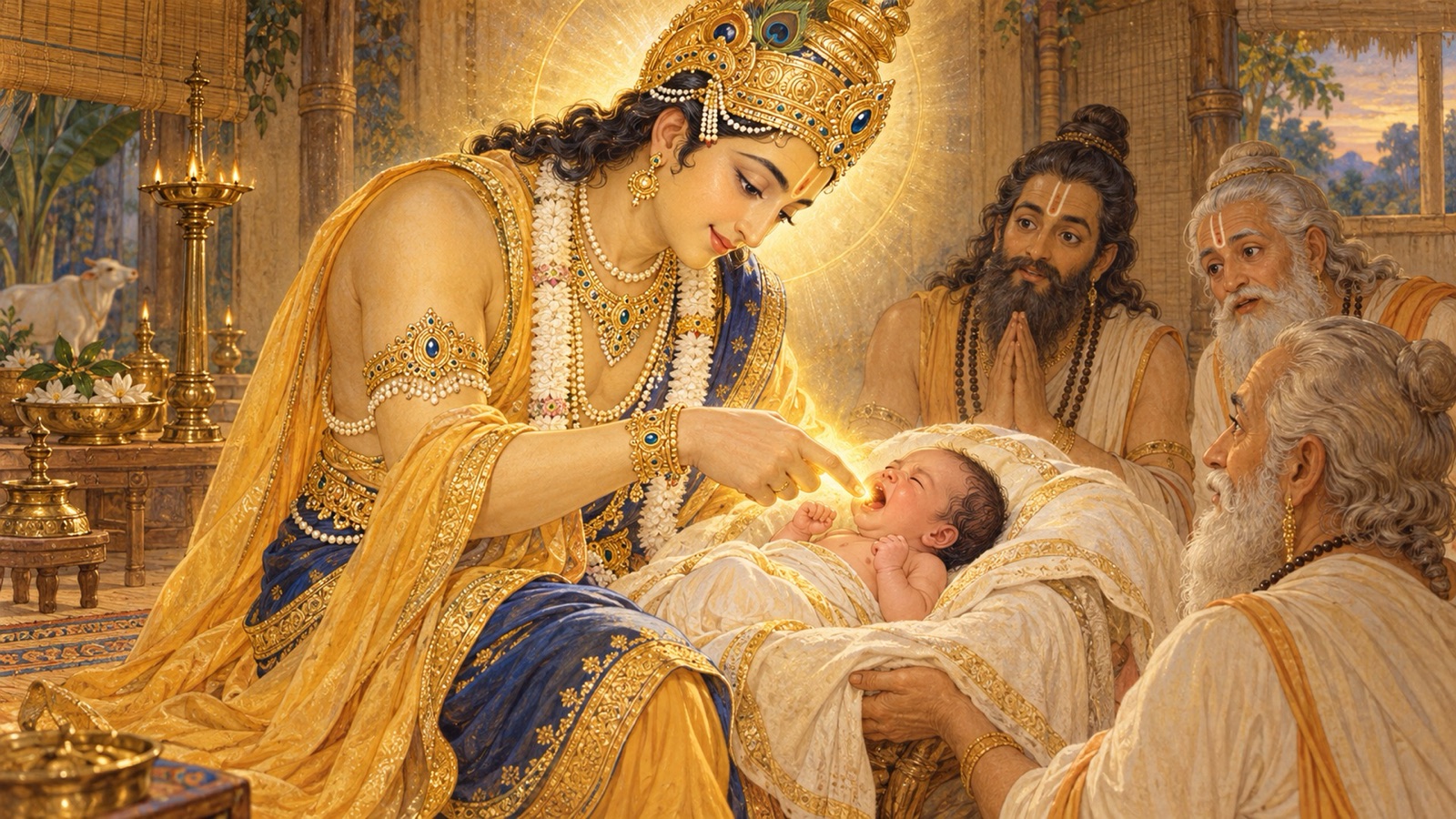
By the grace of the Brahmanas and the gods, Yuvanaswa did not die but attained perfection through austerity in that very hermitage. Indra also named the child Trasaddasyu, “the terror of miscreants,” for villains such as the demon-king Ravana — later slain by Lord Rama, born in this same line — would tremble before him.
The Reign of Mandhata
Empowered by the immortal Lord, Mandhata ruled the entire globe of seven divisions as its one sovereign, so that the whole land from sunrise to sunset was called his domain. Though himself a knower of the Self, he worshipped Lord Vishnu — who is all the gods, who embodies all, and who is beyond sense-perception — through many sacrifices with liberal gifts to the Brahmanas. Through his queen Bindumati he had three sons: Purukutsa, Ambarisha, and the mystic Mucukunda; and fifty daughters, whose story now unfolds.
The Sage Saubhari
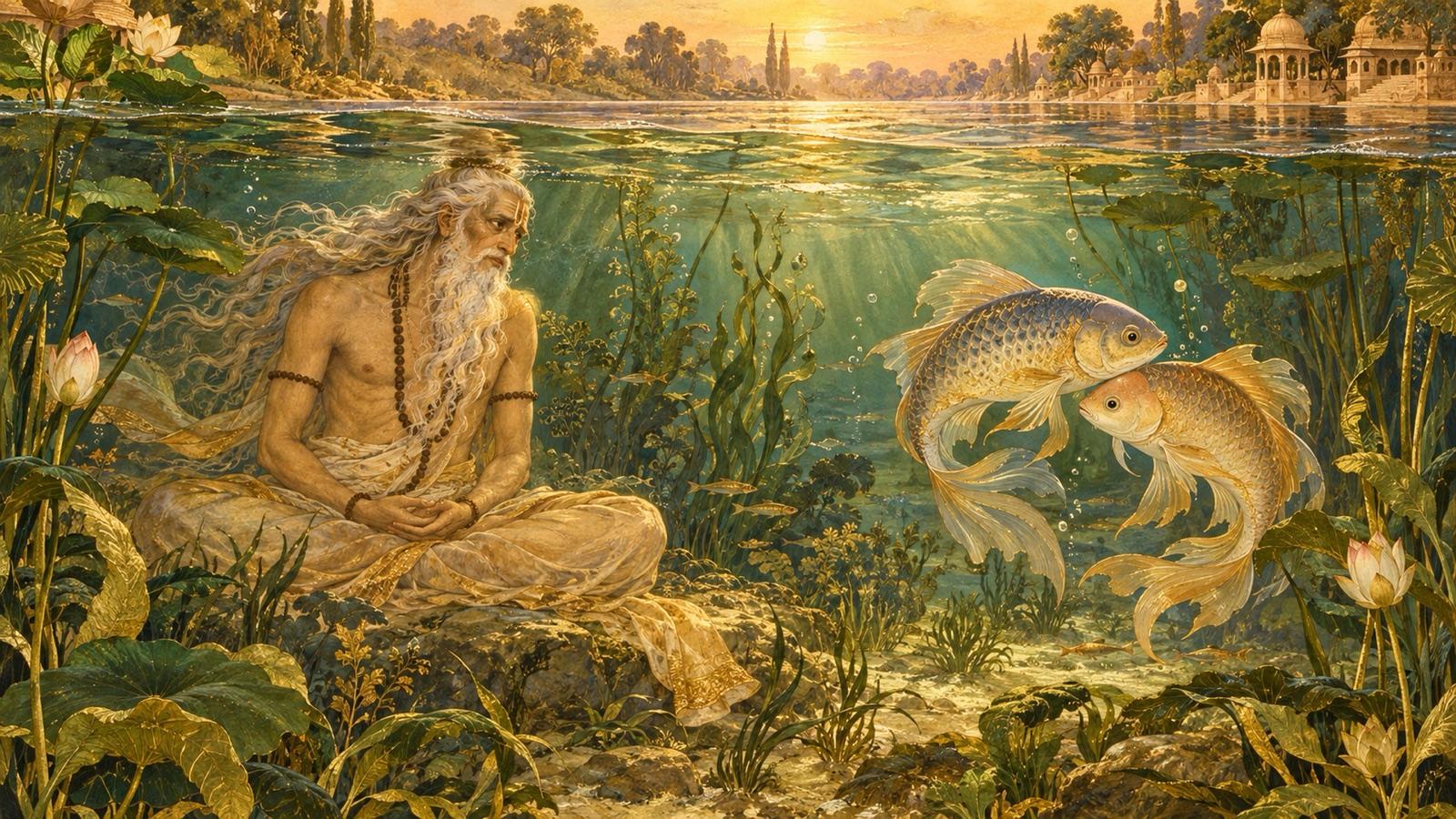
All fifty of Mandhata’s daughters came to choose a single husband — the sage Saubhari. Submerged in the waters of the Yamuna in intense austerity, this aged Brahmana had one day seen the happiness of a great fish sporting with its mate, and a longing for married delight arose in him. He approached Mandhata and asked for one of his daughters. The emperor, wary of giving his child to so old and wrinkled a sage, replied diplomatically that the girl was his if she chose him of her own free will at her svayamvara.
यमुनान्तर्जले मग्नस्तप्यमान: परन्तप: । निर्वृतिं मीनराजस्य दृष्ट्वा मैथुनधर्मिण: ॥ ३९ ॥ जातस्पृहो नृपं विप्र: कन्यामेकामयाचत । सोऽप्याह गृह्यतां ब्रह्मन् कामं कन्या स्वयंवरे ॥ ४० ॥
yamunāntar-jale magnas tapyamānaḥ paraṁ tapaḥ nirvṛtiṁ mīna-rājasya dṛṣṭvā maithuna-dharmiṇaḥ jāta-spṛho nṛpaṁ vipraḥ kanyām ekām ayācata so ’py āha gṛhyatāṁ brahman kāmaṁ kanyā svayaṁvare
Meaning: Immersed in the water of the Yamuna, performing severe austerity, the Brahmana, on seeing the delight of a lordly fish sporting with its mate, was filled with longing and asked the king for one daughter; and the king replied, “Take her, O Brahmana, if the girl chooses you of her own accord.” (Canto 9, Chapter 6, verses 39-40)
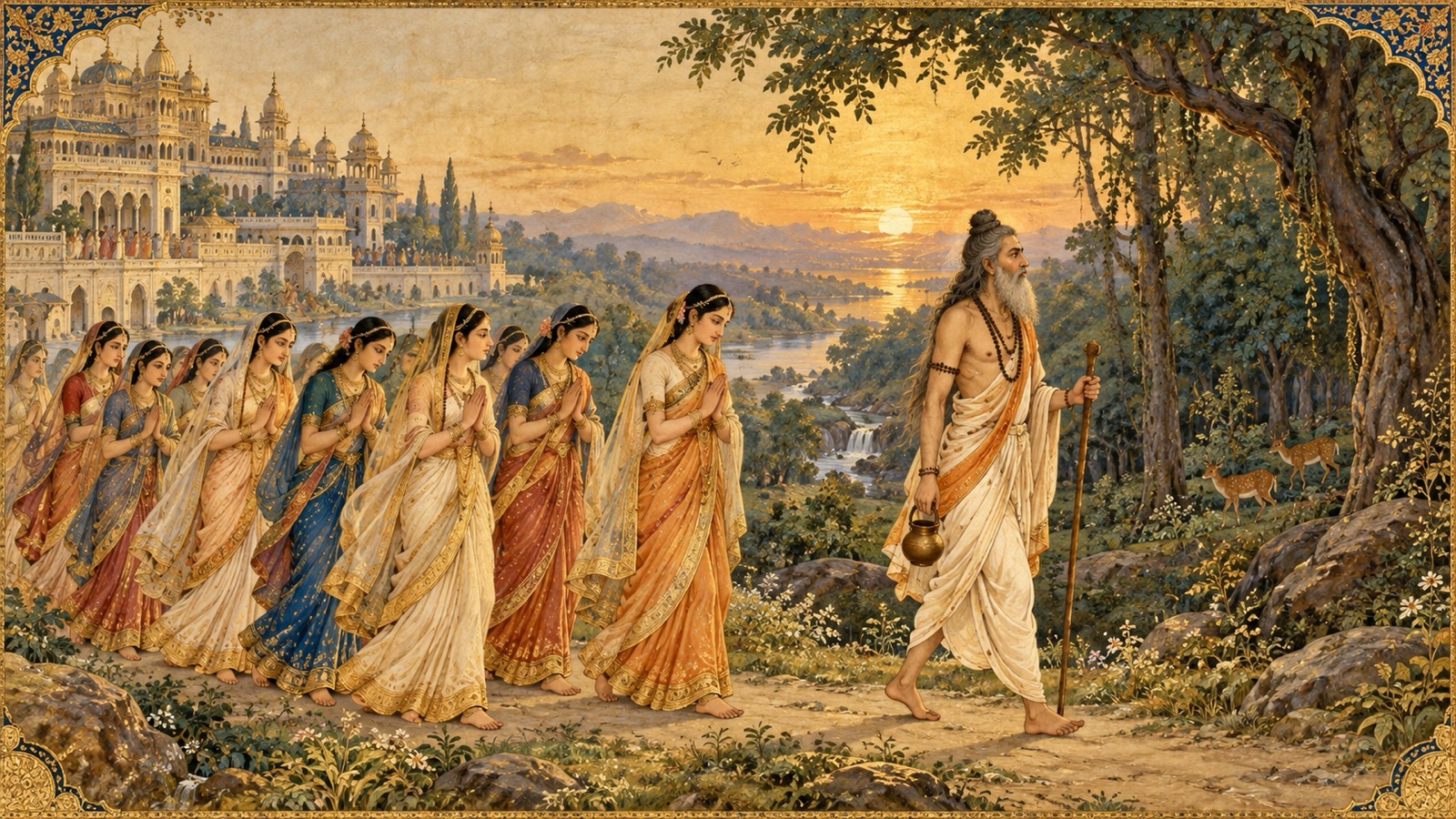
Sensing an indirect refusal, and resolving to make himself irresistible, the powerful sage used his ascetic power to transform himself into a figure of surpassing beauty. Ushered into the princesses’ quarters, he was desired by all fifty, who quarrelled bitterly over him, each insisting he was hers alone. By his boundless yogic wealth Saubhari then created for them opulent palaces, gardens, lakes and every luxury, and revelled with his fifty wives. Even Mandhata, sovereign of the whole earth, was struck with wonder at this household splendour and set aside his own pride of position — yet, like fire fed with drops of butter, Saubhari’s enjoyment only grew and was never satisfied.
The Awakening and Liberation of Saubhari
At last, sitting quietly one day, Saubhari perceived how far he had fallen, and traced the whole ruin to that single moment’s attachment born of watching the fish. He lamented that an austerity maintained for so long had been swept away by one unguarded contact, and drew from it a clear teaching.
Yet Saubhari’s own account of his fall points past the fish to something deeper. Years before, when Garuda, the great carrier of Lord Vishnu, had come to that same river seeking fish for his meal, Saubhari had sheltered this very fish out of misplaced tenderness — inadvertently denying a great Vaishnava his due. It was this offense at the feet of a devotee, more than the fish’s play itself, that opened the breach through which desire finally entered so accomplished a yogi (verse 49). The lesson a devotee draws from this is sobering: mystic power and long austerity are no guarantee of safety; what truly protects the soul is freedom from offense against the Lord’s own devotees, for once that shelter is lost, no tapasya can hold the mind steady.
सङ्गं त्यजेत मिथुनव्रतीनां मुमुक्षु: सर्वात्मना न विसृजेद् बहिरिन्द्रियाणि । एकश्चरन् रहसि चित्तमनन्त ईशे युञ्जीत तद्व्रतिषु साधुषु चेत् प्रसङ्ग: ॥ ५१ ॥
saṅgaṁ tyajeta mithuna-vratīnāṁ mumukṣuḥ sarvātmanā na visṛjed bahir-indriyāṇi ekaś caran rahasi cittam ananta īśe yuñjīta tad-vratiṣu sādhuṣu cet prasaṅgaḥ
Meaning: One who seeks liberation should give up attachment to those bound to married life, should never let the outward senses run loose, and, living alone in seclusion, should fix the mind on the infinite Lord — keeping company, if company be desired at all, only with saintly souls devoted to Him. (Canto 9, Chapter 6, verse 51)
Reflecting that from a solitary ascetic he had become “fifty” through marriage and “five thousand” through his sons, and that his desires now knew no end, Saubhari grew disgusted with household life. Embracing renunciation, he retired to the forest; his devoted wives, who looked upon him as their deity, followed him. There he practised severe austerity, mastered himself, and merged his soul, along with the sacred fires, in the Supreme — and his wives, by the power of his spiritual glory, attained the same goal, as flames subside when the fire that fed them has cooled.
Principal Teachings of This Chapter
1. A moment’s thoughtlessness can undo a great inheritance. Vikukshi loses his birthright not through malice but through one careless act during a sacred rite (verses 6-9).
2. Real strength comes from the Lord. Puranjaya conquers the demons not by his own might but “invigorated by the power of Lord Vishnu,” even riding the king of the gods as his mount (verses 13-19).
3. Destiny works through the smallest events. A king’s midnight thirst, drinking the wrong cup of water, brings forth the world-ruling Mandhata — “the power of destiny alone is the real strength” (verses 27-31).
4. Even great austerity is fragile before a single desire. Saubhari’s long tapas is swept away by one glance at the sporting fish; the senses, once indulged, are never satisfied (verses 39-48).
5. The way back is renunciation and solitude with the Lord. Awakened, Saubhari gives up all, fixes his mind on the infinite Lord in seclusion, and attains liberation — carrying even his wives with him (verses 51-55).
A Devotional Reflection
The two hearts of this chapter — Puranjaya and Saubhari — quietly mirror one another. Puranjaya is strong only because he leans wholly on the Lord; mounted on the king of the gods, he still fights by Vishnu’s power, not his own. Saubhari is a giant of austerity, yet the moment he leans on his own accomplishment and lets a single desire slip past his guard, his whole edifice of self-control collapses, and he spends years discovering that no amount of enjoyment can fill a heart that has turned outward. His story is not told to shame him but to warn us: spiritual strength is never a possession we can bank and forget; it is safe only when it rests, moment by moment, in God. And his ending is full of hope. However far he wandered, the sage did find his way home — through honest self-examination, renunciation, and the fixing of his mind on the infinite Lord. What ruined him was self-reliance; what saved him was surrender. That is the choice set before every seeker.
A Daily Devotional Practice
Today, in the spirit of Saubhari’s hard-won wisdom, keep a gentle guard over your senses. Choose one desire or distraction that habitually pulls your mind outward, and, instead of feeding it, turn quietly inward with the prayer, “Om Namo Bhagavate Vasudevaya.” Spend a few minutes alone, away from noise, letting the mind rest on the Lord. And follow Saubhari’s counsel by seeking, whenever you can, the company of those who love God — for good company steadies the wavering heart far better than willpower alone.
Conclusion
The sixth chapter of Book Nine closes with a single sober teaching: greatness, whether of arms or of austerity, is borrowed strength. It flourishes only while rooted in the Lord and crumbles the moment we claim it as our own — as Saubhari discovered when one unguarded desire consumed a lifetime’s tapas. Yet his story ends not in despair but in hope: the senses can never be satisfied by indulgence, but the heart that turns back to God always finds its rest. Fittingly, it is into this very dynasty of Ikshvaku that Lord Sri Rama Himself would one day descend — proof that this one refuge never fails.
May the divine wisdom of Srimad Bhagavatam awaken pure devotion within our hearts.
Om Namo Bhagavate Vasudevaya.
Jay Shree Madhav.
References and Attribution
- Primary edition: Gita Press, Śrīmad Bhāgavata Mahāpurāṇa (English, complete), Book Nine, Discourse 6, pages 21–33.
- Series: Srimad Bhagavatam Wisdom · Biswa Sanatan Dharma Seva Trust.
- Presented following the spiritual guidance and recommendation of Pandit Dr. Shri Kashinath Mishra.
This is an original, faithful retelling in the writer’s own words, with brief quoted verses shown in Devanāgarī and transliteration and their meanings given as summaries. It is not a reproduction of any single publisher’s continuous translation or commentary. No affiliation with or endorsement by any publisher is implied.
Jay Shree Madhav