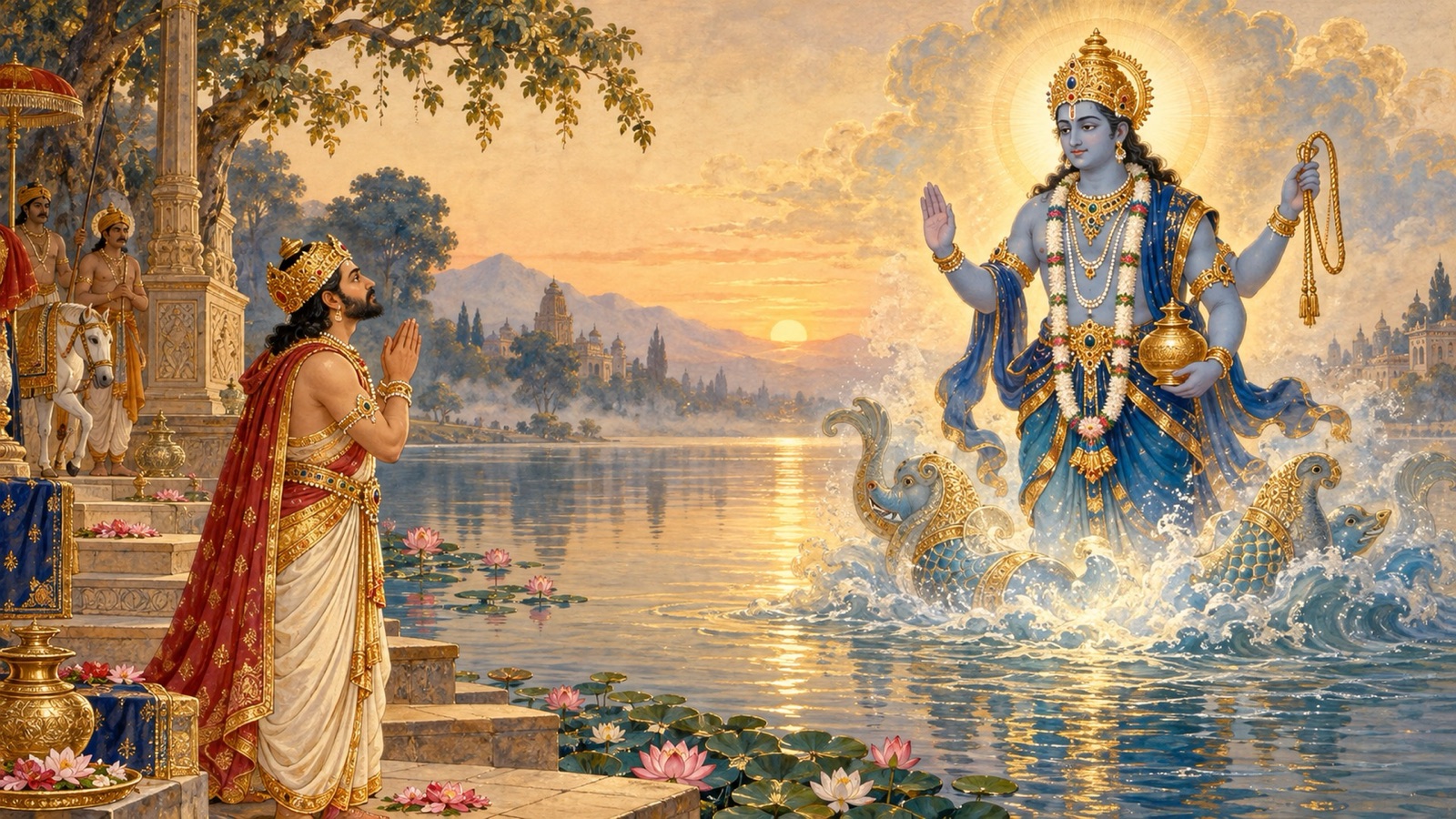
Childless and sorrowful, King Hariscandra stands at the water’s edge and prays with folded hands to Varuna, the lord of the waters, for the boon of a son — a vow that will test his truthfulness to its very limit.
Om Namo Bhagavate Vasudevaya.
Om Namo Bhagavate Vasudevaya.
Om Namo Bhagavate Vasudevaya.
Welcome to Srimad Bhagavatam Wisdom, a devotional journey through the sacred histories and teachings of the Srimad Bhagavat Mahapurana. This seventh chapter of Book Nine follows the solar dynasty forward from Emperor Mandhata to King Hariscandra, whose vow to Varuna and love for his son Rohita bring him, through years of trial, to the one virtue that has kept his name alive for ages — unbending truthfulness.
Chapter Information
- Scripture: Śrīmad Bhāgavata Mahāpurāṇa
- Canto: 9 (Book Nine)
- Chapter: 7 (Discourse 7)
- Chapter title: The Line of Mandhata and the Steadfast King Hariscandra
- Principal speaker: Sukadeva Gosvami, narrating to King Parikshit — the whole related by Suta Gosvami to the sage Saunaka and the assembly of sages at Naimisaranya
- Principal listener: King Parikshit
- Main setting: The kingdoms of the solar dynasty; the subterranean realm of Rasatala; the sacrificial arena of King Hariscandra
- Central subject: The descendants of Mandhata — Purukutsa in Rasatala, the line down to Trisanku — and the story of King Hariscandra, his son Rohita, and the sacrifice by which the king was freed and made steadfast in truth
- Principal verse range: Canto 9, Chapter 7, verses 1–27
- Primary edition: Gita Press Śrīmad Bhāgavata Mahāpurāṇa
The Three Branches of Mandhata’s Line
Sukadeva took up the thread from Mandhata’s three sons — Purukutsa, Ambarisa and the mystic Mucukunda. Ambarisa was adopted by his grandfather Yuvanaswa; from Ambarisa came Yauvanaswa, and from Yauvanaswa came Harita. These three — Purukutsa, Ambarisa and Harita — became the foremost of Mandhata’s line, the heads of its three great branches.
Purukutsa in the Realm of the Serpents
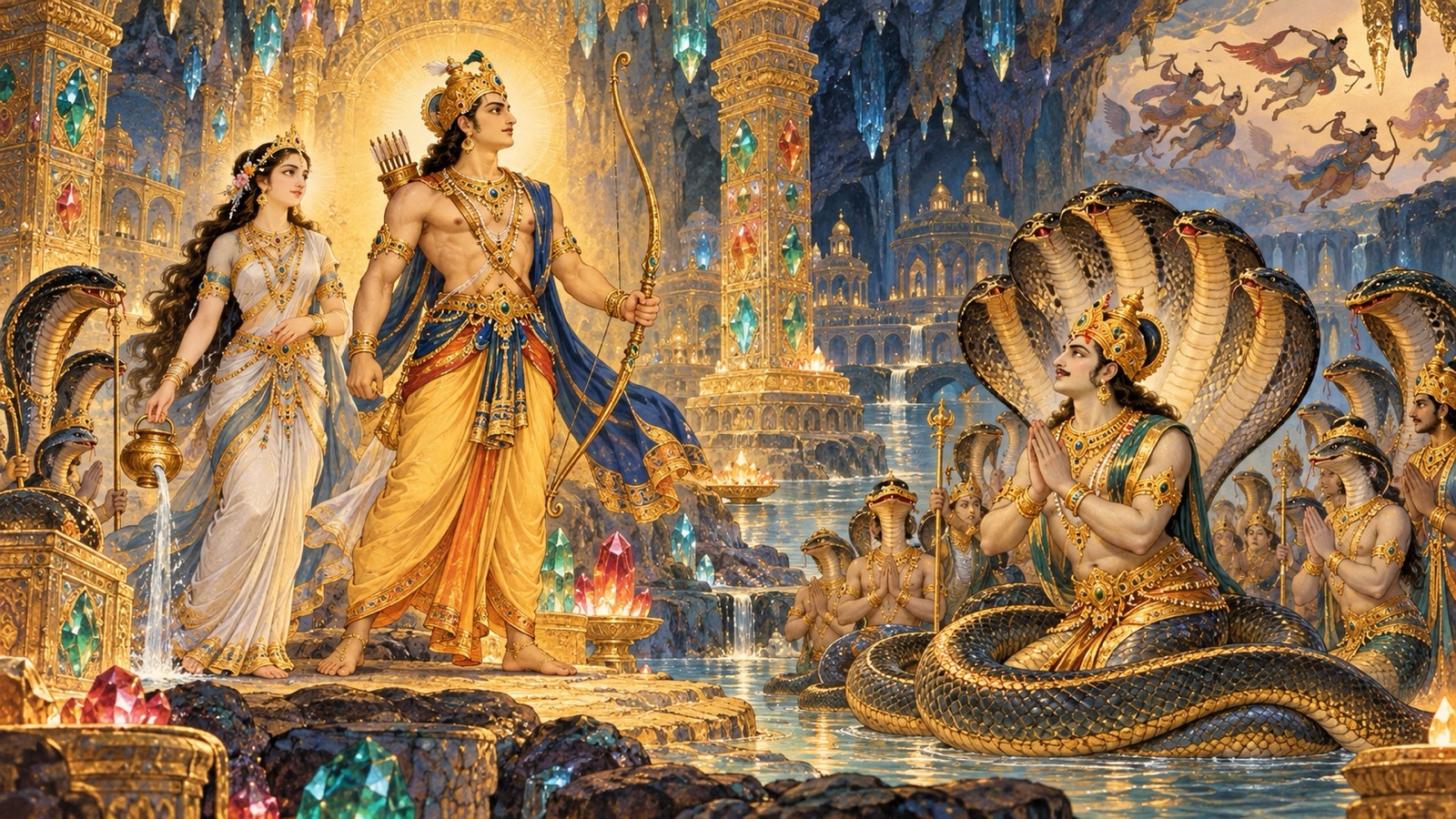
Purukutsa was given the celestial river Narmada in marriage by her brothers, the serpent-demons. At the direction of Vasuki, the king of serpents, Narmada carried Purukutsa down to Rasatala, one of the subterranean spheres.
नर्मदा भ्रातृभिर्दत्ता पुरुकुत्साय योरगै: । तया रसातलं नीतो भुजगेन्द्रप्रयुक्तया ॥ २ ॥
narmadā bhrātṛbhir dattā purukutsāya yoragaiḥ tayā rasātalaṁ nīto bhujagendra-prayuktayā
Meaning: Narmada was given in marriage to Purukutsa by her brothers the serpents; by her, at the direction of Vasuki the lord of serpents, he was carried down to Rasatala. (Canto 9, Chapter 7, verse 2)
There, wielding the power infused into him by Lord Vishnu, Purukutsa destroyed the Gandharvas who deserved to be slain, and in recognition of this service Vasuki granted him a boon: that whoever remembers this deed shall have no fear of serpents.
गन्धर्वानवधीत् तत्र वध्यान् वै विष्णुशक्तिधृक् । नागाल्लब्धवर: सर्पादभयं स्मरतामिदम् ॥ ३ ॥
gandharvān avadhīt tatra vadhyān vai viṣṇu-śakti-dhṛk nāgāl labdha-varaḥ sarpād abhayaṁ smaratām idam
Meaning: There, holding the power of Lord Vishnu, he slew the Gandharvas who deserved slaying, and obtained from the serpents the boon that whoever remembers this shall be free from fear of serpents. (Canto 9, Chapter 7, verse 3)
From Trasaddasyu to Trisanku
Purukutsa’s son was Trasaddasyu, whose son was Anaranya; from Anaranya came Haryaswa, from Haryaswa Aruna, and from Aruna, Tribandhana. Tribandhana’s son was Satyavrata, who became famous as Trisanku. Cursed by his father to the degraded rank of a Candala, he was nonetheless raised bodily to heaven by the extraordinary power of the sage Viswamitra. When the gods hurled him back head-downward, Viswamitra forcibly held him fixed in the sky, where he may be seen as a star to this very day.
तस्य सत्यव्रत: पुत्रस्त्रिशङ्कुरिति विश्रुत: । प्राप्तश्चाण्डालतां शापाद् गुरो: कौशिकतेजसा ॥ ५ ॥ सशरीरो गत: स्वर्गमद्यापि दिवि दृश्यते । पातितोऽवाक् शिरा देवैस्तेनैव स्तम्भितो बलात् ॥ ६ ॥
tasya satyavrataḥ putras triśaṅkur iti viśrutaḥ prāptaś cāṇḍālatāṁ śāpād guroḥ kauśika-tejasā saśarīro gataḥ svargam adyāpi divi dṛśyate pātito ’vāk-śirā devais tenaiva stambhito balāt
Meaning: His son Satyavrata, famed as Trisanku, having been reduced to the state of a Candala by his father’s curse, ascended bodily to heaven by the power of the sage of Kusika’s line (Viswamitra); when the gods cast him down head-foremost, that same seer held him fixed by force, and he is seen in the sky even today. (Canto 9, Chapter 7, verses 5-6)

The Sorrow of Hariscandra
Trisanku’s son was Hariscandra, on whose account the sages Viswamitra and Vasistha, cursing one another, were once transformed into two birds and fought for many years.
त्रैशङ्कवो हरिश्चन्द्रो विश्वामित्रवसिष्ठयो: । यन्निमित्तमभूद् युद्धं पक्षिणोर्बहुवार्षिकम् ॥ ७ ॥
traiśaṅkavo hariścandro viśvāmitra-vasiṣṭhayoḥ yan-nimittam abhūd yuddhaṁ pakṣiṇor bahu-vārṣikam
Meaning: Hariscandra, the son of Trisanku, was the cause of a war lasting many years between Viswamitra and Vasistha, who had become two birds. (Canto 9, Chapter 7, verse 7)
Hariscandra was childless, and his heart was heavy with grief. On the advice of the sage Narada, he took refuge in Varuna, the lord of the waters, praying, “Let a son be born to me, O lord.”
सोऽनपत्यो विषण्णात्मा नारदस्योपदेशत: । वरुणं शरणं यात: पुत्रो मे जायतां प्रभो ॥ ८ ॥
so ’napatyo viṣaṇṇātmā nāradasyopadeśataḥ varuṇaṁ śaraṇaṁ yātaḥ putro me jāyatāṁ prabho
Meaning: Sorrowful and without a son, on the instruction of Narada he sought refuge in Varuna, praying, “O lord, may a son be born to me.” (Canto 9, Chapter 7, verse 8)
He vowed, “If a son is born, O great lord, I shall worship you by sacrificing him to you.” Varuna agreed, and in time a son named Rohita was born to Hariscandra.
यदि वीरो महाराज तेनैव त्वां यजे इति । तथेति वरुणेनास्य पुत्रो जातस्तु रोहित: ॥ ९ ॥
yadi vīro mahārāja tenaiva tvāṁ yaje iti tatheti varuṇenāsya putro jātas tu rohitaḥ
Meaning: “If a heroic son is born, O great lord, I shall sacrifice him to you.” Varuna said, “So be it,” and a son named Rohita was born to him. (Canto 9, Chapter 7, verse 9)
A Father’s Loving Delays
When Rohita was born, Varuna came and asked that the child now be offered. But the father’s heart, bound by love, could not comply. Hariscandra pleaded that a victim was fit for sacrifice only after ten days; then only after the child had teethed; then only after those teeth had fallen; then only after new teeth had grown; and at last only when a Kshatriya boy was old enough to bear armour. Again and again the lord of the waters waited, while the king, tender toward his son, kept finding reasons to delay.
Rohita Flees to the Forest
When Rohita grew old enough to understand, he learned of the sacrifice his father intended, and, wishing to save his life, took up his bow and withdrew into the forest.
रोहितस्तदभिज्ञाय पितु: कर्म चिकीर्षितम् । प्राणप्रेप्सुर्धनुष्पाणिररण्यं प्रत्यपद्यत ॥ १६ ॥
rohitas tad abhijñāya pituḥ karma cikīrṣitam prāṇa-prepsur dhanuṣ-pāṇir araṇyaṁ pratyapadyata
Meaning: Learning of the deed his father intended, Rohita, seeking to preserve his life, took his bow in hand and withdrew to the forest. (Canto 9, Chapter 7, verse 16)
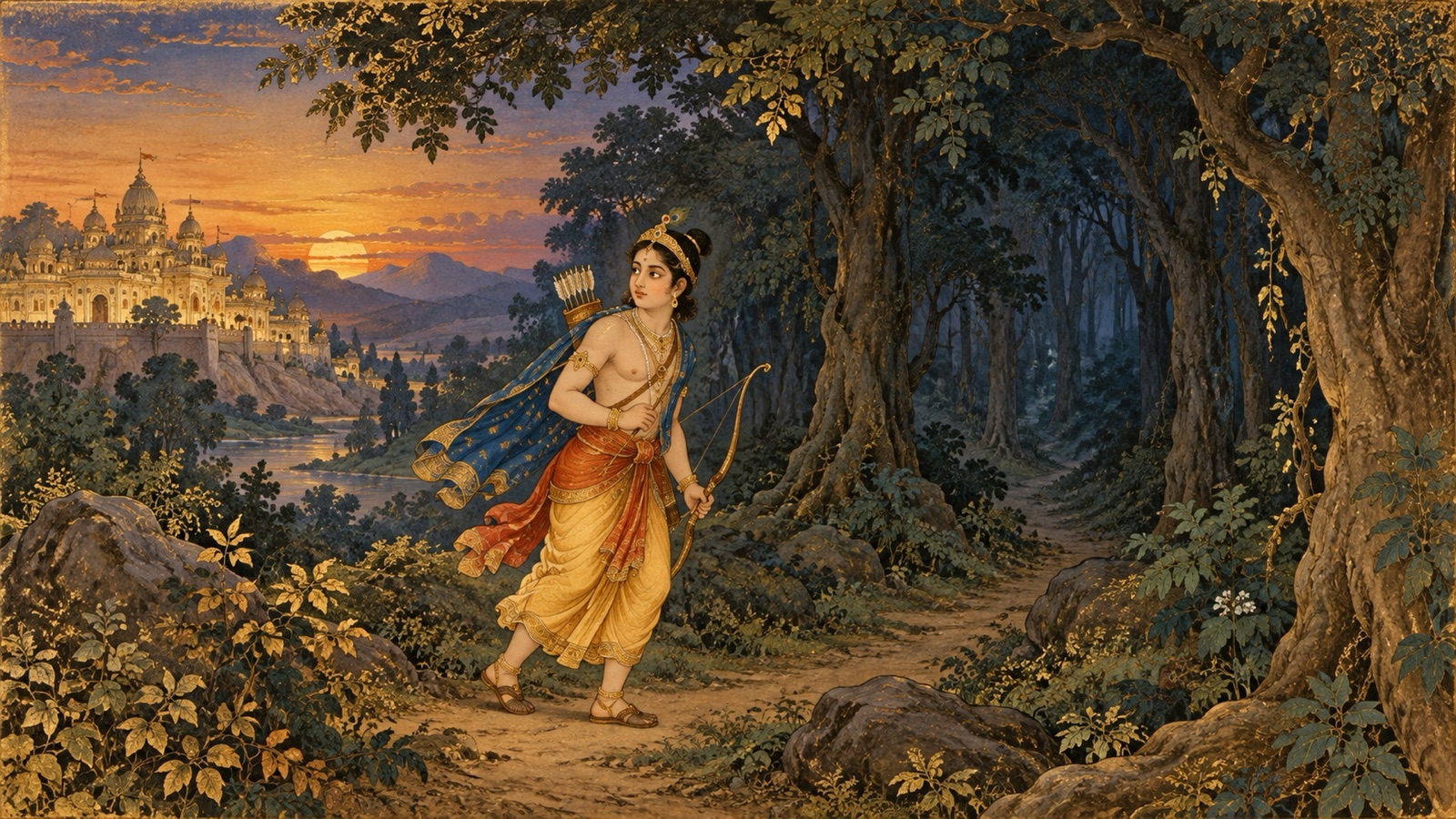
Hearing that his father had been stricken with dropsy by the angry Varuna, Rohita was about to return home, but Indra stopped him — for he would surely be sacrificed if he came back. Instead, Indra counselled him to undertake a holy pilgrimage across the earth, visiting sacred rivers and places of pilgrimage, and Rohita accordingly remained a full year in the forest.
भूमे: पर्यटनं पुण्यं तीर्थक्षेत्रनिषेवणै: । रोहितायादिशच्छक्र: सोऽप्यरण्येऽवसत् समाम् ॥ १८ ॥
bhūmeḥ paryaṭanaṁ puṇyaṁ tīrtha-kṣetra-niṣevaṇaiḥ rohitāyādiśac chakraḥ so ’py araṇye ’vasat samām
Meaning: Indra advised Rohita to undertake the sanctifying pilgrimage over the earth by resorting to holy places and sacred fields; and he too dwelt in the forest for a year. (Canto 9, Chapter 7, verse 18)
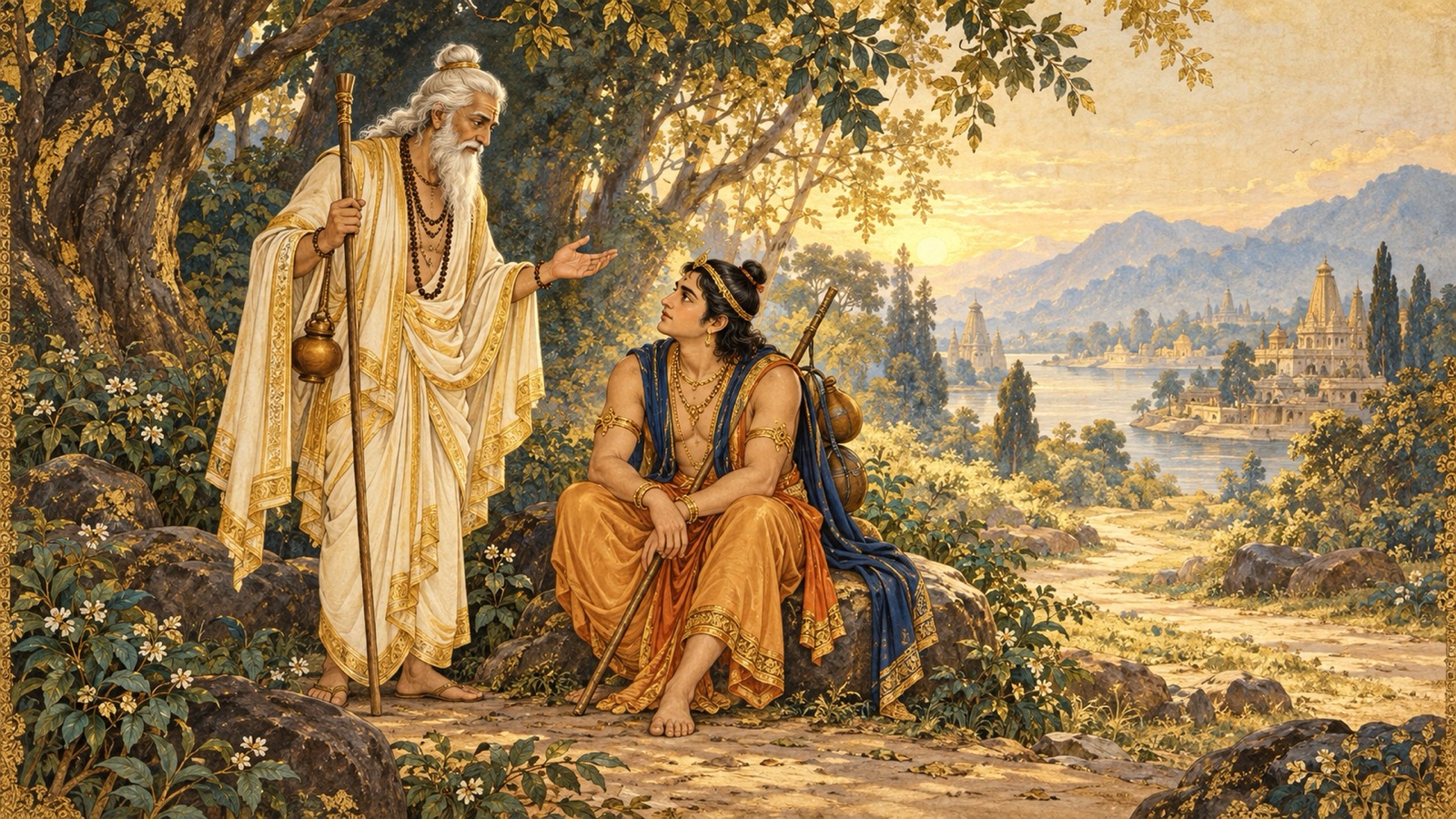
Through the second, third, fourth and fifth years, Indra came to him again, disguised as an aged Brahmana, and each time repeated the same counsel, keeping the prince safely in his wanderings.
The Sacrifice and the Freeing of the King
In the sixth year, returning at last toward the city to see his father, Rohita purchased Sunahsepa, the middle son of the Bhrgu-descended sage Ajigarta, to serve as a substitute victim. Handing the boy over to his father and bowing low, Rohita gave Hariscandra the means to fulfil his vow. The renowned king then propitiated Varuna and the other gods through a human sacrifice and was freed of his affliction. At that great rite four of the mightiest sages officiated — Viswamitra as the Hota, the self-controlled Jamadagni as the Adhwaryu, Vasistha as the Brahma, and Ayasya as the Udgata. Pleased with the king, Indra bestowed on him a chariot of gold.
तस्मै तुष्टो ददाविन्द्र: शातकौम्भमयं रथम् । शुन:शेफस्य माहात्म्यमुपरिष्टात् प्रचक्ष्यते ॥ २३ ॥
tasmai tuṣṭo dadāv indraḥ śātakaumbhamayaṁ ratham śunaḥśephasya māhātmyam upariṣṭāt pracakṣyate
Meaning: Pleased with him, Indra gave him a chariot of gold; the glory of Sunahsepa will be recounted later. (Canto 9, Chapter 7, verse 23)
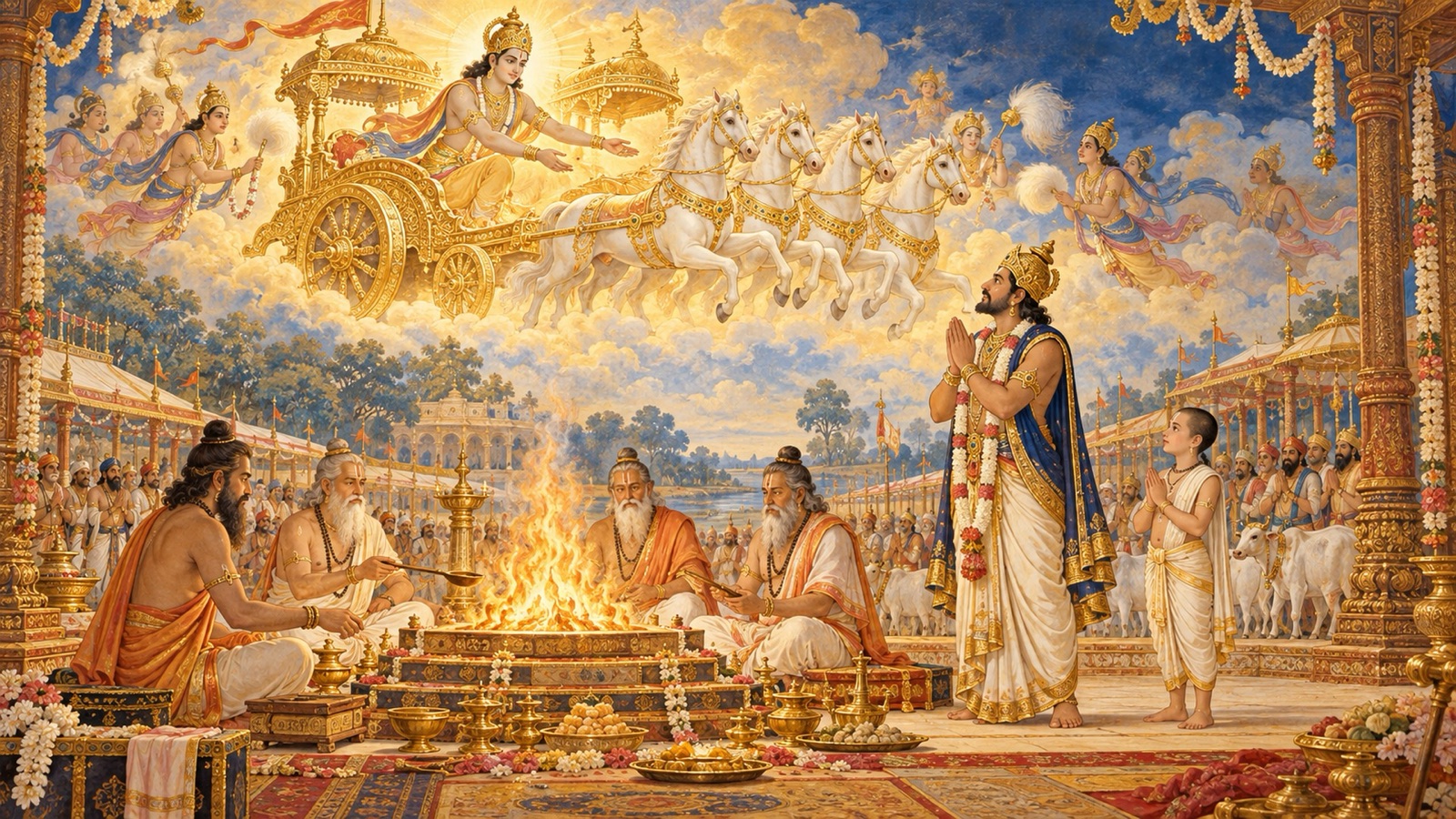
The Liberation of Hariscandra
On another occasion the sage Viswamitra, deeply gratified to see the unshakeable firmness of the king and of his queen Saibya — a firmness drawn from their perfect truthfulness — bestowed upon Hariscandra unobstructed knowledge of the Self.
सत्यं सारं धृतिं दृष्ट्वा सभार्यस्य च भूपते: । विश्वामित्रो भृशं प्रीतो ददावविहतां गतिम् ॥ २४ ॥
satyaṁ sāraṁ dhṛtiṁ dṛṣṭvā sabhāryasya ca bhūpateḥ viśvāmitro bhṛśaṁ prīto dadāv avihatāṁ gatim
Meaning: Seeing the truth, the essence and the fortitude of the king together with his queen, Viswamitra, deeply moved, gave him a path that could never be obstructed. (Canto 9, Chapter 7, verse 24)
Turning inward, the king mentally merged the elements one into another — earth into water, water into fire, fire into air, air into ether, and the subtle principles into the great cosmic intelligence — until, contemplating the pure knowledge-aspect as his very self, he burned away the ignorance that had veiled him. Giving up even that contemplation through the consciousness of unmixed bliss, and with all bondage of body and ego shaken off, he stood at last in his essential nature, beyond the reach of words or reasoning.
मन: पृथिव्यां तामद्भिस्तेजसापोऽनिलेन तत् । खे वायुं धारयंस्तच्च भूतादौ तं महात्मनि । तस्मिञ्ज्ञानकलां ध्यात्वा तयाज्ञानं विनिर्दहन् ॥ २५ ॥ हित्वा तां स्वेन भावेन निर्वाणसुखसंविदा । अनिर्देश्याप्रतर्क्येण तस्थौ विध्वस्तबन्धन: ॥ २६ ॥
manaḥ pṛthivyāṁ tām adbhis tejasāpo ’nilena tat khe vāyuṁ dhārayaṁs tac ca bhūtādau taṁ mahātmani tasmiñ jñāna-kalāṁ dhyātvā tayājñānaṁ vinirdahan hitvā tāṁ svena bhāvena nirvāṇa-sukha-saṁvidā anirdeśyāpratarkyeṇa tasthau vidhvasta-bandhanaḥ
Meaning: He dissolved mind with earth, earth with water, water with fire, fire with wind, and wind with the sky, then the sky with the total material principle; fixing his gaze there on the ray of pure knowledge, he consumed ignorance by it, and relinquishing even that state through the realization of blissful liberation, he remained fixed in his own true being — indescribable, beyond argument, wholly free of bondage. (Canto 9, Chapter 7, verses 25-26)
Here lies the real weight of the ordeal. Varuna does not relent merely because Hariscandra pleads for time, and Viswamitra’s gift is not a reward for ritual perfection; it is truthfulness itself, sustained through every delay, every fear for Rohita’s safety, every hardship of the sacrifice, that Viswamitra names outright as satyam, saram, dhrtim — truth, essence, fortitude. The long years of waiting were not an obstacle to Hariscandra’s liberation but its very forge, purifying a father’s love until nothing could shake it. Where Purukutsa needed Vishnu’s own power and Trisanku reached heaven only by another’s force, Hariscandra needed nothing but his unbroken word — proof that the plainest virtue, held to the end, is itself enough to carry a soul beyond all bondage.
Principal Teachings of This Chapter
1. Divine strength works through the surrendered soul. Purukutsa conquers the Gandharvas not by his own power but “holding the power of Lord Vishnu,” and the memory of that deed still frees others from fear (verses 2-3).
2. Ambition without humility ends suspended between worlds. Trisanku, raised toward heaven yet unable to enter it, hangs fixed in the sky — a lasting image of a life caught between earth and the goal it grasped at (verses 5-6).
3. A vow to the Lord is a sacred debt. Hariscandra’s promise to Varuna cannot simply be forgotten; the whole ordeal flows from the seriousness with which a word given to the divine must be honoured (verses 8-9).
4. Love and duty can pull a heart in two. The king’s tender delays reveal a father torn between his vow and his love — and the Lord’s arrangements gently make a way through, sparing both the son and the promise (verses 10-20).
5. Truthfulness itself becomes the door to liberation. It is the steadfast veracity of Hariscandra and Saibya that moves Viswamitra to grant them Self-knowledge; unwavering truth purifies the heart until it rests in its own essential nature (verses 24-27).
A Devotional Reflection
Hariscandra’s name has echoed through the ages as the very emblem of truthfulness, and this chapter shows us why. His ordeal is not glamorous; it is the quiet agony of a man caught between a promise made to God and the love he bears his only child. He does not break his word, yet he cannot bring himself to strike, and so he waits, and pleads, and delays — and in that very human weakness the Lord’s mercy finds room to work. Providence guides Rohita safely through his years of wandering, provides a way for the vow to be fulfilled, and finally lifts the whole family beyond suffering altogether. What is asked of Hariscandra is not cleverness or strength but simple, unbending honesty, held onto through every trial. And it is precisely that honesty — nothing more spectacular — that ripens into the knowledge of the Self and the peace beyond all reasoning. The chapter quietly promises that the ordinary virtue of truth, kept faithfully, can carry an ordinary heart all the way home.
A Daily Devotional Practice
Today, in the spirit of Hariscandra, keep one promise you would find it easy to let slip — a small commitment to a person, to your practice, or to the Lord — and keep it exactly, without excuse. Before you act, pause and offer the day’s honesty to God with the prayer, “Om Namo Bhagavate Vasudevaya.” Let truthfulness be your worship: speak no falsehood, however convenient, and when keeping your word grows hard, remember that the same Lord who guided Rohita through the forest can make a way for you. Trust that a heart held steady in truth is being drawn, quietly and surely, toward Him.
Conclusion
King Hariscandra’s story endures not for its drama but for one virtue: truthfulness held without compromise, even when it costs a father his dearest hope. Varuna’s long wait, Rohita’s years in the forest, and the sacrifice that freed the king were never only ritual — they were the Lord’s arrangement to test and then reward a heart that would not bend. That same truthfulness, shared fully by Queen Saibya, opens the door to the knowledge of the Self and to freedom from every bondage. May this chapter leave us with its plainest teaching: a promise honoured to the end becomes itself an offering, and the Lord who honours such a heart will carry it, in His own time, to peace.
May the divine wisdom of Srimad Bhagavatam awaken pure devotion within our hearts.
Om Namo Bhagavate Vasudevaya.
Jay Shree Madhav.
References and Attribution
- Primary edition: Gita Press, Śrīmad Bhāgavata Mahāpurāṇa (English, complete), Book Nine, Discourse 7, pages 28–30.
- Series: Srimad Bhagavatam Wisdom · Biswa Sanatan Dharma Seva Trust.
- Presented following the spiritual guidance and recommendation of Pandit Dr. Shri Kashinath Mishra.
This is an original, faithful retelling in the writer’s own words, with brief quoted verses shown in Devanāgarī and transliteration and their meanings given as summaries. It is not a reproduction of any single publisher’s continuous translation or commentary. No affiliation with or endorsement by any publisher is implied.
Jay Shree Madhav