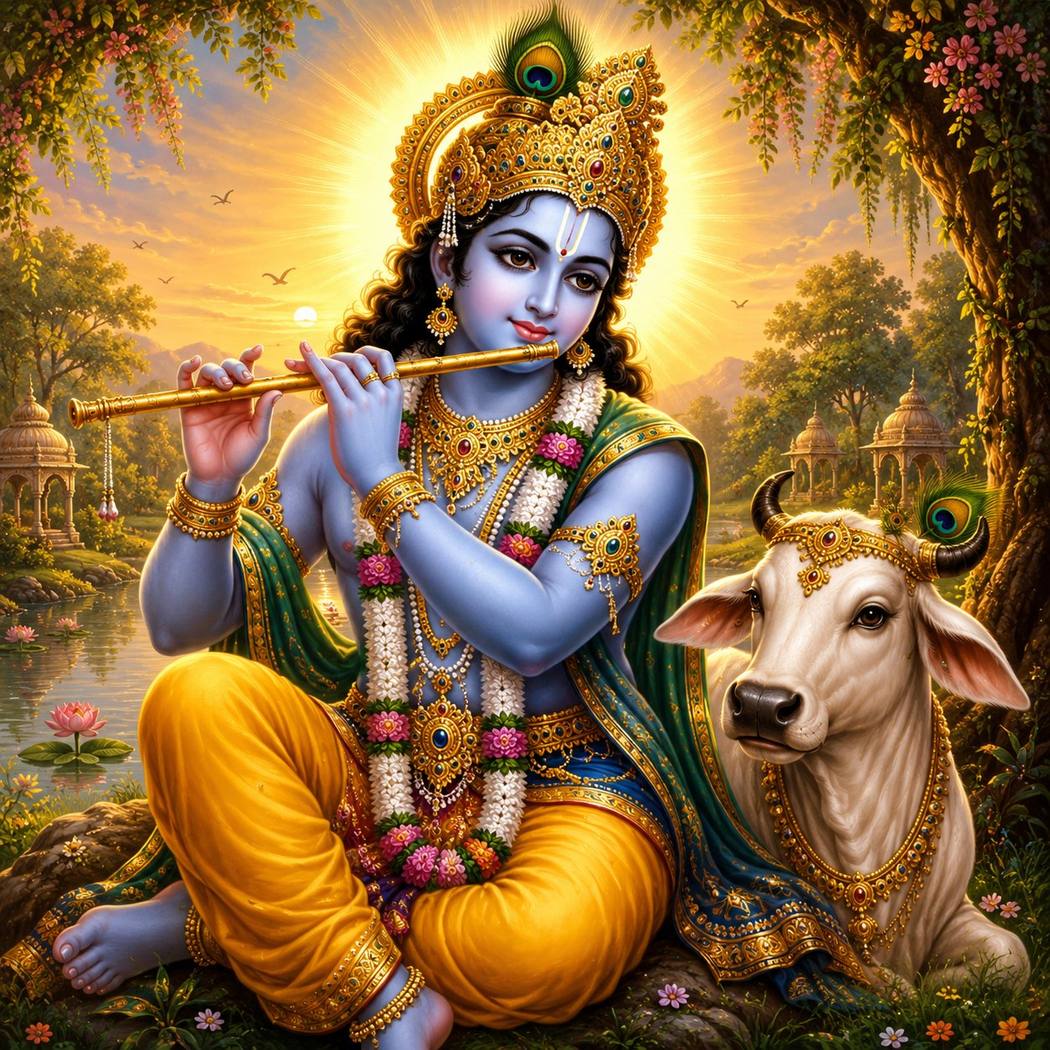
Every tradition of Sanatana Dharma treats Kali Yuga's official length as 432,000 years. Almost nobody outside specialist circles knows that one of the oldest astrological texts in the tradition — the Garga Samhita, attributed to the sage Garga Muni, astrologer to Lord Krishna's own family — quietly names a far shorter, far more specific figure, and attaches a promise to it: not just "the age ends," but who arrives when it does.
Six centuries later, a completely separate body of scripture — the Bhavishya Malika of the Panchasakha — picked up exactly where Garga Samhita left off, extended the count, and tied its completion to a planetary transit precise enough to check against a calendar. That transit has now happened. This article walks through the promise, the arithmetic, and the transit, in order.
1. The promise, in Garga Samhita's own words
"abdāścatuḥ sahastrāṇi kalau catuḥ śatāni ca
gate girivare hi śrīnāthaḥ prādu bhaviṣyati"
Source: Garga Saṁhitā
Meaning: When 4,000 years of Kali Yuga and its 400-year twilight (sandhyā) have passed, Lord Maha-Vishnu (Shrī Nātha) will manifest on Earth.
Notice what this verse does that a bare age-count does not: it does not simply say Kali Yuga will end. It says something arrives at that moment — the Lord Himself, incarnate. Garga Samhita is not read primarily as a prophecy text; it is a classical work of astrology and cosmology. That a text concerned with planetary time-keeping would embed a promise of incarnation, rather than just an expiry date, is itself worth noticing before the numbers are even discussed.
2. Three independent counts, one number: 4,800
Garga Samhita's figure is not an outlier. Two other classical sources, composed for different purposes in different periods, arrive at the identical total. Manusmriti, the foundational law-book of Sanatana Dharma, states:
"catvāryāhuḥ sahastrāṇi varṣāṇāṁ tu kr̥tam yugam
tasya tāvacchatī sandhyā sandhyāśaśca tathāvidhaḥ"
Source: Manusmriti 1.69
Meaning: The age runs 4,000 years, bracketed by two twilight periods (sandhyā) of 400 years each — one at dawn, one at dusk.
Nirnay Sindhu, the authoritative dharmaśāstra digest used across the subcontinent for ritual and calendrical calculation, repeats it independently:
"catvāryabdasahastrāṇi catvāryabdaśatāni ca
kaleryada gamisyanti tadā pūrva yugāśritam"
Source: Nirnay Sindhu
Meaning: When 4,000 years of Kali plus its 400-year twilight have passed, the previous (Satya) Yuga returns.
Add it up the same way each source does: 4,000 core years, plus a 400-year sandhyā at the age's opening, plus a 400-year sandhyā at its close. 4,000 + 400 + 400 = 4,800 years. Three texts, three different purposes — a law-book, a ritual digest, and an astrological treatise — landing on the same total without referencing one another. That convergence is the reason Garga Samhita's promise carries weight beyond its own tradition: it is not a lone claim, it is the astrological confirmation of a number the legal and ritual literature had already fixed.
3. The Panchasakha extend the count — and name the trigger
Roughly six hundred years ago, writing under what the tradition holds was Lord Jagannath's own instruction, Mahapurush Achyutananda Das revisited this exact 4,800-year figure and revised it:
"cāri lakhya je batiśa sahastra, kali Yuga ra aṭai āyuṣa
pāpa bhārā re kali tuṭi jiba, pānca sasra kali bhoga hoiba"
Source: Bhakta Cetāvanī, Achyutananda Das
Meaning: Kali Yuga's full potential lifespan is 432,000 years, but under the weight of humanity's accumulated sins, only 5,000 years will actually be lived through.
Two hundred years added to Garga Samhita's 4,800 — a correction, the Panchasakha's tradition holds, made under direct divine authority rather than independent recalculation. What makes this extension checkable, rather than simply asserted, is that the Malika does not stop at a new number. It attaches the completion of that number to a specific astronomical event: Shani (Saturn) entering Meena Rashi (Pisces) — the Meena-Shani yoga.
"mīna rāśiki śaniścura jiba / oḍiśā naṣṭa bhraṣṭa karideba"
Source: Tattva Bodhini, Achyutananda Das
Meaning: When Saturn enters Pisces, great upheaval follows — physicians will not grasp the source of the diseases that spread, whatever medicine is given, the sickness only worsens.
4. The transit already happened
This is where the promise stops being purely a matter of scriptural interpretation and becomes a checkable astronomical fact. Saturn entered Pisces on 29 March 2025, a Saturday, at approximately 5:00 pm — a transit confirmed independently by standard planetary ephemerides, not just by the Malika's own reckoning. Two sage-astrologers, separated by well over a thousand years and working in entirely different eras of the tradition — Garga Muni in the classical period, the Panchasakha six centuries ago — both chose to anchor their prophecy of the Lord's arrival to a real planetary movement rather than a vague sense of "someday." The movement both point toward has now occurred within living memory.
The Malika underlines the same window from a second, independent verse:
"niścaya kaḷkī hoiba, jedina mīna śani bhoga"
Source: Padma Kalpa, Bhima Bhoi, Adhyaya 27, p.395
Meaning: Kalki will certainly manifest on the day the Meena-Shani yoga is fulfilled — Saturn's move from Aquarius into Pisces.
5. What the promise means for now
Garga Samhita's arithmetic is exact but its promise is not mechanical: "Shree Nath will manifest" is not a claim that anything ends the instant the count completes. It is the same claim the Bhavishya Malika makes about the years that follow the fulfilled transit — a period of transition, not a single moment of arrival. By the traditional count from Lord Krishna's own passing, 5,124 years of Kali Yuga have now elapsed. We are living, the tradition holds, inside the twilight the Garga Samhita's "sandhyā" and the Malika's "Sangam Yuga" both describe — with Satya Yuga beginning in 2032.
None of this is presented by the Malika as cause for alarm. The instruction attached to the promise has not changed across two and a half thousand years of scripture, from an ancient astrologer's Samhita to a six-hundred-year-old palm-leaf prophecy: chant the name of Madhava, keep the three daily prayer-windows of Tri-Sandhya, live simply and truthfully, and cross the twilight into the age the count was always pointing toward.
Jay Shree Madhava