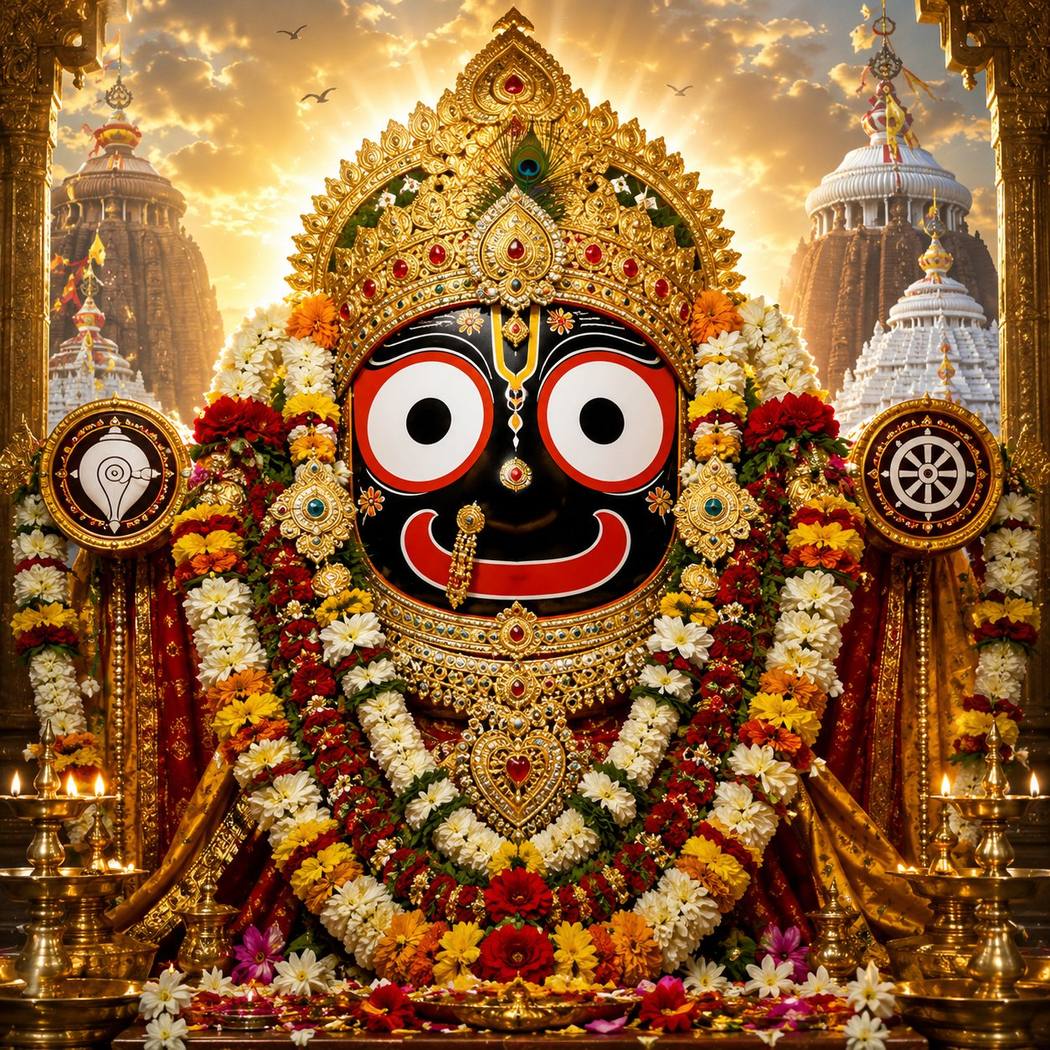
Most sacred texts are written to be read immediately — copied, taught, carried from teacher to student without delay. The Bhavishya Malika was not. It was composed roughly six hundred years ago in Odisha, and for most of those six centuries it sat outside ordinary circulation: known to a lineage of custodians, largely unread by the wider world, surfacing into public attention only in flashes. That is an unusual choice for a scripture that its own authors describe as coming directly from God. Why write something down and then keep it closed?
The answer is not an accident of history. It is stated, in plain terms, inside the text itself.
1. What the Bhavishya Malika actually is
"Bhavishya Malika" means Garland of Future Prophecies — a body of sacred Odia texts composed by the Panchasakha, five saint-poets of 15th–16th century Odisha, at the direct instruction of Lord Jagannath. Because of that origin, the corpus is revered by its tradition as "Brahma Vaani" — the Divine Voice itself, not merely commentary about the divine. The Panchasakha did not compose it in the ordinary way a scholar writes a book. Achyutananda Das, chief among the five, is recorded as having written his portion of the corpus — including 36 Samhitas, 72 Gitas, 27 genealogies, and 100 Bhavishya Malika texts — at Nemal, Odisha, in states of deep meditation, under Jagannath's command.
The scale of the material is itself striking: roughly 185,000 texts are attributed to the Panchasakha's combined output, of which 318 specifically contain future prophecies — the texts that together form the Bhavishya Malika. This was never a single pamphlet. It was a vast, deliberately organized body of work, and only a fraction of it was ever meant to be read as prophecy at all.
2. The scripture names its own condition of secrecy
The clearest statement of why the Malika stayed closed comes from the corpus's own verses on who is permitted to receive it. Achyutananda Das writes:
"taraku tēruā āgē na kahibu, kahilē śāpya pāibu"
Source: Bhaviṣya Mālikā, Achyutananda Das
Meaning: Do not reveal this secret before the unworthy — to do so brings a curse upon the one who reveals it.
This is not vague mysticism about "hidden knowledge." It is a direct instruction, addressed to the tradition's own custodians, about the conditions under which the material may be shared. The same corpus goes further, describing who is actually capable of recognizing what the text points to, even once it is read:
"jōgī mānē jōga aṅta na pāibē āu kēṅhu samaya rahaṅtā"
Source: Bhaviṣya Mālikā, Achyutananda Das
Meaning: Even the highest yogis — those deep in the discipline of yoga — will not attain the end of their practice or grasp the moment that is coming.
"akhila bhramāṇḍa kāraṇa tāraṇa"
Source: Bhaviṣya Mālikā, Achyutananda Das
Meaning: The One who is the cause, sustainer, and deliverer of the entire universe is not something ordinary discernment can identify.
Put together, these verses describe a text built with an internal safeguard: not a lock on the pages, but a claim that genuine comprehension of what the Malika points to — the Lord's final avatar, arriving quietly, unannounced, recognizable only to those who are already oriented toward Him in devotion — was never going to be available to casual or premature reading. Sharing it "before the unworthy," in the tradition's own words, does not simply risk misunderstanding. It risks distortion of something meant to be approached with reverence, not curiosity.
3. A text that surfaced only when the world needed it to
What makes the secrecy claim more than a literary device is the recorded pattern of when the Malika actually broke into public attention. For most of its six-hundred-year history it remained the province of a narrow lineage. Two moments changed that: the 1999 Odisha super-cyclone, one of the deadliest storms to strike the Indian subcontinent in the twentieth century, and the 2020 COVID-19 pandemic, a global event that touched nearly every household on Earth. In both cases, interest in the Malika's warnings spiked sharply — not because the text was newly discovered, but because events on the ground suddenly resembled what it had described.
That is the pattern a scripture built for a specific moment would be expected to show: quiet for centuries, then increasingly legible exactly when its content becomes verifiable against lived experience. A book meant to be read at any time would have circulated steadily. A book meant to be read at the turning of the age would circulate the way this one did — dormant, then suddenly relevant.
4. Why the opening is happening now
The tradition holds that Kali Yuga's five-thousand-year span is complete — 5,124 years have now passed by the count Pandit Dr. Shri Kashinath Mishra cites from the Malika and the regional Panjika almanacs — and that we are living through the twilight (Yuga-Sandhya) between Kali Yuga and the coming Satya Yuga. If the secrecy was tied to timing rather than to permanent concealment, this is precisely the period in which the seal should lift. That is the claim this website exists to test and share: not new doctrine, but the same six-hundred-year-old text, opened at the point its own authors indicated it should be opened.
Pandit Dr. Shri Kashinath Mishra has spent more than four decades studying the Bhavishya Malika Puran and is recognized as its foremost living interpreter. His role, as the tradition frames it, is not to add to the scripture but to make its already-completed text legible to a generation reading it for the first time — at the one moment in six centuries when reading it was always meant to make sense.
5. Why this should not be read as a threat
A text that stays hidden until a dangerous moment can sound ominous. It is worth saying plainly: the Malika's own teaching is not fear, it is preparation. The same corpus that withholds its secret from the unworthy also names, in detail, the practice that makes anyone worthy of receiving it — chanting the name Madhava, keeping the three daily prayer-windows of Tri-Sandhya, living simply and truthfully. Those instructions were never secret. They were published, repeated, and made freely available throughout the six hundred years the prophecies themselves stayed closed — because the practice, unlike the timing, was never meant to wait. The scripture opens now because the age has turned. The invitation it opens with — chant, pray, live rightly, and cross the twilight into Satya Yuga, beginning in 2032 — was there for anyone, the whole time.
Jay Shree Madhava