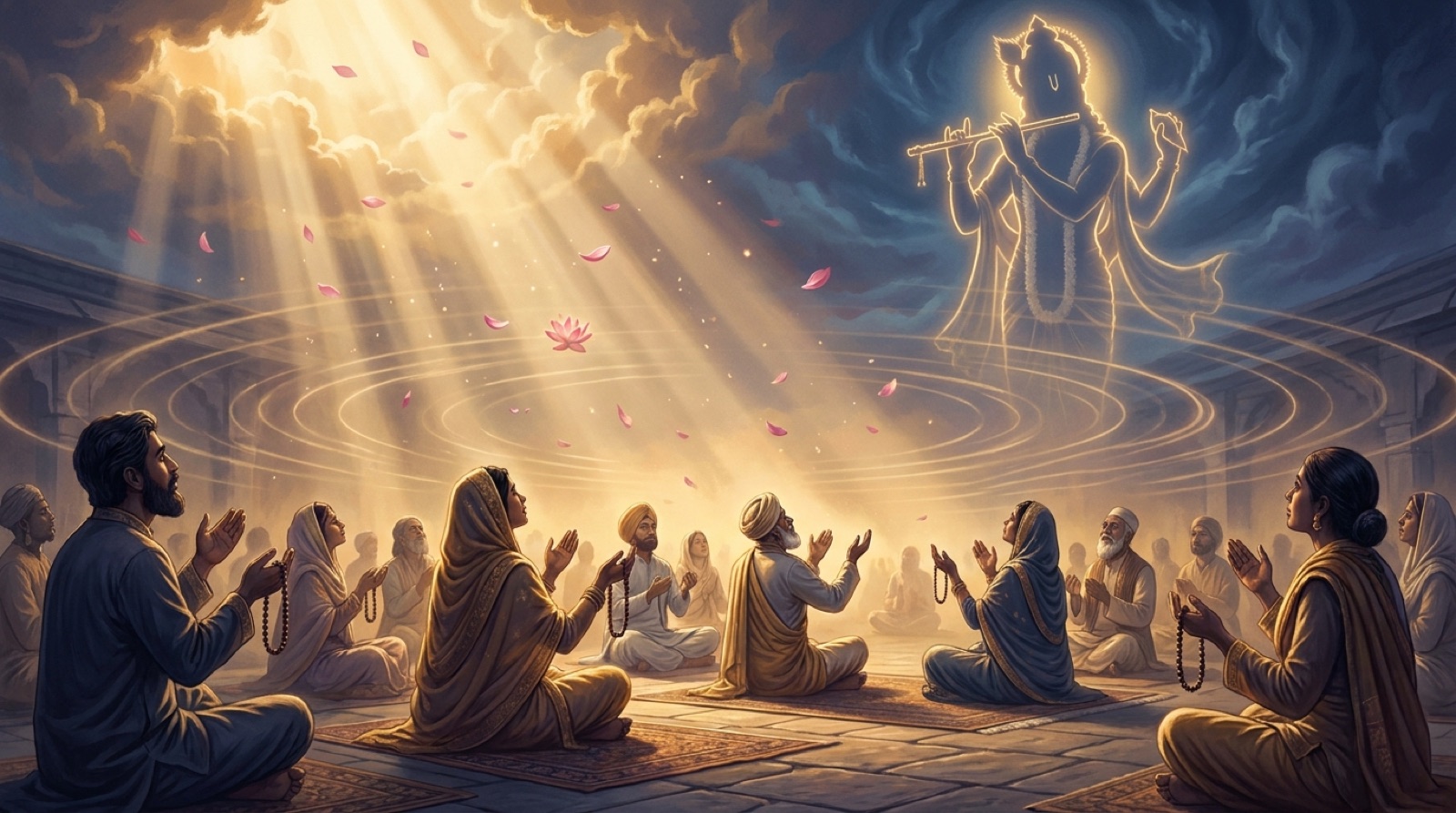
A reader who has followed this blog through the scriptural case for the age's end, the documented signs, and what the Malika says happens next will have noticed a pattern: every single article closes with the same three words — Trisandhya, Madhava, dharma. That is not a formality. It is the Malika's actual answer to the only question that matters once a prophecy is believed: then what should I do? This article takes that closing line and gives it the same verse-by-verse treatment as everything else on this site.
1. Trisandhya — worship at the three twilights
Trisandhya is not a vague call to "be spiritual." It is a specific, three-times-daily practice with fixed windows, taught by Pandit Dr. Shri Kashinath Mishra and Sudharma Maha-Maha Sangh, and it means reciting three named hymns — the Sri Dashavatara Stotra, the Durga-Madhava Stuti, and the Sri Vishnu Shodasha Nama Stotram (the Sixteen Names) — at three windows each day:
Morning 04:00–06:30 · Noon 11:30–13:00 · Evening 17:00–19:00
The Trisandhya FAQ published by Sudharma Maha-Maha Sangh states its scope plainly:
“In the disasters ahead — floods rising to a hundred feet, forty-nine kinds of destructive winds, earthquakes, and meteorite showers — Trisandhya alone protects. A household where everyone performs Trisandhya knows no sorrow, no scarcity, no disease, and stands close to Mahavishnu.”
Source: Trisandhya FAQ (English), Sudharma Maha-Maha Sangh
No ritual bathing is required for the practice — the teaching directs devotees to meditate on Maa Ganga for purity instead, which makes Trisandhya something any devotee, anywhere in the world, can actually keep. That is by design: the Malika was not written for one region. Free copies of the full prayer text are available in English, Hindi, Arabic, and Hebrew in this site's resources section.
2. The Name behind the practice — Madhava
Trisandhya's third hymn, the Sixteen Names, points toward something the Malika treats as even more central: a single name reserved for this age. Sishu Ananta Das names and half-conceals it in the same verse:
“praṇaba ādyare lekhathu nandana, ā kāra thiba ṇa thoi…
nāga tini bāḷa ekākṣara sāra…”
Source: Pata Madana, Sishu Ananta Das, p.39, 2nd Adhyaya
Meaning: Write the Pranava (Om) first, without the long vowel held apart — coded within these syllables is the one secret, single-syllable (ekakshara) Name at the essence of everything. At the final time, some fail to read it correctly. That Name is Madhava.
A separate line of teaching, drawn from Vani Tika (Yashobanta Das), decodes the widely-chanted Hare Krishna Mahamantra itself as a map of the same truth: Ram corresponds to Balabhadra, Krishna to Jagannath, Hare to Sudarshana, and the doubled Hare Hare to Mahalakshmi Yogamaya — meaning the sixteen-name mantra already contains every divine form the Malika describes, which is why the tradition calls it the Maha-mantra of this age. Chanting Madhava continuously is described, in the Kavita Khanda of Achyutananda Das, as the literal chariot — the gati — of liberation in Kali Yuga.
3. Who the Malika says is recognized
The scripture is unusually specific about numbers here too. Multiple texts — Utpata Sagara, Kutta Malika, and the Sitabdhu Nakshangu Nirshingu — converge on a devotee-count for the time of manifestation: roughly 12,000 devotees present, of whom 5,000 survive every trial, 3,000 arriving from foreign countries including China, Japan, Germany, and Russia, and 312 specifically recognized within Odisha. An inner circle is described as 16 principal devotees (called Mangal), each guiding 64 sub-devotees — 1,024 in total.
What determines who falls into that recognized group is not stated as birth, wealth, or status. The Malika's own Kali Kalpa Gita puts it in terms of surrender itself:
“ଏରେ ପ୍ରଭୁ କହୁ ଭୋଳରେ ଭକ୍ତ, ଭଗବାନ ସ୍ୱରୂପରେ ଏ ଥାଇ ଏକ
ଭକ୍ତ ହୋଇ ଥିବ ଶ୍ରୀ ଭୋଳରେ, ପ୍ରଭୁ ଜଗ୍ଗୁଥିବ ଆମ୍ବରଭୋଳ”
Source: Kali Kalpa Gita, Achyutananda Das, Adhyaya 2, p.7
Meaning: At the time of the Mahapurush, thousands of devotees will be present in the land. Those who are true devotees in heart and conduct — fully surrendered — will abide in the Lord's own divine form, and the Lord will recognize and protect them.
Elsewhere the teaching is even more direct: Trisandhya itself is named as the defining line — those who keep it are those who are recognized. Not eloquence, not public devotion, not credentials. A householder in any country, reciting the same three hymns at the same three windows every day, satisfies the same condition the Malika describes for a devotee in Odisha six centuries ago.
4. Why this is the hopeful half of every hard article on this site
Read on their own, the sign-set articles on this blog — falling idols, out-of-season blooms, strange births, wars foretold — can read as unrelenting. They are not meant to. The Malika pairs every warning with a stated way through it, and that pairing is the actual reason this site exists: not to catalogue omens, but to point toward the practice the same texts say determines the outcome. Trisandhya. Madhava. Dharma. Three words, repeated at the end of every article, because the scripture repeats them at the end of every warning.
Anyone who wants to begin can download the complete Trisandhya prayer text free, in four languages, from this site's resources page — and read the fuller account of what protection through the twilight looks like in the Q&A App, which searches 200+ recorded sessions of Pandit Dr. Shri Kashinath Mishra for exactly this question.
Jay Shree Madhava