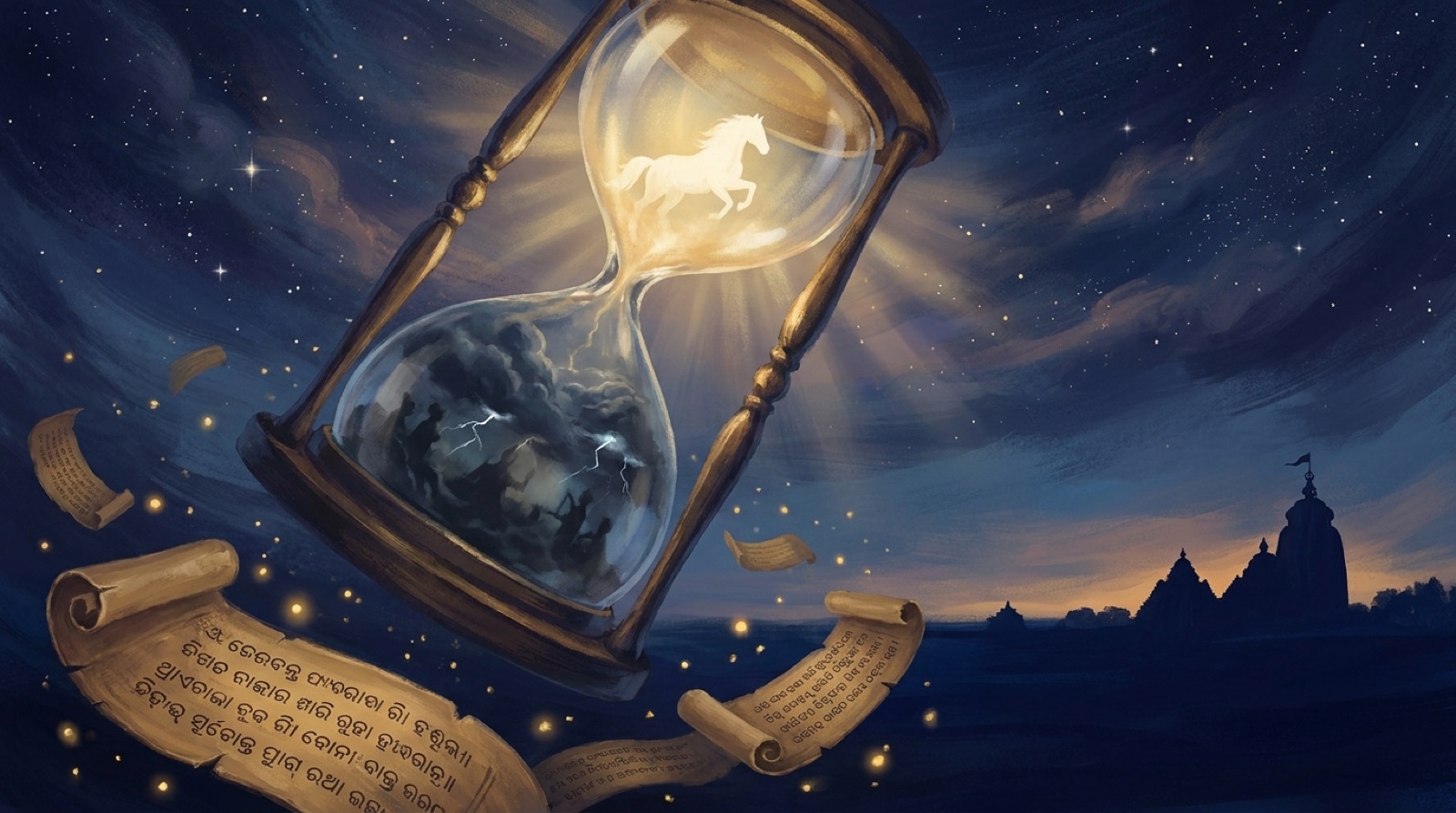
This site has already made the case, verse by verse, that Kali Yuga's 5,000-year term is complete and that Satya Yuga begins in 2032. That leaves the harder, more human question: what does the space between now and then actually contain? A headline year is easy to state. What fills the years leading up to it is where most readers stop trusting a prophecy — because vague reassurance ("everything will be fine") is cheap, and the Bhavishya Malika does not deal in it. It names things.
1. The count itself is not new information — it is arithmetic already shown to hold
The 2032 date is not a single verse standing alone; it recurs across independent Malika texts — Kali Kalpa Gita Adhyaya-3 and Kalachakra Yuga-Pralaya Asuchi among them — converging on the same figure the way the 5,000-year term itself converges across five separate scriptures. And the transition it describes is not a future promise with no present evidence: this site has already documented that Saturn entered Pisces on 29 March 2025, the exact planetary marker four Malika texts name as the Meena-Śani signature of the turning point (see the full analysis). The clock the Panchasakha set six centuries ago has already struck once. What follows is what the same texts say comes next.
2. What the transition itself contains — named plainly, framed honestly
The Malika does not pretend the corridor between the ages is empty. It describes a period of upheaval — what the tradition calls the "remaining Mahabharata war" of Kali Yuga, alongside natural disasters and the kind of civilizational strain this site's nature-sign and sign-set articles have already documented in dated news events. One verse, cited in the official channel's own scripts, gives the scale in stark terms:
“Ardharu ardhe maribe, Bhārata varṣare,
sabu rājya śūnya haibo, yuddha goḷa pare”
Source: channel script (Video_44), verse cited from the Bhavishya Malika corpus
Meaning: Less than half-of-half survive across Bharat; every kingdom stands empty after the war has passed.
Read alone, that line sounds like the doom this site has always refused to traffic in. Read with its own continuation, the meaning changes completely:
“Gāṅke rahibe tini-cāri jana, pavana āhāra kari…
mukhe bolo thube Hari”
Source: channel script (Video_44), verse cited from the Bhavishya Malika corpus
Meaning: Even where only three or four devotees remain in a village, surviving on air and endurance, they carry through on the Name of Hari alone.
The teaching's own arithmetic behind these lines: of roughly 800 crore people alive, some 64 crore remain — 33 crore of them described as divine beings already present in human bodies, and 31 crore as human devotees who held to dharma. That is not a number offered to frighten; it is the reason the very next teaching is protection, not despair. Trisandhya, dharma, and the chanting of Madhava are named, repeatedly, as exactly what determines which side of that arithmetic a devotee stands on — a teaching this site returns to at the end of every article for a reason.
3. Who the Malika says is already here
What separates this account from generic apocalyptic literature is its specificity about help already in place. Pandit Dr. Shri Kashinath Mishra's teaching, drawn from the Malika corpus, holds that the five Pandavas, twelve Gopals, and 256 devotees have already taken birth to assist the transition — alongside Radha Rani herself, present in Jagannath Kshetra, Odisha. These are not abstractions arriving later; the teaching states they are already living among us, unrecognized, the way the Malika elsewhere warns that even "the highest yogis" will not recognize the Lord in human form when He is present.
4. The unfinished business, and who finishes it
One of the Malika's channel scripts names a figure most readers of the Bhagavatam already know from a different context — Parashuram, the sixth avatar, in penance at Mahendragiri — as the one who instructs Kalki directly and grants Him the 64 kalas (the sixty-four arts/sciences of complete mastery):
“Tatho digvijaya bhūpān, dharma-hīnān kali-priyān,
nigr̥hya bodhāṁde, maruśca sthāpayāsī”
Source: channel script (Video_51), Sanskrit verse cited from the Bhavishya Malika corpus
Meaning: Having subdued the dharma-less rulers who delighted in Kali's ways, the Lord instructs Kalki and establishes the saintly king Maru — who has kept penance in the Himalayas since the Treta age — on the throne at Delhi.
The teaching describes this as the completion of the Mahabharata war's leftover portion — unfinished business from an earlier age, closed out only now. King Maru's guru-dakshina to the Lord is not gold or ceremony but the protection of cows, saints, and the earth itself, and the ending of Mleccha rule. The same teaching holds that one lakh devotees are then appointed as local rulers under Maru, governing by a constitution the Malika describes, for 1,009 years — the bridge era before Satya Yuga is fully established.
5. The dawn itself
Of all the verses in the bank, one names the moment of arrival most directly — not the war, not the count, but the sight on the other side of it:
“…līḷā karuthibe ananta mādhaba, sarbe ānanda hoiṇa”
Source: Tera Janma Sharana, Achyutananda Das, Pana Tinsha Toli p.56 ch.67
Meaning: After Kalki's work is complete, the divine darshan of Sita-Rama becomes visible to all; devotees of surrendered heart abide in bliss as the transformation into Satya Yuga culminates.
That is the Malika's own answer to "what happens in 2032" — not an abstraction, but a described event: the war's unfinished business closed, a righteous king crowned, a period of divinely-guided governance, and then a visible darshan marking the age's actual turn. The same texts that named a 2020s planetary transit centuries in advance, and were correct, are naming this sequence too.
6. What to do with eight years
None of this is a countdown to fear. It is a description of what is already underway, with a stated exit on the other side. The practice the Malika prescribes for the years between now and 2032 has not changed across any of the articles on this site: Trisandhya at dawn, noon, and dusk; the continuous remembrance of Madhava; the reading of Shrimad Bhagavat; a clean, dharma-aligned life. Pandit Dr. Shri Kashinath Mishra's four decades of work on this scripture return, again and again, to the same practical point — that the devotee's task in the twilight is not to calculate the odds, but to be found, at the dawn, among the 31 crore who held on.
In the coming days on this blog we will look at the Malika's own protection verses in detail — what Trisandhya actually is, why the Name of Madhava is described as the "chariot of liberation" for this age, and who the texts say crosses the twilight safely.
Jay Shree Madhava