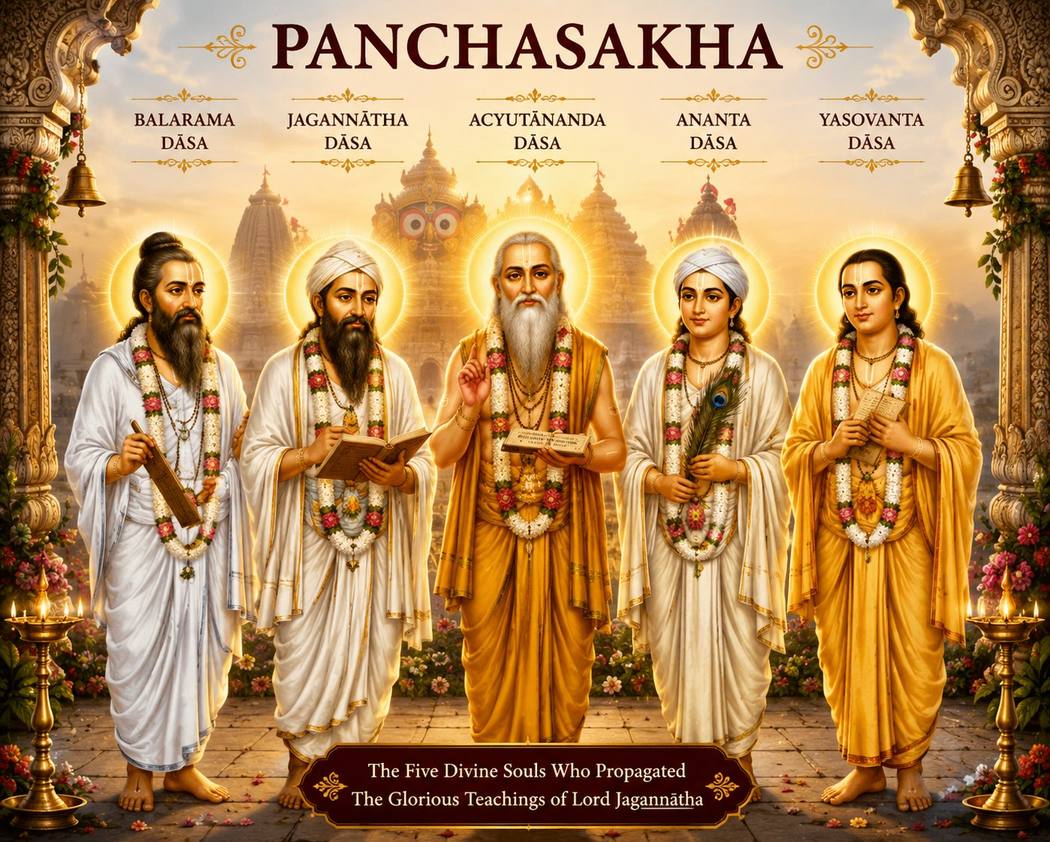
A common, fair objection to any prophecy is that it comes from nowhere in particular — an unnamed seer, an undated text, a tradition too vague to check. The Bhavishya Malika does not have that problem. It was written by five specific men, in a specific place, in a specific generation, each of whom put his own name to his own books. Between them they are credited with roughly 185,000 manuscripts, of which 318 contain the future-facing material now known collectively as the Bhavishya Malika — "Garland of Future Prophecies."
Their names were Achyutananda Das, Sishu Ananta Das, Jagannath Das, Balaram Das, and Jasobanta Das — the Panchasakha, "five friends," of 15th–16th century Odisha, contemporaries of Sri Chaitanya Mahaprabhu (born 1486). Tradition holds they were reborn in every age specifically to help re-establish dharma at Lord Maha-Vishnu's side, and that in Kali Yuga they were instructed to write down what they were shown, so it could later guide devotees through the age's end.
1. Named men, dated births, recorded villages
This is not folklore with the details sanded off. Each of the five has a recorded birth year and birthplace within Odisha:
- Achyutananda Das — born 1485, Tilakana (Tripura) village, Kendrapara district; son of Deenbandhu Khuntia and Padmavati.
- Sishu Ananta Das — born 1488, Balipatna village near Bhubaneswar, Puri district; son of Kapilendra and Gaura Devi.
- Jagannath Das — born 1490, Kapileshwar village, Puri district; son of Bhagwan Das and Padmavati. Sri Chaitanya Mahaprabhu himself gave him the title Atibadi — "the greatest" — for his scriptural knowledge and devotion.
- Balaram Das — born 1470 (some sources: 1482), Chandrapur village, Puri district; son of Shomnath Mahapatra and Mahamaya Devi.
- Jasobanta Das — born 1482 (some sources: 1486), Nandigram near Adhang, Cuttack district; son of Balbhadra Malla and Rekha Devi.
Each left behind a catalogue of named, individually titled works — Achyutananda's alone include the Harivamsa Purana, the Jugabdhi Gita, the Sunya Sanhita and dozens more; Jagannath Das was the first to render the Shrimad Bhagavat Maha Purana into Odia. This is the literary record of five real people, not an oral legend with no fixed author.
2. Five different gifts — in the Malika's own words
The tradition itself is specific about what distinguished the five from one another, in a verse attributed to Achyutananda Das describing his own companions:
“āgama bhāva jāṇe Jaśobanta
gārakaṭā jantra jāṇe Ananta
āgata nāgata Achyuta jāṇe
Balarāma Dāsa tatva bakhāṇe
bhakti ra bhāva jāṇe Jagannātha
Pancasakhāe oḍiśā mahanta
mleccha patita uddhāribā pāīn
janama labhile Oḍiśā bhuīn”
Source: Bhaviṣya Mālikā, Achyutananda Das
Meaning: Jasobanta Das could perceive the shape of coming events; Sishu Ananta Das could read the future through mathematical puzzles; Achyutananda knew what was and was not yet to come; Balaram Das expounded the essential truths of scripture; Jagannath Das knew the heart of devotion. The five great souls of Odisha took birth on this land to uplift the fallen of a degraded age.
The point of this verse is not mystique for its own sake — it is a division of labour. Five men, each credited with a distinct method and a distinct emphasis, working from the same instruction and arriving, across separate books, at compatible conclusions. And Achyutananda Das explains, in his own words, why the writing itself was necessary:
“hetu rasāibā pāīn ki Acyuta sāhāstra purāṇa kale
kali kāla ṭhāru bali kāla jāeen haka kathā ṭā lekhile”
Source: Bhaviṣya Mālikā, Achyutananda Das
Meaning: To awaken the devotees' dormant consciousness, Achyutananda earnestly recorded, across countless scriptures, the true account of everything that would unfold from the end of Kali Yuga into the dawn of Satya Yuga.
3. Independent authors, the same number
Here is what makes five separate signatures matter more than one. Sishu Ananta Das, writing in his own book under his own name, records:
“kali Yuga pānca sahasra gale, Biṣṇu je janama hoibe bhale”
Source: Pata Madana, Sishu Ananta Das
Meaning: When 5,000 years of Kali Yuga have passed, Lord Vishnu will take a noble human birth.
Achyutananda Das, in a separate work, reaches the identical figure:
“kaḷi pāñca sahasra baraṣa bhoga heba, sehidinu satya kaḷi prakāśa pāiba”
Source: Kali Kalpa Gita, Achyutananda Das, Ch.7 p.21
Meaning: When Kali's 5,000 years are fully spent, that same day Satya Yuga's light will dawn.
Two Panchasakha members, two different books, one number: 5,000 years. As our earlier article on the scriptural evidence lays out, this figure also converges with the Manusmriti, the Nirnay Sindhu, and the Garga Samhita — texts entirely outside the Panchasakha's own tradition. By the traditional count, 5,124 years have now passed since the epoch of Kali Yuga began.
4. Why this matters for how the prophecies should be judged
Vague, anonymous prophecy is cheap — it can be read into almost any outcome after the fact. What the Panchasakha left behind is the opposite: five named authors, each with a documented life and a signed body of work, converging independently on specific figures that a modern reader can check against the calendar. It is the same standard applied to any historical source — named author, dated composition, checkable claim — and the Bhavishya Malika, unusually for prophetic literature, passes it.
This is also why interest in the tradition has surged in living memory rather than fading with age: the 1999 Odisha super-cyclone and the COVID-19 pandemic of 2020 both drew fresh, widespread attention back to books written five centuries earlier, because the authors' descriptions kept matching events no one living in the 1500s could have simply guessed at.
5. What the Panchasakha asked of their readers
The Panchasakha did not claim authorship for themselves. Their own tradition holds that they considered themselves scribes, not sources — recording what they were shown, for the benefit of devotees who would need it centuries later. Their instruction to those readers, repeated across their combined body of work, has not changed: chant the name of Madhava, keep the three daily windows of Tri-Sandhya, read the Shrimad Bhagavat, and hold to dharma through the twilight — so as to cross safely into Satya Yuga, beginning 2032.
Verses and biographical details drawn from our Teaching Chapter 2: Who Are the Authors?, which carries the fuller account of all five Panchasakha and their combined literary corpus.
Jay Shree Madhava