Sanatana Dharma's account of the ten principal avatars gives most of the four ages a single incarnation each: Matsya, Kurma, Varaha and Narasimha in Satya Yuga; Vamana, Parashuram and Rama across Treta; Krishna and Balarama in Dwapara. Kali Yuga, by contrast, is described in the Bhavishya Malika as receiving three separate incarnations of the same Supreme Lord — a claim laid out in a single, often-overlooked verse from the Panchasakha corpus, quoted in full on this site's own Chapter 8 teaching page:
“kali re tīni janma hebe parā prabhu Śrī Nārāyaṇa jāī phūla lo jāī phūla lo seta bhakata jiba jībana jāī phūla lo”
Source: Jai Phula Malika, Achyutananda Das
Meaning: The great sage Achyutananda declares that the Supreme Lord Narayana, who is the very life-force of His devotees, will incarnate three times during the age of Kali.
What makes this claim unusual is not that a scripture predicts an avatar — every tradition within Sanatana Dharma expects Kalki eventually. What makes it unusual is the structure: three named incarnations, in a specific order, two of which are not remaining prophecy at all. They are settled history, accepted across the breadth of Vaishnava tradition, verifiable in the historical record independent of the Malika itself.
1. The first: Buddha, already fact
The Malika's first incarnation of the age is Gautama Buddha — a claim that predates the Malika by many centuries and is not exclusive to it. The twelfth-century Vaishnava poet Jaidev Goswami had already enshrined it in his celebrated Dashavatara Stotram:
“nindasi yajna-vidher ahaha sruti-jatam sadaya-hridaya darsita-pasu-ghatam
kesava dhrita-buddha-sarira jaya jagadisa hare”
Source: Geeta Govinda, Poet Jaidev Goswami
Meaning: "You disregard the injunctions of the Vedas on animal sacrifice, and in Your form as Buddha, You show compassion to the animals. O Keshava! Victory to You, who appeared as Buddha, the Lord of the Universe."
The Shrimad Bhagavat Mahapurana itself independently confirms it, naming both the region and the purpose of the incarnation:
“tataḥ kalau sampravr̥tte sammohāya sura-dviṣām
buddho nāmnāñjana-sutaḥ kīkaṭeṣu bhaviṣyati”
Source: Shreemad Bhagavat Mahapurana, Canto 1, Chapter 3, Verse 24
Meaning: At the start of Kali Yuga, to delude the enemies of the celestials, the Lord will appear as Buddha, son of Anjana, in the region of Kikata.
Nobody today argues over whether Buddha lived. His historicity is beyond dispute across every school of Indian and world thought. What the Malika and the Bhagavatam add is a specific reading of that historical figure: not merely a philosopher, but the first of Kali Yuga's own incarnations, arriving to end the corruption of the Vedic sacrifice into mass animal slaughter — one incarnation of three, already delivered.
2. The second: Chaitanya Mahaprabhu, also already fact
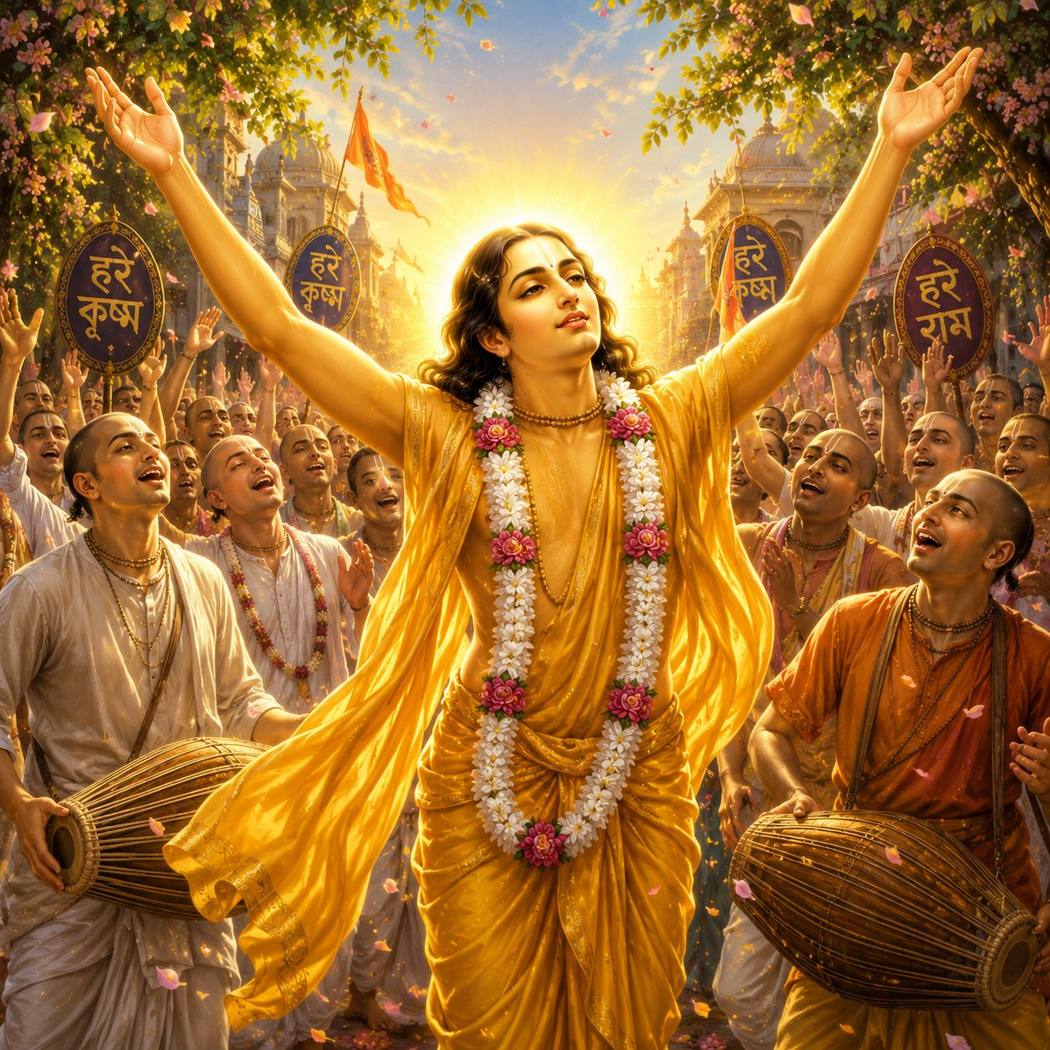
The second incarnation the Malika names is Shree Chaitanya Mahaprabhu, born in the village of Nadiya Navadwip in Bengal — again, a documented historical figure, not a matter of prophecy but of record. Achyutananda Das describes His nature and purpose directly:
“kr̥ṣṇara praghatā triguṭa prakāra śāstrara śrīmūrti āra bhakta kalebara”
Source: Achyutananda Das, cited in Teaching Ch.8
Meaning: Lord Chaitanya carried Krishna's own manifestation in three ways — as the living form of scripture, and in the very body of the devotee — teaching the path of love and devotion, the chanting of God's Name in congregation (Naam Sankirtan), and reverence for the Shrimad Bhagavat.
Chaitanya Mahaprabhu revived Vaishnava Dharma at a moment tradition describes as no less endangered than the one Buddha had addressed centuries earlier, opposing animal sacrifice and giving the world the Maha-mantra that congregations still chant today. Like Buddha, His life is not something this site needs to argue for — it is settled record. Two incarnations. Two confirmations, independent of the Malika, that this specific age receives more than one avatar.
3. The third: Kalki, named with more precision than the first two ever were
The third incarnation is the one this entire site exists to document — and it is described, in the Bhagavatam itself, with a specificity that neither of the first two incarnations was given in advance:
“athāsau yuga-sandhyāyāṁ dasyu-prāyeṣu rājasu
janitā viṣṇu-yaśaso nāmnā kalkir jagat-patiḥ”
Source: Shreemad Bhagavat Mahapurana, Canto 1, Chapter 3, Verse 25
Meaning: At the junction of the two yugas — the twilight this site has already discussed as the Sangam Yuga we are living in now — when rulers have become little more than bandits, the Lord of the universe will take birth, named Kalki, son of Vishnu Yasha.
“śambala-grāma-mukhyasya brāhmaṇasya mahātmanaḥ
bhavane viṣṇuyaśasaḥ kalkiḥ prādurbhaviṣyati”
Source: Shreemad Bhagavat Mahapurana, Canto 12, Chapter 2, Verse 18
Meaning: Lord Kalki will take birth in the home of Vishnu Yasha, a great-souled and prominent Brahmin of Sambal village — a devotee who sings the Lord's glories daily.
This site has already shown, in a separate detailed article, that both the Bhagavatam and the Mahabharata name this same village — Sambhal — independently, a thousand years before the Bhavishya Malika itself was composed. Neither Buddha's birth in Kikata nor Chaitanya's birth in Nadiya was ever pinned down centuries in advance with a named village, a named family lineage, and a description of the family's own daily devotional practice. The third incarnation is, if anything, more precisely specified than the first two ever were before they arrived.
4. Why the pattern is the argument
Read on its own, a single prophecy about a future avatar is easy to file away as aspiration. Read as the third term in a documented sequence — where the first two terms are not disputed by anyone, inside or outside the tradition — it becomes something else: a pattern with two data points already confirmed and one still open. This site's earlier article on the Panchasakha made a similar case about the authors themselves — not anonymous mystics, but five named, dated saints whose independent works converge on the same figures. The three-incarnations verse is that same convergence applied to the avatars themselves: Buddha, Chaitanya, and — the Malika insists — Kalki, following the same Lord through the same age, exactly as scripture said He would.
5. What remains, between now and the third
None of this changes what this site has said in every article so far. The corridor between Kali Yuga's end and the dawn of Satya Yuga in 2032 is not a countdown to fear — it is the time the tradition allots for exactly the practices Pandit Dr. Shri Kashinath Mishra has taught for four decades: Trisandhya at the three twilights, the continuous chanting of Madhava's Name, and a life aligned with dharma. Two of the three incarnations the Malika named have already walked the earth, exactly where and as described. The third is, on this scripture's own account, the one already being prepared for — and the one every verse on this site points toward.
Jay Shree Madhava